
从细菌细胞中分离具有生物活性的纳米材料(包含体)。
Isolation of biologically active nanomaterial (inclusion bodies) from bacterial cells.
机构信息
Laboratory for Biosynthesis and Biotransformation, National Institute of Chemistry, Ljubljana, Slovenia.
出版信息
Microb Cell Fact. 2010 Sep 10;9:66. doi: 10.1186/1475-2859-9-66.
BACKGROUND
In recent years bacterial inclusion bodies (IBs) were recognised as highly pure deposits of active proteins inside bacterial cells. Such active nanoparticles are very interesting for further downstream protein isolation, as well as for many other applications in nanomedicine, cosmetic, chemical and pharmaceutical industry.To prepare large quantities of a high quality product, the whole bioprocess has to be optimised. This includes not only the cultivation of the bacterial culture, but also the isolation step itself, which can be of critical importance for the production process.To determine the most appropriate method for the isolation of biologically active nanoparticles, three methods for bacterial cell disruption were analyzed.
RESULTS
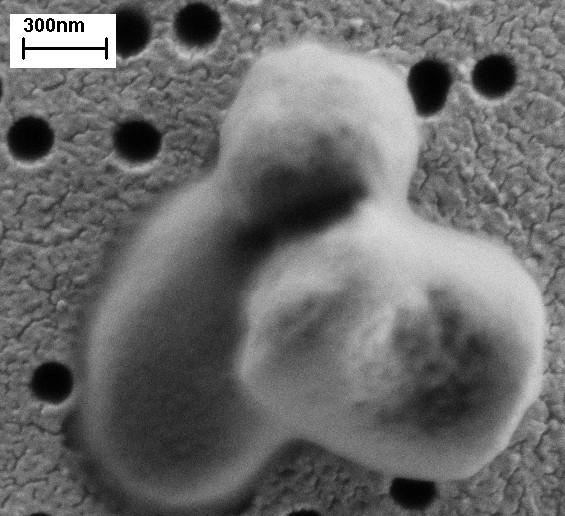
In this study, enzymatic lysis and two mechanical methods, high-pressure homogenization and sonication, were compared.During enzymatic lysis the enzyme lysozyme was found to attach to the surface of IBs, and it could not be removed by simple washing. As this represents an additional impurity in the engineered nanoparticles, we concluded that enzymatic lysis is not the most suitable method for IBs isolation.During sonication proteins are released (lost) from the surface of IBs and thus the surface of IBs appears more porous when compared to the other two methods. We also found that the acoustic output power needed to isolate the IBs from bacterial cells actually damages proteins structures, thereby causing a reduction in biological activity.High-pressure homogenization also caused some damage to IBs, however the protein loss from the IBs was negligible. Furthermore, homogenization had no side-effects on protein biological activity.
CONCLUSIONS
The study shows that among the three methods tested, homogenization is the most appropriate method for the isolation of active nanoparticles from bacterial cells.
背景
近年来,细菌包含体(IBs)被认为是细菌细胞内高纯度活性蛋白的沉积物。这些活性纳米颗粒对于进一步的下游蛋白质分离以及纳米医学、化妆品、化学和制药工业的许多其他应用非常有趣。为了制备大量高质量的产品,整个生物工艺都必须进行优化。这不仅包括细菌培养的优化,还包括分离步骤本身,这对生产过程可能至关重要。为了确定分离生物活性纳米颗粒的最合适方法,分析了三种细菌细胞破碎方法。
结果
在这项研究中,比较了酶裂解和两种机械方法,高压匀浆和超声。在酶裂解过程中,发现酶溶菌酶附着在 IBs 的表面,并且不能通过简单的洗涤去除。由于这代表了工程纳米颗粒中的额外杂质,因此我们得出结论,酶裂解不是分离 IBs 的最适合方法。在超声过程中,蛋白质从 IBs 的表面释放(损失),因此与其他两种方法相比,IBs 的表面看起来更加多孔。我们还发现,从细菌细胞中分离 IBs 所需的声输出功率实际上会破坏蛋白质结构,从而导致生物活性降低。高压匀浆也会对 IBs 造成一些损伤,但 IBs 中的蛋白质损失可以忽略不计。此外,匀浆对蛋白质生物活性没有副作用。
结论
该研究表明,在所测试的三种方法中,匀浆是从细菌细胞中分离活性纳米颗粒的最适合方法。



 Zotero 插件