
双相情感障碍中细胞对锂治疗和可卡因滥用反应的遗传网络模型。
A genetic network model of cellular responses to lithium treatment and cocaine abuse in bipolar disorder.
作者信息
McEachin Richard C, Chen Haiming, Sartor Maureen A, Saccone Scott F, Keller Benjamin J, Prossin Alan R, Cavalcoli James D, McInnis Melvin G
机构信息
Department of Psychiatry, University of Michigan, Ann Arbor, USA.
出版信息
BMC Syst Biol. 2010 Nov 19;4:158. doi: 10.1186/1752-0509-4-158.
BACKGROUND
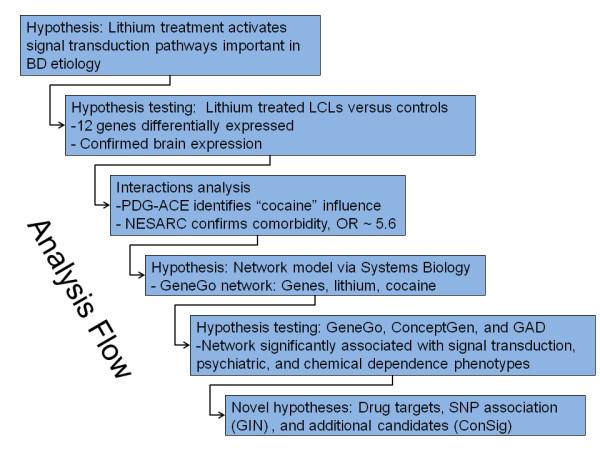
Lithium is an effective treatment for Bipolar Disorder (BD) and significantly reduces suicide risk, though the molecular basis of lithium's effectiveness is not well understood. We seek to improve our understanding of this effectiveness by posing hypotheses based on new experimental data as well as published data, testing these hypotheses in silico, and posing new hypotheses for validation in future studies. We initially hypothesized a gene-by-environment interaction where lithium, acting as an environmental influence, impacts signal transduction pathways leading to differential expression of genes important in the etiology of BD mania.
RESULTS
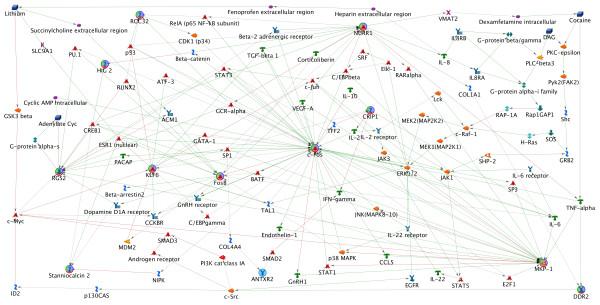
Using microarray and rt-QPCR assays, we identified candidate genes that are differentially expressed with lithium treatment. We used a systems biology approach to identify interactions among these candidate genes and develop a network of genes that interact with the differentially expressed candidates. Notably, we also identified cocaine as having a potential influence on the network, consistent with the observed high rate of comorbidity for BD and cocaine abuse. The resulting network represents a novel hypothesis on how multiple genetic influences on bipolar disorder are impacted by both lithium treatment and cocaine use. Testing this network for association with BD and related phenotypes, we find that it is significantly over-represented for genes that participate in signal transduction, consistent with our hypothesized-gene-by environment interaction. In addition, it models related pharmacogenomic, psychiatric, and chemical dependence phenotypes.
CONCLUSIONS
We offer a network model of gene-by-environment interaction associated with lithium's effectiveness in treating BD mania, as well as the observed high rate of comorbidity of BD and cocaine abuse. We identified drug targets within this network that represent immediate candidates for therapeutic drug testing. Posing novel hypotheses for validation in future work, we prioritized SNPs near genes in the network based on functional annotation. We also developed a "concept signature" for the genes in the network and identified additional candidate genes that may influence the system because they are significantly associated with the signature.
背景
锂是治疗双相情感障碍(BD)的有效药物,能显著降低自杀风险,但其有效性的分子基础尚未完全明确。我们试图通过基于新的实验数据以及已发表的数据提出假设,在计算机上对这些假设进行测试,并提出新的假设以便在未来研究中进行验证,从而加深对这种有效性的理解。我们最初假设存在基因 - 环境相互作用,其中锂作为一种环境影响因素,会影响信号转导通路,导致在BD躁狂症病因中起重要作用的基因出现差异表达。
结果
通过微阵列和实时定量聚合酶链反应(rt - QPCR)分析,我们鉴定出了经锂治疗后差异表达的候选基因。我们采用系统生物学方法来确定这些候选基因之间的相互作用,并构建了一个与差异表达候选基因相互作用的基因网络。值得注意的是,我们还发现可卡因对该网络有潜在影响,这与观察到的BD与可卡因滥用的高共病率一致。由此产生的网络代表了一个关于锂治疗和可卡因使用如何影响双相情感障碍多种遗传影响的新假设。对该网络与BD及相关表型的关联性进行测试时,我们发现参与信号转导的基因在其中显著富集,这与我们假设的基因 - 环境相互作用相符。此外,它还模拟了相关的药物基因组学、精神病学和化学依赖表型。
结论
我们提供了一个与锂治疗BD躁狂症有效性以及观察到的BD与可卡因滥用高共病率相关的基因 - 环境相互作用网络模型。我们在这个网络中确定了药物靶点,这些靶点是治疗性药物测试的直接候选对象。在未来的工作中提出新的假设以便进行验证时,我们根据功能注释对网络中基因附近的单核苷酸多态性(SNP)进行了优先级排序。我们还为网络中的基因开发了一个“概念特征”,并鉴定出了其他可能影响该系统的候选基因,因为它们与该特征显著相关。
 Zotero 插件