
端粒与癌症和衰老。
Telomeres in cancer and ageing.
机构信息
Telomeres and Telomerase Group, Molecular Oncology Programme, Spanish National Cancer Research Centre (CNIO), Melchor Fernández Almagro, 3, 28029 Madrid, Spain.
出版信息
Philos Trans R Soc Lond B Biol Sci. 2011 Jan 12;366(1561):76-84. doi: 10.1098/rstb.2010.0291.
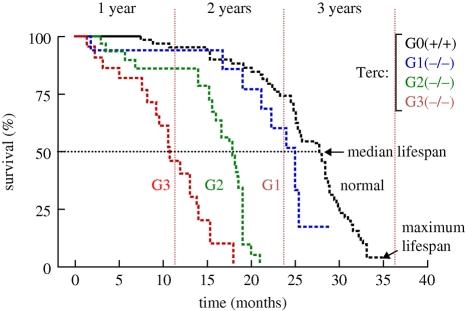
Telomeres protect the chromosome ends from unscheduled DNA repair and degradation. Telomeres are heterochromatic domains composed of repetitive DNA (TTAGGG repeats) bound to an array of specialized proteins. The length of telomere repeats and the integrity of telomere-binding proteins are both important for telomere protection. Furthermore, telomere length and integrity are regulated by a number of epigenetic modifications, thus pointing to higher order control of telomere function. In this regard, we have recently discovered that telomeres are transcribed generating long, non-coding RNAs, which remain associated with the telomeric chromatin and are likely to have important roles in telomere regulation. In the past, we showed that telomere length and the catalytic component of telomerase, Tert, are critical determinants for the mobilization of stem cells. These effects of telomerase and telomere length on stem cell behaviour anticipate the premature ageing and cancer phenotypes of telomerase mutant mice. Recently, we have demonstrated the anti-ageing activity of telomerase by forcing telomerase expression in mice with augmented cancer resistance. Shelterin is the major protein complex bound to mammalian telomeres; however, its potential relevance for cancer and ageing remained unaddressed to date. To this end, we have generated mice conditionally deleted for the shelterin proteins TRF1, TPP1 and Rap1. The study of these mice demonstrates that telomere dysfunction, even if telomeres are of a normal length, is sufficient to produce premature tissue degeneration, acquisition of chromosomal aberrations and initiation of neoplastic lesions. These new mouse models, together with the telomerase-deficient mouse model, are valuable tools for understanding human pathologies produced by telomere dysfunction.
端粒保护染色体末端免受非计划 DNA 修复和降解。端粒是由重复 DNA(TTAGGG 重复序列)结合到一系列专门蛋白质组成的异染色质结构域。端粒重复序列的长度和端粒结合蛋白的完整性对于端粒保护都很重要。此外,端粒长度和完整性受多种表观遗传修饰的调节,从而表明端粒功能的高级别调控。在这方面,我们最近发现端粒被转录产生长的非编码 RNA,这些 RNA 仍然与端粒染色质相关,并且可能在端粒调节中发挥重要作用。过去,我们表明端粒长度和端粒酶的催化成分 Tert 是干细胞动员的关键决定因素。端粒酶和端粒长度对干细胞行为的这些影响预示着端粒酶突变小鼠的过早衰老和癌症表型。最近,我们通过在具有增强的癌症抗性的小鼠中强制表达端粒酶,证明了端粒酶的抗衰老活性。Shelterin 是与哺乳动物端粒结合的主要蛋白质复合物;然而,迄今为止,其对癌症和衰老的潜在相关性尚未得到解决。为此,我们已经生成了条件性缺失 Shelterin 蛋白 TRF1、TPP1 和 Rap1 的小鼠。对这些小鼠的研究表明,即使端粒长度正常,端粒功能障碍也足以导致过早的组织退化、获得染色体畸变和启动肿瘤病变。这些新的小鼠模型与端粒酶缺陷型小鼠模型一起,是理解端粒功能障碍引起的人类病理的有价值的工具。



 Zotero 插件