
胡椒曲叶莱拉病毒需要新德里番茄曲叶病毒的 DNA B 组分来引起曲叶症状。
Pepper leaf curl Lahore virus requires the DNA B component of Tomato leaf curl New Delhi virus to cause leaf curl symptoms.
机构信息
Agricultural Biotechnology Division, National Institute for Biotechnology and Genetic Engineering (NIBGE), P O Box 577, Jhang Road, Faisalabad, Pakistan.
出版信息
Virol J. 2010 Dec 13;7:367. doi: 10.1186/1743-422X-7-367.
BACKGROUND
Begomoviruses are whitefly-transmitted geminiviruses with genomes that consist of either two components (known as DNA A and DNA B) or a single component (homologous to the DNA A component of bipartite begomoviruses). Monopartite begomoviruses are often associated with a symptom-modulating DNA satellite (collectively known as betasatellites). Both bipartite and monopartite begomoviruses with associated satellites have previously been identified in chillies showing leaf curl symptoms in Pakistan.
RESULTS
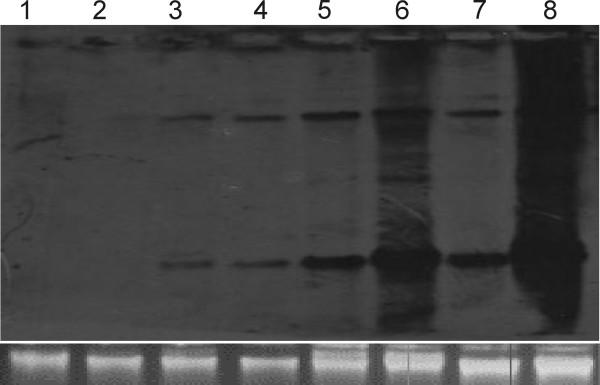
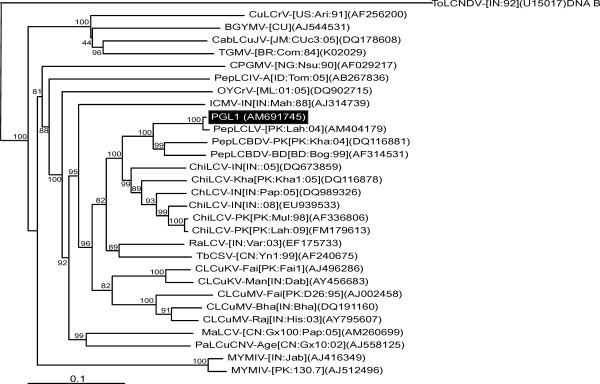
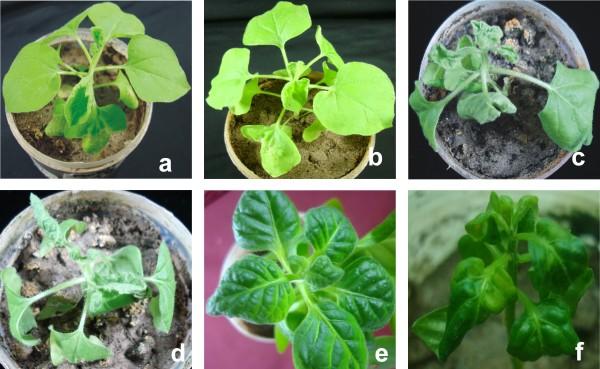
A chilli plant (Capsicum annum) with chilli leaf curl disease symptoms was found to contain a begomovirus, a betasatellite and the DNA B component of Tomato leaf curl New Delhi virus (ToLCNDV). The begomovirus consisted of 2747 nucleotides and had the highest sequence identity (99%) with Pepper leaf curl Lahore virus (PepLCLV-[PK: Lah:04], acc. no. AM404179). Agrobacterium-mediated inoculation of the clone to Nicotiana benthamiana, induced very mild symptoms and low levels of viral DNA, detected in systemically infected leaves by PCR. No symptoms were induced in Nicotiana tabacum or chillies either in the presence or absence of a betasatellite. However, inoculation of PepLCLV with the DNA B component of ToLCNDV induced leaf curl symptoms in N. benthamiana, N. tabacum and chillies and viral DNA accumulated to higher levels in comparison to plants infected with just PepLCLV.
CONCLUSIONS
Based on our previous efforts aimed at understanding of diversity of begomoviruses associated with chillies, we propose that PepLCLV was recently mobilized into chillies upon its interaction with DNA B of ToLCNDV. Interestingly, the putative rep-binding iterons found on PepLCLV (GGGGAC) differ at two base positions from those of ToLCNDV (GGTGTC). This is the first experimental demonstration of the infectivity for a bipartite begomovirus causing chilli leaf curl disease in chillies from Pakistan and suggests that component capture is contributing to the emerging complexity of begomovirus diseases in the region.
背景
双生病毒是烟粉虱传播的单链 DNA 病毒,基因组由两个或一个成分组成(分别称为 DNA A 和 DNA B)。单分体病毒通常与一个症状调节 DNA 卫星(统称为贝塔卫星)相关联。在巴基斯坦表现出卷叶症状的辣椒中,以前已经鉴定出具有相关卫星的双分体和单分体双生病毒。
结果
在一种表现出辣椒卷叶病症状的辣椒植物中,发现了一种双生病毒、一种贝塔卫星和番茄卷叶新德里病毒(ToLCNDV)的 DNA B 成分。该双生病毒由 2747 个核苷酸组成,与辣椒叶卷曲拉合尔病毒(PepLCLV-[PK:Lah:04],acc。编号 AM404179)的序列同一性最高(99%)。用农杆菌介导的克隆接种到烟草原生质体中,诱导了非常轻微的症状和低水平的病毒 DNA,通过 PCR 在系统感染的叶片中检测到。在存在或不存在贝塔卫星的情况下,烟草或辣椒均未引起症状。然而,在烟草原生质体、烟草和辣椒中接种带有 ToLCNDV DNA B 成分的 PepLCLV 会引起卷叶症状,与仅感染 PepLCLV 的植物相比,病毒 DNA 的积累水平更高。
结论
基于我们之前旨在了解与辣椒相关的双生病毒多样性的努力,我们提出 PepLCLV 最近在与 ToLCNDV 的 DNA B 相互作用时被转移到辣椒中。有趣的是,在 PepLCLV 上发现的假定 rep 结合重复序列在两个碱基位置上与 ToLCNDV 的重复序列(GGTGTC)不同。这是首次在巴基斯坦辣椒中实验证明双分体引起辣椒卷叶病的双生病毒对辣椒的侵染性,并表明成分捕获是导致该地区双生病毒病日益复杂化的原因之一。


 Zotero 插件