
抗性淀粉类型 2 和 4 对人体粪便微生物组成有不同影响。
Resistant starches types 2 and 4 have differential effects on the composition of the fecal microbiota in human subjects.
机构信息
Department of Food Science and Technology, University of Nebraska, Lincoln, Nebraska, United States of America.
出版信息
PLoS One. 2010 Nov 29;5(11):e15046. doi: 10.1371/journal.pone.0015046.
BACKGROUND
To systematically develop dietary strategies based on resistant starch (RS) that modulate the human gut microbiome, detailed in vivo studies that evaluate the effects of different forms of RS on the community structure and population dynamics of the gut microbiota are necessary. The aim of the present study was to gain a community wide perspective of the effects of RS types 2 (RS2) and 4 (RS4) on the fecal microbiota in human individuals.
METHODS AND FINDINGS
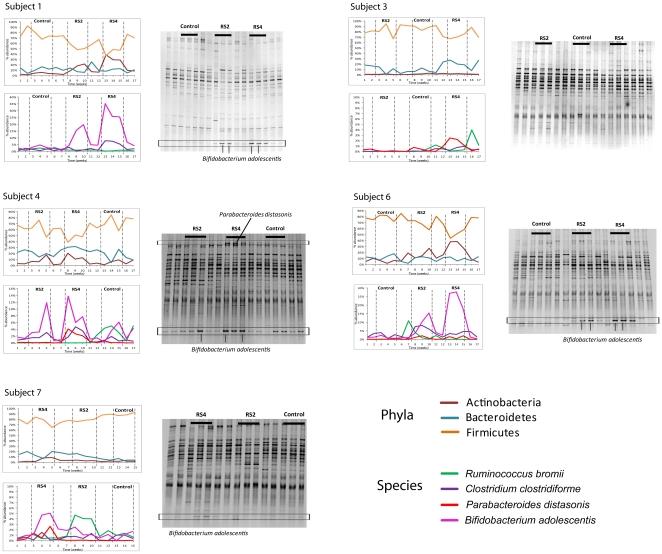
Ten human subjects consumed crackers for three weeks each containing either RS2, RS4, or native starch in a double-blind, crossover design. Multiplex sequencing of 16S rRNA tags revealed that both types of RS induced several significant compositional alterations in the fecal microbial populations, with differential effects on community structure. RS4 but not RS2 induced phylum-level changes, significantly increasing Actinobacteria and Bacteroidetes while decreasing Firmicutes. At the species level, the changes evoked by RS4 were increases in Bifidobacterium adolescentis and Parabacteroides distasonis, while RS2 significantly raised the proportions of Ruminococcus bromii and Eubacterium rectale when compared to RS4. The population shifts caused by RS4 were numerically substantial for several taxa, leading for example, to a ten-fold increase in bifidobacteria in three of the subjects, enriching them to 18-30% of the fecal microbial community. The responses to RS and their magnitudes varied between individuals, and they were reversible and tightly associated with the consumption of RS.
CONCLUSION
Our results demonstrate that RS2 and RS4 show functional differences in their effect on human fecal microbiota composition, indicating that the chemical structure of RS determines its accessibility by groups of colonic bacteria. The findings imply that specific bacterial populations could be selectively targeted by well designed functional carbohydrates, but the inter-subject variations in the response to RS indicates that such strategies might benefit from more personalized approaches.
背景
为了系统地制定基于抗性淀粉(RS)的饮食策略来调节人体肠道微生物群,有必要进行详细的体内研究,评估不同形式的 RS 对肠道微生物群落结构和种群动态的影响。本研究旨在从群落水平上探讨 RS 类型 2(RS2)和 4(RS4)对人体粪便微生物群的影响。
方法和发现
10 名受试者以双盲、交叉设计的方式,连续三周每天食用含有 RS2、RS4 或天然淀粉的饼干。16S rRNA 标签的多重测序显示,这两种 RS 都引起了粪便微生物群的几种显著的组成变化,对群落结构有不同的影响。RS4 但不是 RS2 引起了门水平的变化,显著增加了放线菌和拟杆菌,而减少了厚壁菌门。在物种水平上,RS4 引起的变化是双歧杆菌和副拟杆菌的增加,而 RS2 与 RS4 相比,显著增加了瘤胃球菌和真杆菌的比例。RS4 引起的种群变化在几个分类群中数量上是实质性的,例如,在三个受试者中双歧杆菌增加了十倍,使它们占粪便微生物群的 18-30%。对 RS 的反应及其幅度在个体之间存在差异,而且是可逆的,并与 RS 的摄入密切相关。
结论
我们的结果表明,RS2 和 RS4 在对人体粪便微生物群组成的影响上表现出功能上的差异,这表明 RS 的化学结构决定了其可被结肠细菌群利用的程度。这些发现表明,特定的细菌群体可以通过精心设计的功能性碳水化合物被选择性地靶向,但对 RS 的反应的个体间差异表明,这种策略可能受益于更个性化的方法。



 Zotero 插件