
水稻 CESA/CSL 超家族的表达谱分析及综合分析。
Expression profiling and integrative analysis of the CESA/CSL superfamily in rice.
机构信息
National Key Laboratory of Crop Genetic Improvement, Biomass and Bioenergy Research Centre, Huazhong Agricultural University, Wuhan, Hubei 430070, PR China.
出版信息
BMC Plant Biol. 2010 Dec 20;10:282. doi: 10.1186/1471-2229-10-282.
BACKGROUND
The cellulose synthase and cellulose synthase-like gene superfamily (CESA/CSL) is proposed to encode enzymes for cellulose and non-cellulosic matrix polysaccharide synthesis in plants. Although the rice (Oryza sativa L.) genome has been sequenced for a few years, the global expression profiling patterns and functions of the OsCESA/CSL superfamily remain largely unknown.
RESULTS
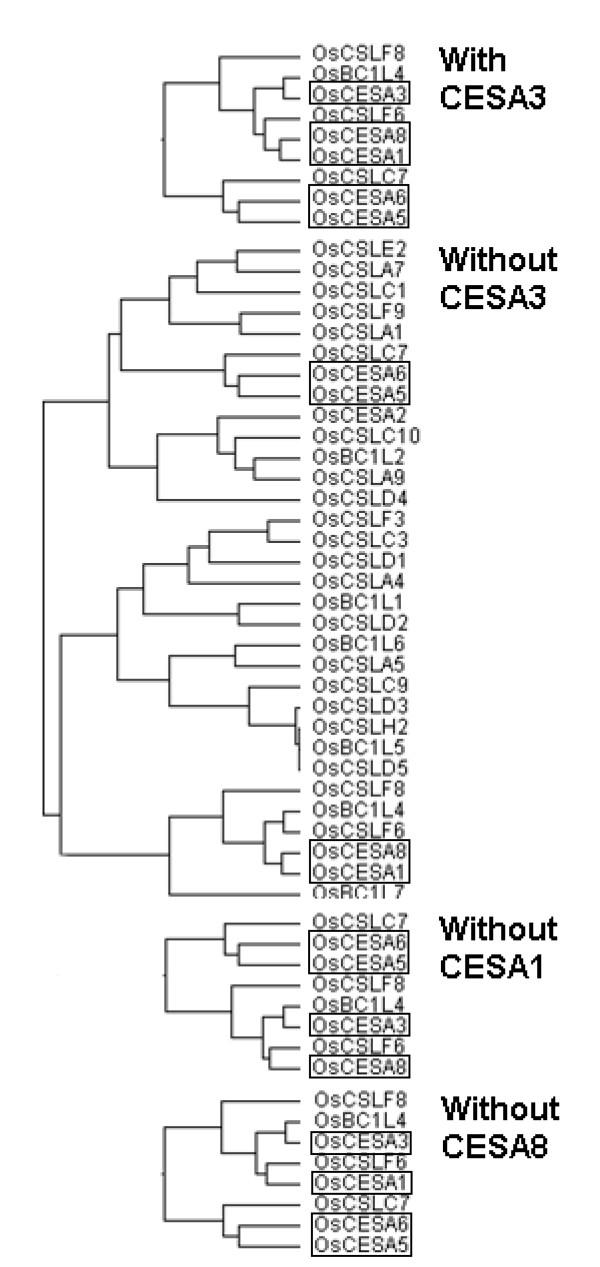
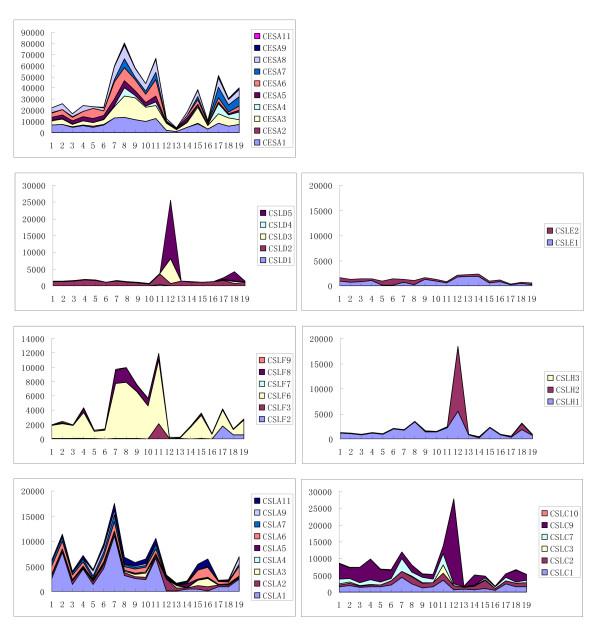
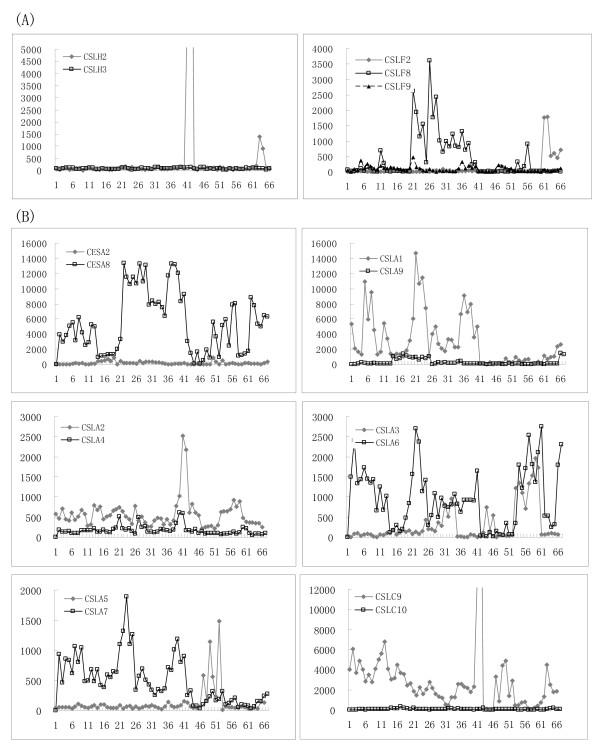
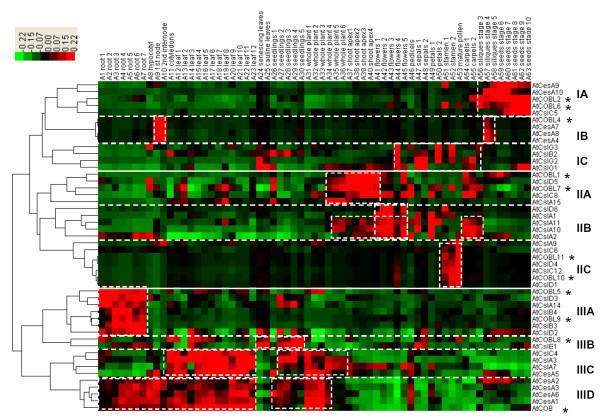
A total of 45 identified members of OsCESA/CSL were classified into two clusters based on phylogeny and motif constitution. Duplication events contributed largely to the expansion of this superfamily, with Cluster I and II mainly attributed to tandem and segmental duplication, respectively. With microarray data of 33 tissue samples covering the entire life cycle of rice, fairly high OsCESA gene expression and rather variable OsCSL expression were observed. While some members from each CSL family (A1, C9, D2, E1, F6 and H1) were expressed in all tissues examined, many of OsCSL genes were expressed in specific tissues (stamen and radicles). The expression pattern of OsCESA/CSL and OsBC1L which extensively co-expressed with OsCESA/CSL can be divided into three major groups with ten subgroups, each showing a distinct co-expression in tissues representing typically distinct cell wall constitutions. In particular, OsCESA1, -3 & -8 and OsCESA4, -7 & -9 were strongly co-expressed in tissues typical of primary and secondary cell walls, suggesting that they form as a cellulose synthase complex; these results are similar to the findings in Arabidopsis. OsCESA5/OsCESA6 is likely partially redundant with OsCESA3 for OsCESA complex organization in the specific tissues (plumule and radicle). Moreover, the phylogenetic comparison in rice, Arabidopsis and other species can provide clues for the prediction of orthologous gene expression patterns.
CONCLUSIONS
The study characterized the CESA/CSL of rice using an integrated approach comprised of phylogeny, transcriptional profiling and co-expression analyses. These investigations revealed very useful clues on the major roles of CESA/CSL, their potentially functional complement and their associations for appropriate cell wall synthesis in higher plants.
背景
纤维素合酶和纤维素合酶样基因超家族(CESA/CSL)被认为在植物中编码纤维素和非纤维素基质多糖的合成酶。尽管水稻(Oryza sativa L.)基因组已经测序了几年,但 OsCESA/CSL 超家族的全球表达谱模式和功能在很大程度上仍然未知。
结果
根据系统发育和基序组成,共鉴定出 45 个 OsCESA/CSL 成员,分为两个聚类。复制事件对该超家族的扩张贡献很大,其中 I 类和 II 类主要归因于串联和片段复制。利用涵盖水稻整个生命周期的 33 个组织样本的微阵列数据,观察到相当高的 OsCESA 基因表达和相当可变的 OsCSL 表达。虽然每个 CSL 家族的一些成员(A1、C9、D2、E1、F6 和 H1)在所有检查的组织中都有表达,但许多 OsCSL 基因在特定组织(雄蕊和胚根)中表达。OsCESA/CSL 和广泛与 OsCESA/CSL 共表达的 OsBC1L 的表达模式可分为三大组十个亚组,每个组在代表典型不同细胞壁组成的组织中表现出明显的共表达。特别是,OsCESA1、-3 和 -8 以及 OsCESA4、-7 和 -9 在典型的初生和次生细胞壁组织中强烈共表达,表明它们形成纤维素合酶复合物;这些结果与拟南芥的发现相似。OsCESA5/OsCESA6 可能与 OsCESA3 部分冗余,用于 OsCESA 复合物在特定组织(芽和胚根)中的组织。此外,在水稻、拟南芥和其他物种中的系统发育比较可以为预测同源基因表达模式提供线索。
结论
本研究采用系统发育、转录谱和共表达分析相结合的方法对水稻的 CESA/CSL 进行了表征。这些研究揭示了 CESA/CSL 的主要作用、它们潜在的功能互补以及它们在高等植物中适当细胞壁合成的关联的非常有用的线索。




 Zotero 插件