
α-TEA 通过激活 p73 与化疗药物协同诱导 p53 突变型三阴性人乳腺癌细胞凋亡。
α-TEA cooperates with chemotherapeutic agents to induce apoptosis of p53 mutant, triple-negative human breast cancer cells via activating p73.
机构信息
School of Biological Sciences/C0900, University of Texas, 1 University Station, Austin, TX 78712, USA.
出版信息
Breast Cancer Res. 2011 Jan 7;13(1):R1. doi: 10.1186/bcr2801.
INTRODUCTION
Successful treatment of p53 mutant, triple-negative breast cancers (TNBC) remains a daunting challenge. Doxorubicin (DOXO) and cisplatin (CDDP) are standard-of-care treatments for TNBC, but eventually fail due to acquired drug resistance and toxicity. New treatments for overcoming drug resistance and toxicity in p53 mutant, TNBC are therefore badly needed. Unlike p53, p73 - a member of the p53 family - is usually not mutated in cancers and has been shown to regulate p53-mediated apoptotic signaling in p53-deficient cancers. Therefore, identification of anticancer agents that can activate p73 in p53-deficient cancers may provide a chemotherapeutic approach for treatment of p53 mutant cancers. Here we report on the reconstitution of the p53 tumor suppressor pathway in a p53-independent manner via p73 with combination treatments of α-TEA, a small bioactive lipid, plus DOXO or CDDP.
METHODS
p53 mutant, TNBC cell lines MDA-MB-231, BT-20 and MDA-MB-468 were used to evaluate the anticancer effect of chemotherapeutic drugs and α-TEA using annexin V (FITC)/PI staining, western blot analyses, RT-PCR and siRNA knockdown techniques.
RESULTS
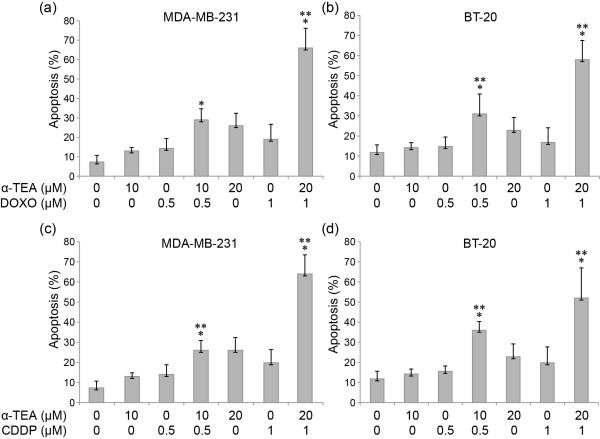
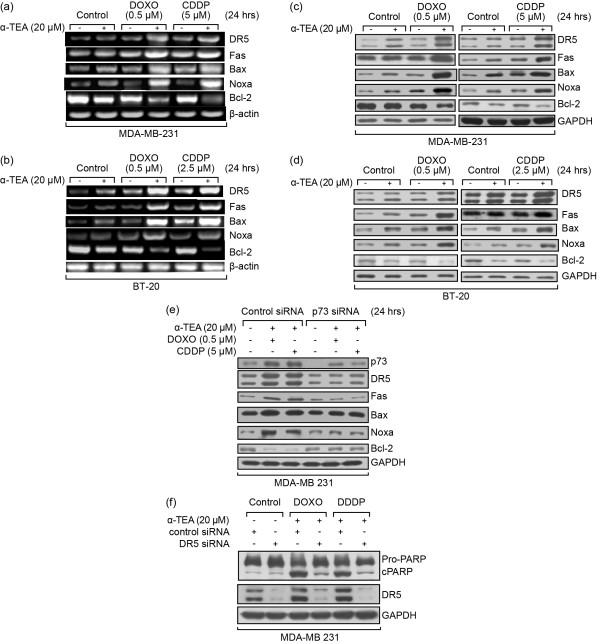
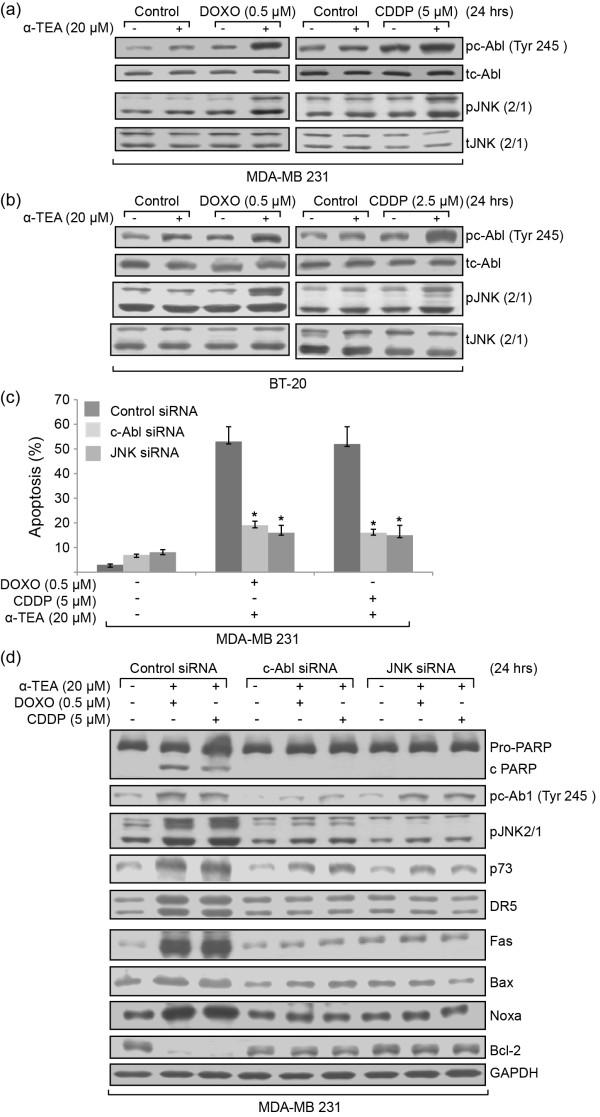
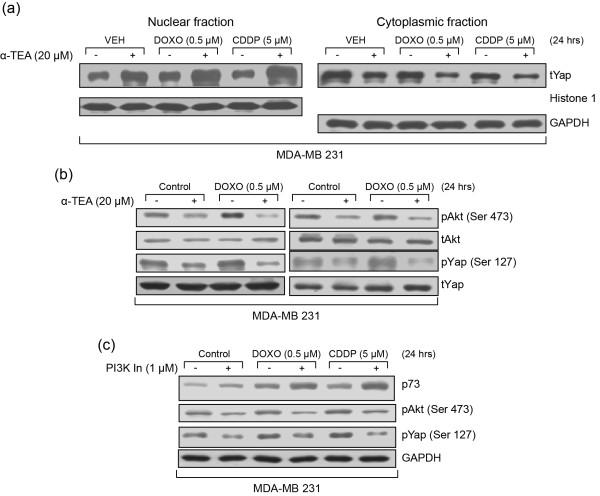
Combination treatments of α-TEA plus DOXO or CDDP act cooperatively to induce apoptosis, caspase-8 and caspase-9 cleavage, p73, phospho-c-Ab1 and phospho-JNK protein expression, and increase expression of p53 downstream mediators; namely, death receptor-5, CD95/APO-1 (Fas), Bax and Noxa, as well as Yap nuclear translocation - plus reduce expression of Bcl-2. Knockdown of p73, c-Abl, JNK or Yap using siRNAs shows that p73 plays a critical role in combination treatment-enhanced apoptosis and the expression of pro-apoptotic and anti-apoptotic mediators, and that c-Abl, JNK and Yap are upstream mediators of p73 in combination treatment responses.
CONCLUSIONS
Data show that α-TEA in combination with DOXO or CDDP synergistically enhances apoptosis in TNBC via targeting p53-mediated genes in a p73-dependent manner, and that p73 responses are downstream of c-Abl, JNK and Yap.
简介
成功治疗 p53 突变的三阴性乳腺癌(TNBC)仍然是一个艰巨的挑战。阿霉素(DOXO)和顺铂(CDDP)是 TNBC 的标准治疗方法,但最终由于获得性耐药和毒性而失败。因此,急需寻找新的治疗方法来克服 p53 突变的 TNBC 中的耐药性和毒性。与 p53 不同,p73 - p53 家族的成员 - 在癌症中通常不会突变,并已被证明可调节 p53 缺失型癌症中的 p53 介导的凋亡信号。因此,鉴定能够在 p53 缺失型癌症中激活 p73 的抗癌剂可能为治疗 p53 突变型癌症提供一种化疗方法。在这里,我们报告了通过 p73 以非依赖于 p53 的方式重建 p53 肿瘤抑制途径,并用 α-TEA(一种小生物活性脂质)联合 DOXO 或 CDDP 进行治疗。
方法
使用 Annexin V(FITC)/PI 染色,western blot 分析,RT-PCR 和 siRNA 敲低技术,使用 p53 突变的 TNBC 细胞系 MDA-MB-231、BT-20 和 MDA-MB-468 来评估化疗药物和 α-TEA 的抗癌作用。
结果
α-TEA 联合 DOXO 或 CDDP 联合治疗可协同诱导细胞凋亡,caspase-8 和 caspase-9 裂解,p73,磷酸化-c-Abl 和磷酸化-JNK 蛋白表达,并增加 p53 下游介质的表达;即死亡受体-5、CD95/APO-1(Fas)、Bax 和 Noxa,以及 Yap 核易位 - 同时降低 Bcl-2 的表达。使用 siRNA 敲低 p73、c-Abl、JNK 或 yap 显示 p73 在联合治疗增强的细胞凋亡和促凋亡和抗凋亡介质的表达中起着关键作用,并且 c-Abl、JNK 和 yap 是联合治疗反应中 p73 的上游介质。
结论
数据表明,α-TEA 联合 DOXO 或 CDDP 通过靶向 p73 依赖性方式协同增强 TNBC 中的细胞凋亡,并且 p73 反应是 c-Abl、JNK 和 yap 的下游反应。




 Zotero 插件