
人类基因组多样性计划群体中的全基因组关联研究 SNPs:选择是否会影响具有共同性状关联的非连锁 SNPs?
Genome-wide association study SNPs in the human genome diversity project populations: does selection affect unlinked SNPs with shared trait associations?
机构信息
Department of Genetics, Stanford University, Stanford, California, United States of America.
出版信息
PLoS Genet. 2011 Jan 6;7(1):e1001266. doi: 10.1371/journal.pgen.1001266.
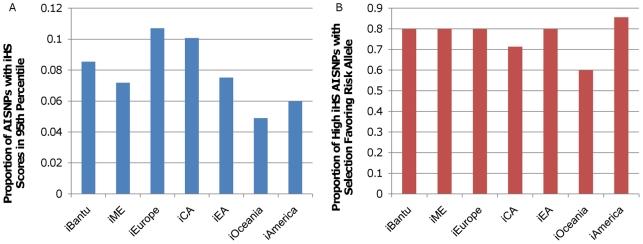
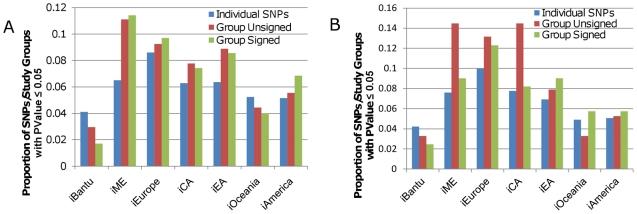
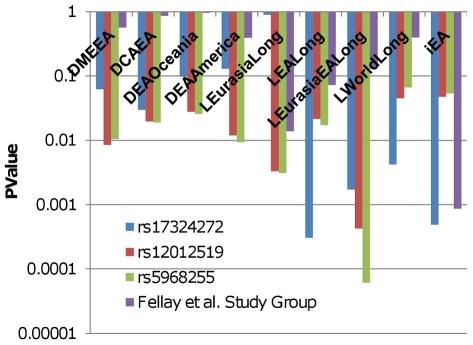
Genome-wide association studies (GWAS) have identified more than 2,000 trait-SNP associations, and the number continues to increase. GWAS have focused on traits with potential consequences for human fitness, including many immunological, metabolic, cardiovascular, and behavioral phenotypes. Given the polygenic nature of complex traits, selection may exert its influence on them by altering allele frequencies at many associated loci, a possibility which has yet to be explored empirically. Here we use 38 different measures of allele frequency variation and 8 iHS scores to characterize over 1,300 GWAS SNPs in 53 globally distributed human populations. We apply these same techniques to evaluate SNPs grouped by trait association. We find that groups of SNPs associated with pigmentation, blood pressure, infectious disease, and autoimmune disease traits exhibit unusual allele frequency patterns and elevated iHS scores in certain geographical locations. We also find that GWAS SNPs have generally elevated scores for measures of allele frequency variation and for iHS in Eurasia and East Asia. Overall, we believe that our results provide evidence for selection on several complex traits that has caused changes in allele frequencies and/or elevated iHS scores at a number of associated loci. Since GWAS SNPs collectively exhibit elevated allele frequency measures and iHS scores, selection on complex traits may be quite widespread. Our findings are most consistent with this selection being either positive or negative, although the relative contributions of the two are difficult to discern. Our results also suggest that trait-SNP associations identified in Eurasian samples may not be present in Africa, Oceania, and the Americas, possibly due to differences in linkage disequilibrium patterns. This observation suggests that non-Eurasian and non-East Asian sample populations should be included in future GWAS.
全基因组关联研究(GWAS)已经确定了超过 2000 个与性状相关的 SNP 关联,而且这个数字还在不断增加。GWAS 主要关注对人类适应度有潜在影响的性状,包括许多免疫、代谢、心血管和行为表型。鉴于复杂性状的多基因性质,选择可能通过改变许多相关位点的等位基因频率对其施加影响,这一可能性尚未得到实证研究的探索。在这里,我们使用 38 种不同的等位基因频率变化衡量标准和 8 种 iHS 分数来描述分布在全球 53 个人群中的 1300 多个 GWAS SNP。我们应用这些相同的技术来评估按性状关联分组的 SNP。我们发现,与色素沉着、血压、传染病和自身免疫性疾病相关的 SNP 群体在某些地理位置表现出异常的等位基因频率模式和升高的 iHS 分数。我们还发现,GWAS SNP 在欧亚大陆和东亚的等位基因频率变化衡量标准和 iHS 方面普遍具有较高的分数。总的来说,我们认为我们的结果为几个复杂性状的选择提供了证据,这些选择导致了许多相关位点的等位基因频率变化和/或升高的 iHS 分数。由于 GWAS SNP 总体上表现出升高的等位基因频率衡量标准和 iHS 分数,因此复杂性状的选择可能相当广泛。我们的发现最符合这种选择是正向或负向的,尽管两者的相对贡献很难辨别。我们的结果还表明,在欧亚人群中确定的性状-SNP 关联可能不存在于非洲、大洋洲和美洲,这可能是由于连锁不平衡模式的差异所致。这一观察结果表明,未来的 GWAS 应该包括非欧亚和非东亚的样本人群。


 Zotero 插件