
肝细胞癌的治疗。
Medical treatment of hepatocellular carcinoma.
机构信息
Department of Digestive Diseases and Interna Medicine, Policlinico S. Orsola Malpighi, Bologna, Italy.
出版信息
Mediterr J Hematol Infect Dis. 2009 Dec 16;1(3):e2009021. doi: 10.4084/MJHID.2009.021.
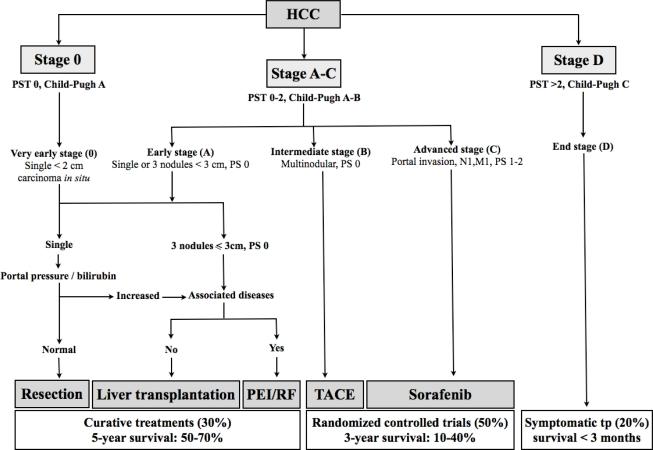
Hepatocellular carcinoma (HCC) is the fifth most common neoplasm and the third leading cause of cancer-related deaths worldwide. Cirrhosis, most often due to viral hepatitis, is the predominant risk factors for HCC and geographical differences in both risk factors and incidence are largely due to epidemiological variations in hepatitis B and C infection. Hepatic function is a relevant parameter in selecting therapy in HCC. The current clinical classification of HCC split patients into 5 stages, with a specific treatment schedule for any stage. As patients with early stages can receive curative treatments, such as surgical resection, liver transplantation or local ablation, surveillance program in high-risk populations has become mandatory. Sorafenib, a multikinase inhibitor, has recently shown survival benefits in patients at advanced stage of disease. Hopefully, new molecular targeted therapies and their combination with sorafenib or interventional and surgical procedures, should expand the therapeutic armamentarium against HCC.
肝细胞癌 (HCC) 是第五种最常见的肿瘤,也是全球癌症相关死亡的第三大主要原因。肝硬化,通常是由病毒性肝炎引起的,是 HCC 的主要危险因素,而危险因素和发病率的地域差异主要归因于乙型肝炎和丙型肝炎感染的流行病学变化。肝功能是选择 HCC 治疗方法的一个相关参数。目前 HCC 的临床分类将患者分为 5 期,每一期都有特定的治疗方案。由于早期患者可以接受根治性治疗,如手术切除、肝移植或局部消融,因此在高危人群中进行监测计划已成为强制性要求。索拉非尼是一种多激酶抑制剂,最近在晚期疾病患者中显示出生存获益。希望新的分子靶向治疗及其与索拉非尼或介入和手术的联合应用,能够扩大 HCC 的治疗手段。
 Zotero 插件