
基于黑视蛋白的辐照度探测电路的研制。
Development of melanopsin-based irradiance detecting circuitry.
机构信息
Department of Biology, Johns Hopkins University, Baltimore, MD 21218, USA.
出版信息
Neural Dev. 2011 Mar 18;6:8. doi: 10.1186/1749-8104-6-8.
BACKGROUND
Most retinal ganglion cells (RGCs) convey contrast and motion information to visual brain centers. Approximately 2% of RGCs are intrinsically photosensitive (ipRGCs), express melanopsin and are necessary for light to modulate specific physiological processes in mice. The ipRGCs directly target the suprachiasmatic nucleus (SCN) to photoentrain circadian rhythms, and the olivary pretectal nucleus (OPN) to mediate the pupillary light response. How and when this ipRGC circuitry develops is unknown.
RESULTS
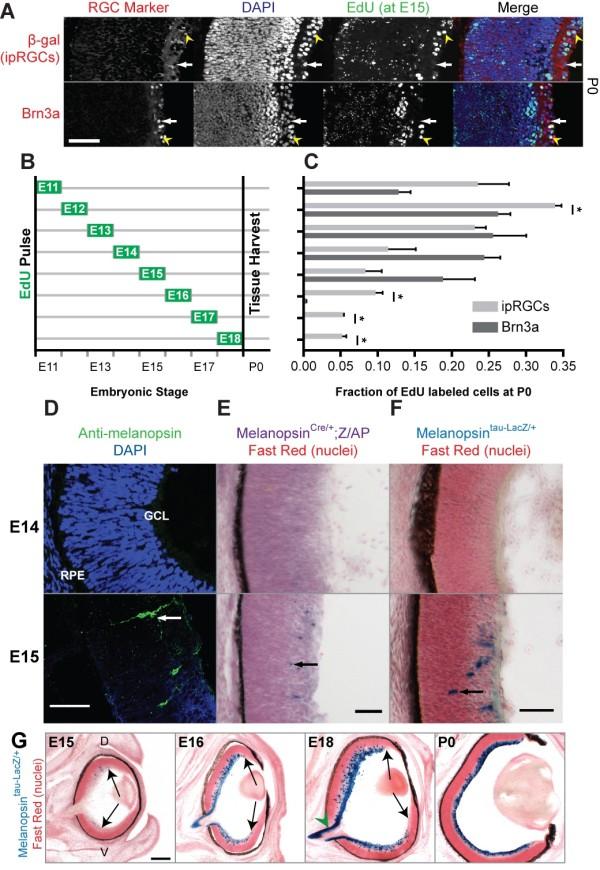
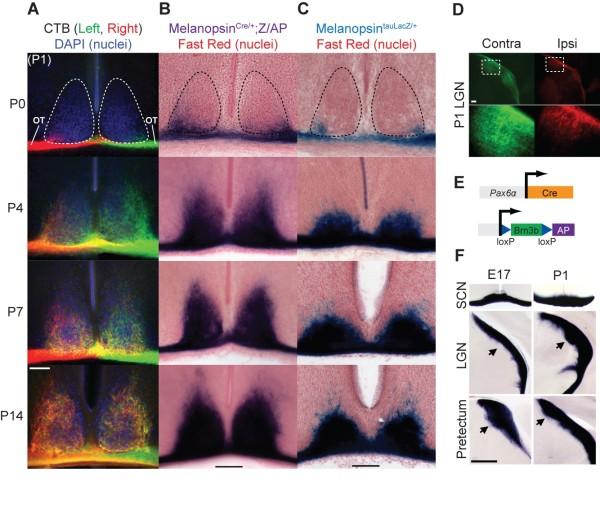
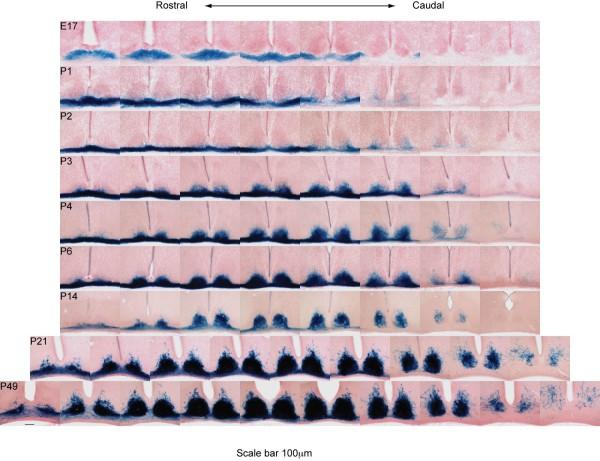
Here, we show that some ipRGCs follow a delayed developmental time course relative to other image-forming RGCs. Specifically, ipRGC neurogenesis extends beyond that of other RGCs, and ipRGCs begin innervating the SCN at postnatal ages, unlike most RGCs, which innervate their image-forming targets embryonically. Moreover, the appearance of ipRGC axons in the OPN coincides precisely with the onset of the pupillary light response.
CONCLUSIONS
Some ipRGCs differ not only functionally but also developmentally from RGCs that mediate pattern-forming vision.
背景
大多数视网膜神经节细胞(RGCs)将对比度和运动信息传递到视觉大脑中枢。大约 2%的 RGCs 是内在光敏的(ipRGCs),表达黑视蛋白,对于光调节小鼠的特定生理过程是必要的。ipRGCs 直接靶向视交叉上核(SCN)以光诱发昼夜节律,靶向橄榄状脑桥核(OPN)以介导瞳孔对光反应。这种 ipRGC 回路如何以及何时发育尚不清楚。
结果
在这里,我们表明,一些 ipRGCs 的发育时间相对于其他形成图像的 RGCs 延迟。具体来说,ipRGC 的神经发生时间超过了其他 RGCs,并且 ipRGCs 开始在出生后时期向 SCN 发出神经支配,而不像大多数 RGCs 那样在胚胎期向其形成图像的靶标发出神经支配。此外,ipRGC 轴突出现在 OPN 中与瞳孔对光反应的开始精确吻合。
结论
一些 ipRGCs 在功能上不仅与介导形成图像的视觉的 RGCs 不同,而且在发育上也不同。


 Zotero 插件