
STIM1 和 STIM2 在大鼠神经元中的钙库操纵性钙内流中的差异作用。
Differential roles for STIM1 and STIM2 in store-operated calcium entry in rat neurons.
机构信息
Laboratory of Neurodegeneration, International Institute of Molecular and Cell Biology, Warsaw, Poland.
出版信息
PLoS One. 2011 Apr 26;6(4):e19285. doi: 10.1371/journal.pone.0019285.
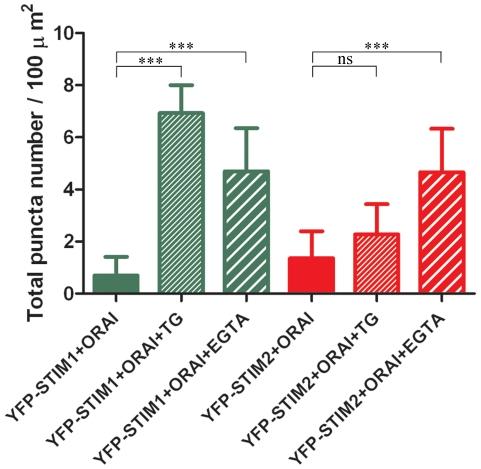
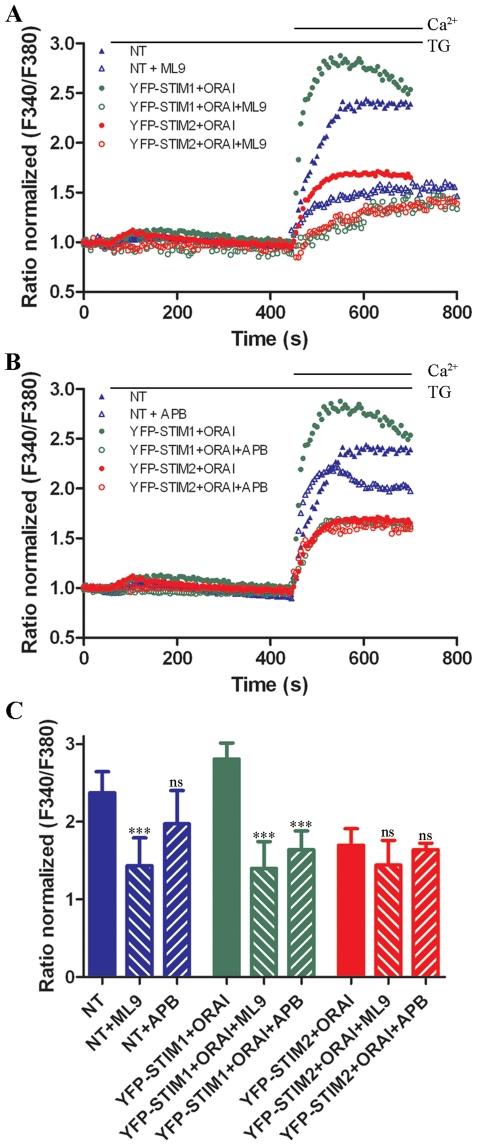
The interaction between Ca(2+) sensors STIM1 and STIM2 and Ca(2+) channel-forming protein ORAI1 is a crucial element of store-operated calcium entry (SOCE) in non-excitable cells. However, the molecular mechanism of SOCE in neurons remains unclear. We addressed this issue by establishing the presence and function of STIM proteins. Real-time polymerase chain reaction from cortical neurons showed that these cells contain significant amounts of Stim1 and Stim2 mRNA. Thapsigargin (TG) treatment increased the amount of both endogenous STIM proteins in neuronal membrane fractions. The number of YFP-STIM1/ORAI1 and YFP-STIM2/ORAI1 complexes was also enhanced by such treatment. The differences observed in the number of STIM1 and STIM2 complexes under SOCE conditions and the differential sensitivity to SOCE inhibitors suggest their distinct roles. Endoplasmic reticulum (ER) store depletion by TG enhanced intracellular Ca(2+) levels in loaded with Fura-2 neurons transfected with YFP-STIM1 and ORAI1, but not with YFP-STIM2 and ORAI1, which correlated well with the number of complexes formed. Moreover, the SOCE inhibitors ML-9 and 2-APB reduced Ca(2+) influx in neurons expressing YFP-STIM1/ORAI1 but produced no effect in cells transfected with YFP-STIM2/ORAI1. Moreover, in neurons transfected with YFP-STIM2/ORAI1, the increase in constitutive calcium entry was greater than with YFP-STIM1/ORAI1. Our data indicate that both STIM proteins are involved in calcium homeostasis in neurons. STIM1 mainly activates SOCE, whereas STIM2 regulates resting Ca(2+) levels in the ER and Ca(2+) leakage with the additional involvement of STIM1.
钙(Ca2+)传感器 STIM1 和 STIM2 与钙通道形成蛋白 ORAI1 的相互作用是无兴奋性细胞中储存操作钙内流(SOCE)的关键因素。然而,神经元中 SOCE 的分子机制尚不清楚。我们通过建立 STIM 蛋白的存在和功能来解决这个问题。皮质神经元的实时聚合酶链反应显示,这些细胞含有大量的 Stim1 和 Stim2 mRNA。他普西格拉汀(TG)处理增加了神经元膜部分中两种内源性 STIM 蛋白的含量。这种处理还增强了 YFP-STIM1/ORAI1 和 YFP-STIM2/ORAI1 复合物的数量。在 SOCE 条件下观察到的 STIM1 和 STIM2 复合物数量的差异以及对 SOCE 抑制剂的不同敏感性表明它们具有不同的作用。TG 耗尽内质网(ER)储存会增强转染有 YFP-STIM1 和 ORAI1 的负载 Fura-2 神经元的细胞内 Ca2+水平,但不会增强转染有 YFP-STIM2 和 ORAI1 的神经元,这与形成的复合物数量很好地相关。此外,SOCE 抑制剂 ML-9 和 2-APB 降低了表达 YFP-STIM1/ORAI1 的神经元中的 Ca2+内流,但对转染有 YFP-STIM2/ORAI1 的细胞没有影响。此外,在转染有 YFP-STIM2/ORAI1 的神经元中,组成性钙内流的增加大于转染有 YFP-STIM1/ORAI1 的神经元。我们的数据表明,两种 STIM 蛋白都参与神经元中的钙稳态。STIM1 主要激活 SOCE,而 STIM2 调节内质网中的静息 Ca2+水平和 Ca2+渗漏,同时还涉及 STIM1。



 Zotero 插件