
褪黑素延长释放制剂治疗糖尿病伴失眠患者的疗效和安全性:一项随机、双盲、交叉研究。
Efficacy and safety of prolonged-release melatonin in insomnia patients with diabetes: a randomized, double-blind, crossover study.
机构信息
Geriatric Palliative Department, Shoham Geriatric Medical Center, Pardes Hana, Israel;
出版信息
Diabetes Metab Syndr Obes. 2011;4:307-13. doi: 10.2147/DMSO.S23904. Epub 2011 Aug 2.
BACKGROUND
Diabetes is a major comorbidity in insomnia patients. The efficacy and safety of prolonged-release melatonin 2 mg in the treatment of glucose, lipid metabolism, and sleep was studied in 36 type 2 diabetic patients with insomnia (11 men, 25 women, age 46-77 years).
METHODS
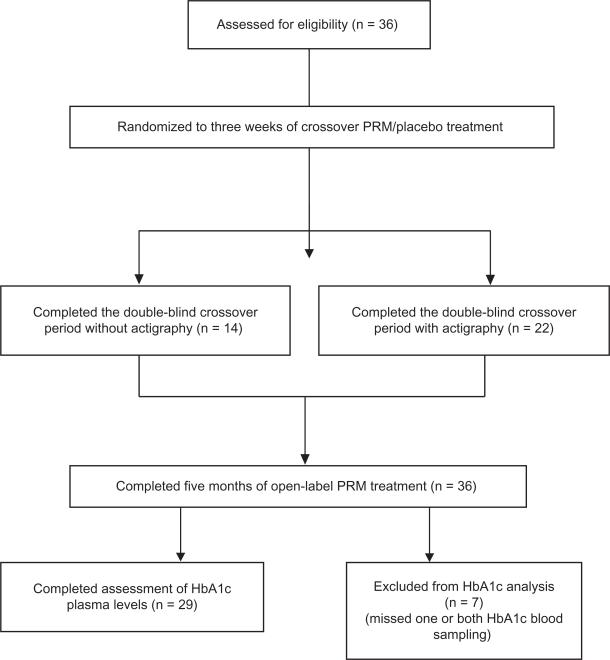
In a randomized, double-blind, crossover study, the subjects were treated for 3 weeks (period 1) with prolonged-release melatonin or placebo, followed by a one-week washout period, and then crossed over for another 3 weeks (period 2) of treatment with the other preparation. All tablets were taken 2 hours before bedtime for a period of 3 weeks. In an extension period of 5 months, prolonged-release melatonin was given nightly to all patients in an open-label design. Sleep was objectively monitored in a subgroup of 22 patients using wrist actigraphy. Fasting glucose, fructosamine, insulin, C-peptide, triglycerides, total cholesterol, high-density and low-density lipoprotein cholesterol, and some antioxidants, as well as glycosylated hemoglobin (HbA1c) levels were measured at baseline and at the end of the study. All concomitant medications were continued throughout the study.
RESULTS
No significant changes in serum glucose, fructosamine, insulin, C-peptide, antioxidant levels or blood chemistry were observed after 3 weeks of prolonged-release melatonin treatment. Sleep efficiency, wake time after sleep onset, and number of awakenings improved significantly with prolonged-release melatonin as compared with placebo. Following 5 months of prolonged-release melatonin treatment, mean HbA1c (±standard deviation) was significantly lower than at baseline (9.13% ± 1.55% versus 8.47% ± 1.67%, respectively, P = 0.005).
CONCLUSION
Short-term use of prolonged-release melatonin improves sleep maintenance in type 2 diabetic patients with insomnia without affecting glucose and lipid metabolism. Long-term prolonged-release melatonin administration has a beneficial effect on HbA1c, suggesting improved glycemic control.
背景
糖尿病是失眠患者的主要合并症。在 36 例患有失眠的 2 型糖尿病患者(11 名男性,25 名女性,年龄 46-77 岁)中,研究了延长释放型褪黑素 2mg 对葡萄糖、脂代谢和睡眠的疗效和安全性。
方法
在一项随机、双盲、交叉研究中,受试者在第 1 阶段(3 周)接受延长释放型褪黑素或安慰剂治疗,然后进行为期 1 周的洗脱期,然后交叉接受另 3 周(第 2 阶段)的另一种制剂治疗。所有片剂均在睡前 2 小时服用,为期 3 周。在 5 个月的扩展期内,所有患者均以开放标签设计每晚给予延长释放型褪黑素。在 22 名患者的亚组中使用腕部动作描记法客观监测睡眠。在研究结束时测量空腹血糖、果糖胺、胰岛素、C 肽、甘油三酯、总胆固醇、高密度和低密度脂蛋白胆固醇以及一些抗氧化剂,以及糖化血红蛋白(HbA1c)水平。在整个研究过程中继续使用所有伴随药物。
结果
在延长释放型褪黑素治疗 3 周后,血清葡萄糖、果糖胺、胰岛素、C 肽、抗氧化剂水平或血液化学无明显变化。与安慰剂相比,延长释放型褪黑素可显著提高睡眠效率、睡眠后醒来时间和觉醒次数。在延长释放型褪黑素治疗 5 个月后,平均 HbA1c(±标准差)明显低于基线(9.13%±1.55%比 8.47%±1.67%,分别为 P=0.005)。
结论
短期使用延长释放型褪黑素可改善患有失眠的 2 型糖尿病患者的睡眠维持,而不影响葡萄糖和脂代谢。长期给予延长释放型褪黑素对 HbA1c 有有益影响,提示血糖控制改善。
 Zotero 插件