
小檗碱和黄连对高脂饮食喂养的 C57BL/6J 小鼠肠道微生物和肥胖的作用及作用机制。
Effects and action mechanisms of berberine and Rhizoma coptidis on gut microbes and obesity in high-fat diet-fed C57BL/6J mice.
机构信息
Life Science Division, Graduate School at Shenzhen, Tsinghua University, Shenzhen, China.
出版信息
PLoS One. 2011;6(9):e24520. doi: 10.1371/journal.pone.0024520. Epub 2011 Sep 6.
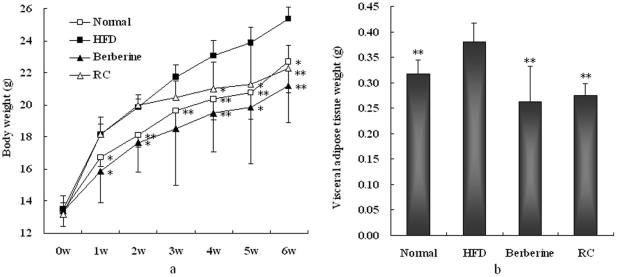
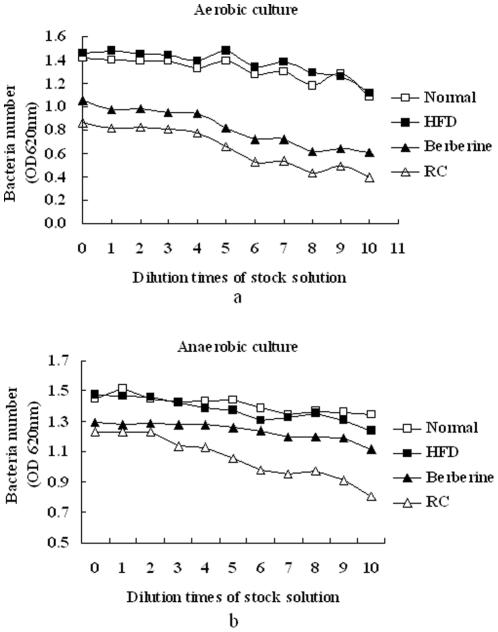
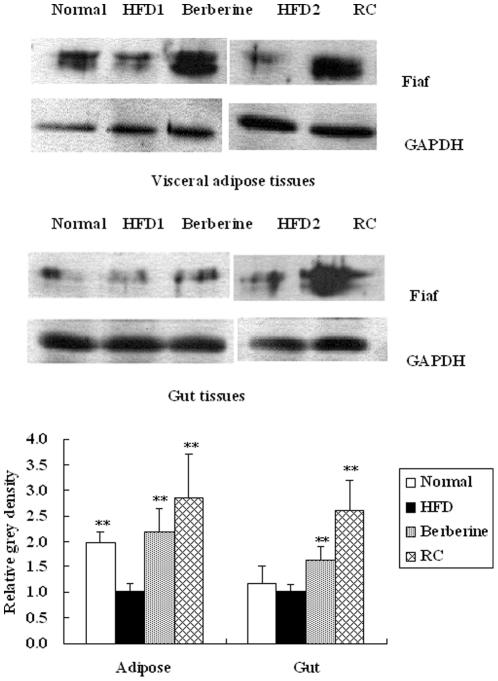
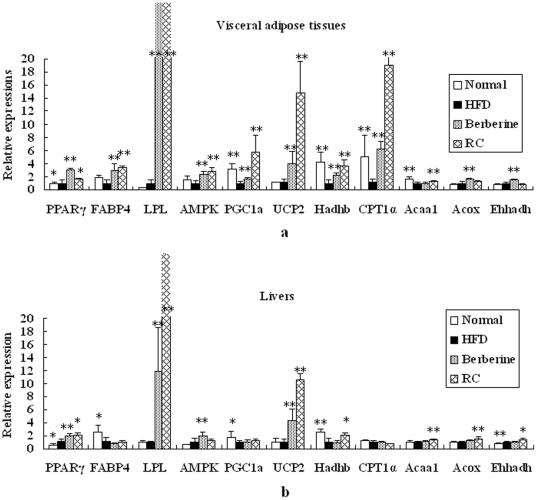
Gut microbes play important roles in regulating fat storage and metabolism. Rhizoma coptidis (RC) and its main active compound, berberine, have either antimicrobial or anti-obesity activities. In the present study, we hypothesize that RC exerts anti-obesity effects that are likely mediated by mechanisms of regulating gut microbes and berberine may be a key compound of RC. Gut microbes and glucose and lipid metabolism in high-fat diet-fed C57BL/6J (HFD) mice in vivo are investigated after RC and berberine treatments. The results show that RC (200 mg/kg) and berberine (200 mg/kg) significantly lower both body and visceral adipose weights, and reduce blood glucose and lipid levels, and decrease degradation of dietary polysaccharides in HFD mice. Both RC and berberine significantly reduce the proportions of fecal Firmicutes and Bacteroidetes to total bacteria in HFD mice. In the trial ex vivo, both RC and berberine significantly inhibit the growth of gut bacteria under aerobic and anaerobic conditions. In in vitro trials, both RC and berberine significantly inhibit the growth of Lactobacillus (a classical type of Firmicutes) under anaerobic conditions. Furthermore, both RC and berberine significantly increase fasting-induced adipose factor (Fiaf, a key protein negatively regulated by intestinal microbes) expressions in either intestinal or visceral adipose tissues. Both RC and berberine significantly increase mRNA expressions of AMPK, PGC1α, UCP2, CPT1α, and Hadhb related to mitochondrial energy metabolism, which may be driven by increased Fiaf expression. These results firstly suggest that antimicrobial activities of RC and berberine may result in decreasing degradation of dietary polysaccharides, lowering potential calorie intake, and then systemically activating Fiaf protein and related gene expressions of mitochondrial energy metabolism in visceral adipose tissues. Taken together, these action mechanisms may contribute to significant anti-obesity effects. Findings in the present study also indicate that pharmacological regulation on gut microbes can develop an anti-obesity strategy.
肠道微生物在调节脂肪储存和代谢方面发挥着重要作用。黄连及其主要活性化合物小檗碱具有抗菌或抗肥胖活性。在本研究中,我们假设黄连发挥抗肥胖作用,可能是通过调节肠道微生物的机制介导的,而小檗碱可能是黄连的关键化合物。在体内研究了黄连和小檗碱对高脂肪饮食喂养的 C57BL/6J(HFD)小鼠的肠道微生物和葡萄糖及脂质代谢的影响。结果表明,黄连(200mg/kg)和小檗碱(200mg/kg)可显著降低 HFD 小鼠的体重和内脏脂肪重量,降低血糖和血脂水平,并减少膳食多糖的降解。黄连和小檗碱均可显著降低 HFD 小鼠粪便中厚壁菌门和拟杆菌门的比例。在体外试验中,黄连和小檗碱在有氧和无氧条件下均显著抑制肠道细菌的生长。在体外试验中,黄连和小檗碱在无氧条件下均显著抑制乳杆菌(厚壁菌门的典型代表)的生长。此外,黄连和小檗碱均可显著增加空腹诱导脂肪因子(Fiaf,一种受肠道微生物负调控的关键蛋白)在肠或内脏脂肪组织中的表达。黄连和小檗碱均可显著增加与线粒体能量代谢相关的 AMPK、PGC1α、UCP2、CPT1α 和 Hadhb 的 mRNA 表达,这可能是由 Fiaf 表达增加驱动的。这些结果首先表明,黄连和小檗碱的抗菌活性可能导致膳食多糖的降解减少,降低潜在的热量摄入,然后系统地激活内脏脂肪组织中 Fiaf 蛋白和相关的线粒体能量代谢基因表达。综上所述,这些作用机制可能有助于发挥显著的抗肥胖作用。本研究的结果还表明,对肠道微生物的药理学调节可以开发出一种抗肥胖策略。



 Zotero 插件