
鉴定人α4β2 和 α3β4 神经元烟碱型乙酰胆碱受体上的负变构位点。
Identification of a negative allosteric site on human α4β2 and α3β4 neuronal nicotinic acetylcholine receptors.
机构信息
Biophysics Program, Ohio State University, Columbus, Ohio, United States of America.
出版信息
PLoS One. 2011;6(9):e24949. doi: 10.1371/journal.pone.0024949. Epub 2011 Sep 15.
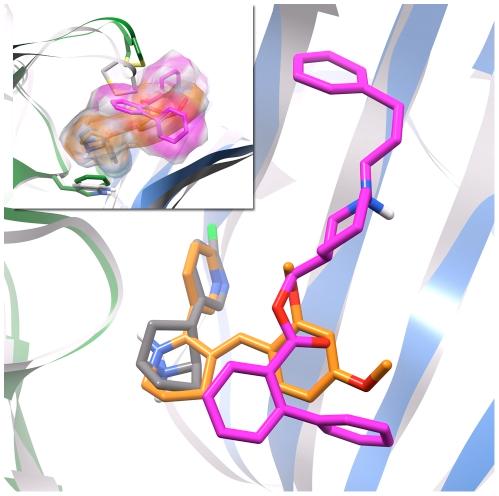
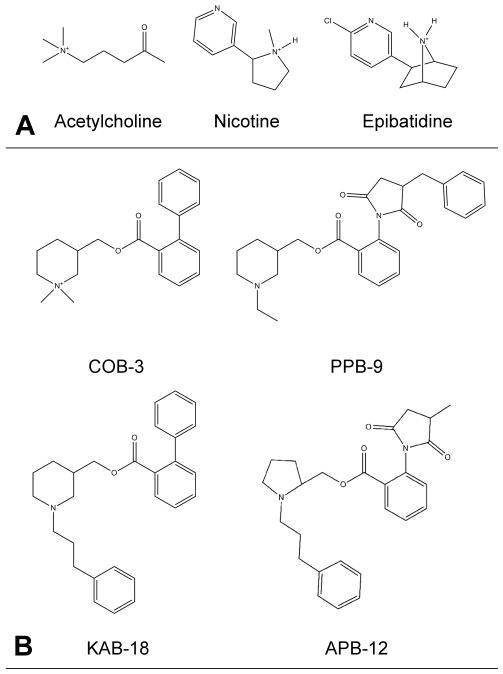
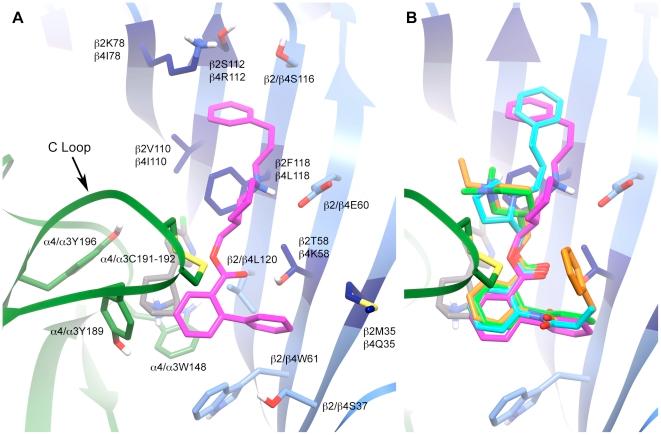
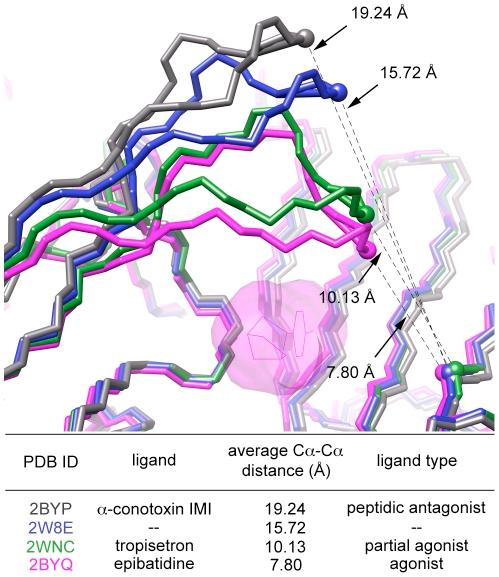
Acetylcholine-based neurotransmission is regulated by cationic, ligand-gated ion channels called nicotinic acetylcholine receptors (nAChRs). These receptors have been linked to numerous neurological diseases and disorders such as Alzheimer's disease, Parkinson's disease, and nicotine addiction. Recently, a class of compounds has been discovered that antagonize nAChR function in an allosteric fashion. Models of human α4β2 and α3β4 nicotinic acetylcholine receptor (nAChR) extracellular domains have been developed to computationally explore the binding of these compounds, including the dynamics and free energy changes associated with ligand binding. Through a blind docking study to multiple receptor conformations, the models were used to determine a putative binding mode for the negative allosteric modulators. This mode, in close proximity to the agonist binding site, is presented in addition to a hypothetical mode of antagonism that involves obstruction of C loop closure. Molecular dynamics simulations and MM-PBSA free energy of binding calculations were used as computational validation of the predicted binding mode, while functional assays on wild-type and mutated receptors provided experimental support. Based on the proposed binding mode, two residues on the β2 subunit were independently mutated to the corresponding residues found on the β4 subunit. The T58K mutation resulted in an eight-fold decrease in the potency of KAB-18, a compound that exhibits preferential antagonism for human α4β2 over α3β4 nAChRs, while the F118L mutation resulted in a loss of inhibitory activity for KAB-18 at concentrations up to 100 µM. These results demonstrate the selectivity of KAB-18 for human α4β2 nAChRs and validate the methods used for identifying the nAChR modulator binding site. Exploitation of this site may lead to the development of more potent and subtype-selective nAChR antagonists which may be used in the treatment of a number of neurological diseases and disorders.
基于乙酰胆碱的神经递质传递受阳离子配体门控离子通道的调节,这些通道被称为烟碱型乙酰胆碱受体(nAChRs)。这些受体与许多神经疾病和障碍有关,如阿尔茨海默病、帕金森病和尼古丁成瘾。最近,发现了一类化合物,它们以变构的方式拮抗 nAChR 的功能。已经开发出了人类α4β2 和α3β4 烟碱型乙酰胆碱受体(nAChR)细胞外结构域的模型,以计算这些化合物的结合情况,包括与配体结合相关的动力学和自由能变化。通过对多个受体构象进行盲目对接研究,该模型用于确定负变构调节剂的假定结合模式。这种模式与激动剂结合位点非常接近,同时还提出了一种假设的拮抗模式,涉及 C 环闭合的阻塞。分子动力学模拟和 MM-PBSA 结合自由能计算被用作预测结合模式的计算验证,而野生型和突变型受体的功能测定则提供了实验支持。基于提出的结合模式,β2 亚基上的两个残基被独立突变为β4 亚基上的相应残基。T58K 突变导致 KAB-18 的效力降低了八倍,KAB-18 是一种对人类α4β2 nAChR 具有优先拮抗作用的化合物,而 F118L 突变导致 KAB-18 在高达 100 µM 的浓度下对 KAB-18 的抑制活性丧失。这些结果表明 KAB-18 对人类α4β2 nAChR 的选择性,并验证了用于鉴定 nAChR 调节剂结合位点的方法。利用该位点可能会导致开发出更有效和亚型选择性的 nAChR 拮抗剂,这些拮抗剂可用于治疗多种神经疾病和障碍。



 Zotero 插件