
人心外膜脂肪组织中 chemerin mRNA 表达与冠状动脉粥样硬化的关系。
Association of chemerin mRNA expression in human epicardial adipose tissue with coronary atherosclerosis.
机构信息
Department of Endocrinology, The Key Laboratory of Remodeling-related Cardiovascular Diseases, Beijing Anzhen Hospital, Capital Medical University, Ministry of Education, Beijing, 100029, China.
出版信息
Cardiovasc Diabetol. 2011 Oct 7;10:87. doi: 10.1186/1475-2840-10-87.
BACKGROUND
Growing evidence suggests that epicardial adipose tissue (EAT) may play a key role in the pathogenesis and development of coronary artery disease (CAD) by producing several inflammatory adipokines. Chemerin, a novel adipokine, has been reported to be involved in regulating immune responses and glucolipid metabolism. Given these properties, chemerin may provide an interesting link between obesity, inflammation and atherosclerosis. In this study, we sought to determine the relationship of chemerin expression in EAT and the severity of coronary atherosclerosis in Han Chinese patients.
METHODS
Serums and adipose tissue biopsies (epicardial and thoracic subcutaneous) were obtained from CAD (n = 37) and NCAD (n = 16) patients undergoing elective cardiac surgery. Gensini score was used to assess the severity of CAD. Serum levels of chemerin, adiponectin and insulin were measured by ELISA. Chemerin protein expression in adipose tissue was detected by immunohistochemistry. The mRNA levels of chemerin, chemR23, adiponectin and TNF-alpha in adipose tissue were detected by RT-PCR.
RESULTS
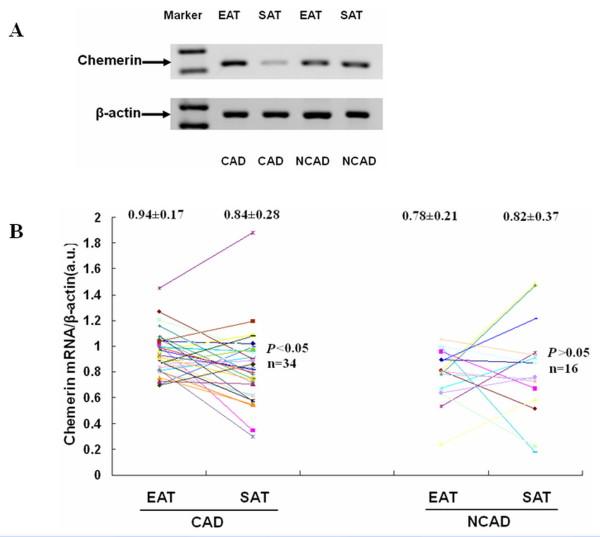
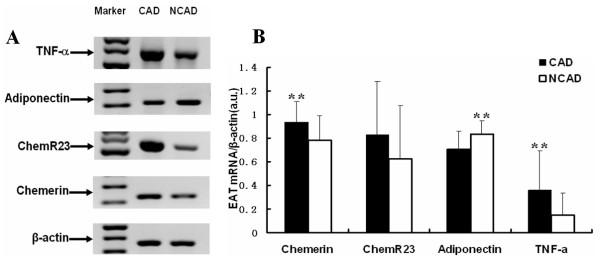
We found that EAT of CAD group showed significantly higher levels of chemerin and TNF-alpha mRNA, and significantly lower level of adiponectin mRNA than that of NCAD patients. In CAD group, significantly higher levels of chemerin mRNA and protein were observed in EAT than in paired subcutaneous adipose tissue (SAT), whereas such significant difference was not found in NCAD group. Chemerin mRNA expression in EAT was positively correlated with Gensini score (r = 0.365, P < 0.05), moreover, this correlation remained statistically significant (r = 0.357, P < 0.05) after adjusting for age, gender, BMI and waist circumference. Chemerin mRNA expression in EAT was also positively correlated with BMI (r = 0.305, P < 0.05), waist circumference (r = 0.384, P < 0.01), fasting blood glucose (r = 0.334, P < 0.05) and negatively correlated with adiponectin mRNA expression in EAT (r = -0.322, P < 0.05). However, there were no significant differences in the serum levels of chemerin or adiponectin between the two groups. Likewise, neither serum chemerin nor serum adiponectin was associated with Gensini score (P > 0.05).
CONCLUSIONS
The expressions of chemerin mRNA and protein are significantly higher in EAT from patients with CAD in Han Chinese patients. Furthermore, the severity of coronary atherosclerosis is positive correlated with the level of chemerin mRNA in EAT rather than its circulating level.
背景
越来越多的证据表明,心外膜脂肪组织(EAT)通过产生多种炎症脂肪因子,在心外膜脂肪组织(EAT)可能在冠心病(CAD)的发病机制和发展中发挥关键作用。趋化素是一种新型脂肪因子,据报道,它参与调节免疫反应和糖脂代谢。鉴于这些特性,趋化素可能为肥胖、炎症和动脉粥样硬化之间提供了一个有趣的联系。在这项研究中,我们试图确定趋化素在 EAT 中的表达与汉族冠心病患者冠状动脉粥样硬化严重程度之间的关系。
方法
从接受择期心脏手术的 CAD(n=37)和 NCAD(n=16)患者中获得血清和脂肪组织活检(心外膜和胸皮下)。使用 Gensini 评分评估 CAD 的严重程度。通过 ELISA 测量血清趋化素、脂联素和胰岛素水平。通过免疫组织化学检测脂肪组织中的趋化素蛋白表达。通过 RT-PCR 检测脂肪组织中趋化素、chemR23、脂联素和 TNF-α的 mRNA 水平。
结果
我们发现 CAD 组的 EAT 表现出明显更高水平的趋化素和 TNF-α mRNA,以及明显更低水平的脂联素 mRNA。在 CAD 组中,EAT 中的趋化素 mRNA 和蛋白水平明显高于配对的皮下脂肪组织(SAT),而在 NCAD 组中未发现这种显著差异。EAT 中的趋化素 mRNA 表达与 Gensini 评分呈正相关(r=0.365,P<0.05),此外,在调整年龄、性别、BMI 和腰围后,这种相关性仍然具有统计学意义(r=0.357,P<0.05)。EAT 中的趋化素 mRNA 表达也与 BMI(r=0.305,P<0.05)、腰围(r=0.384,P<0.01)、空腹血糖(r=0.334,P<0.05)呈正相关,与 EAT 中的脂联素 mRNA 表达呈负相关(r=-0.322,P<0.05)。然而,两组之间血清趋化素或脂联素水平无显著差异。同样,血清趋化素或血清脂联素与 Gensini 评分均无相关性(P>0.05)。
结论
汉族冠心病患者 EAT 中的趋化素 mRNA 和蛋白表达水平明显升高。此外,冠状动脉粥样硬化的严重程度与 EAT 中趋化素 mRNA 的水平呈正相关,而与循环趋化素水平无关。

 Zotero 插件