
同时激活副交感神经和交感神经显示,麻醉的高血压大鼠心率、血管张力和肾上腺素释放的自主控制发生改变。
Simultaneous parasympathetic and sympathetic activation reveals altered autonomic control of heart rate, vascular tension, and epinephrine release in anesthetized hypertensive rats.
作者信息
Berg Torill, Jensen Jørgen
机构信息
Department of Physiology, Institute of Basic Medical Sciences, University of Oslo Oslo, Norway.
出版信息
Front Neurol. 2011 Nov 23;2:71. doi: 10.3389/fneur.2011.00071. eCollection 2011.
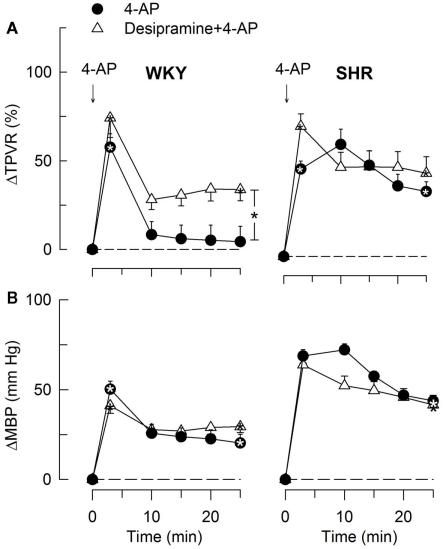
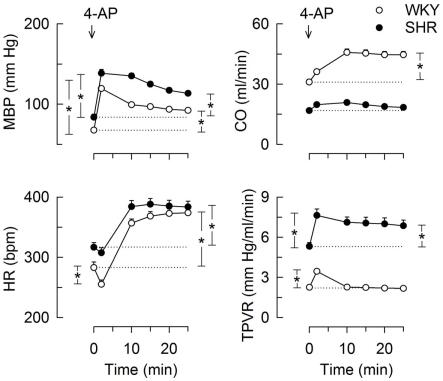
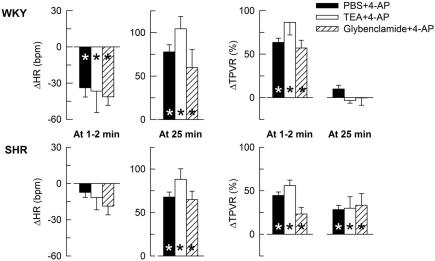
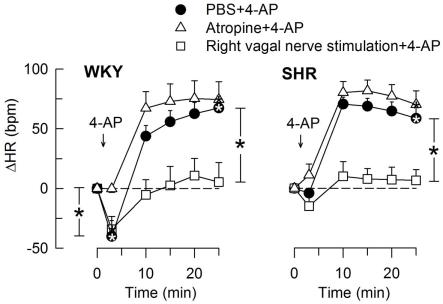
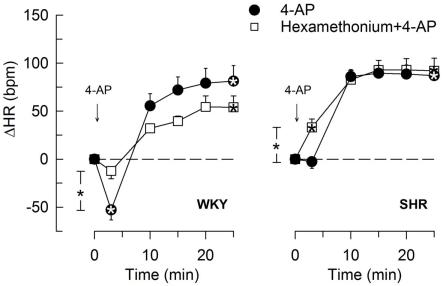
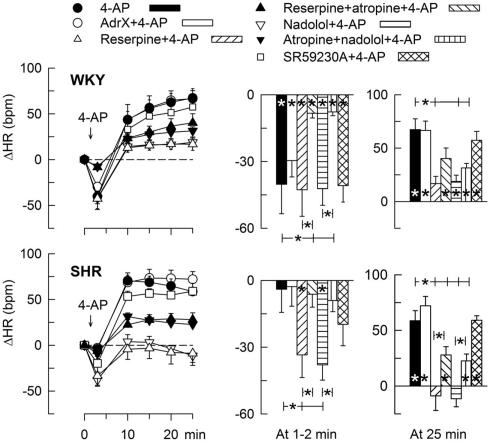
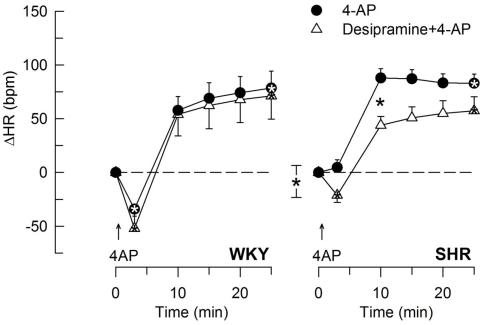
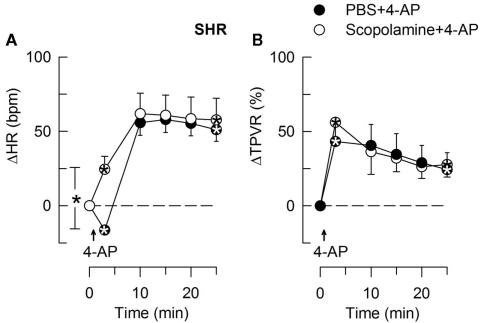
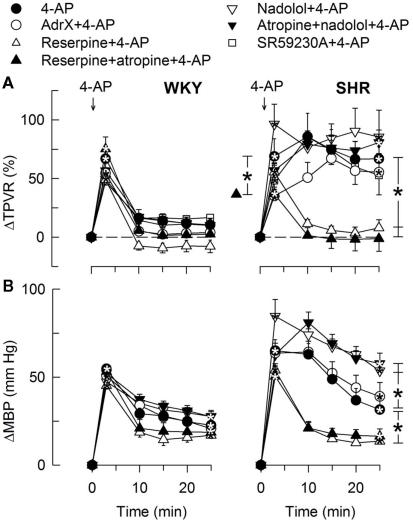
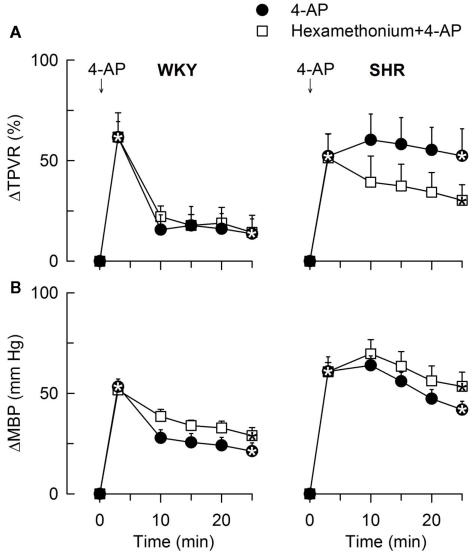
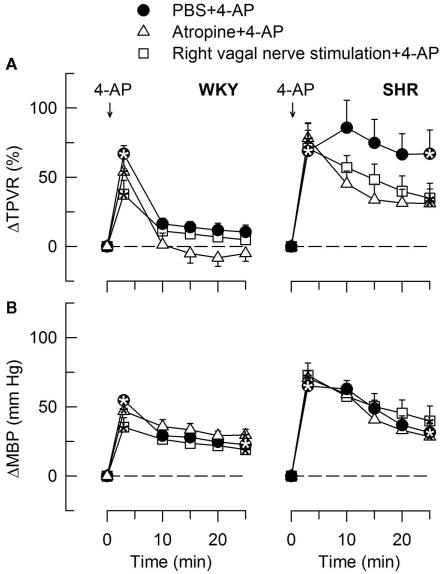
Sympathetic hyperactivity and parasympathetic insufficiency characterize blood pressure (BP) control in genetic hypertension. This shift is difficult to investigate in anesthetized rats. Here we present a pharmacological approach to simultaneously provoke sympathetic and parasympathetic transmitter release, and identify their respective roles in the concomitant cardiovascular response. To stimulate transmitter release in anesthetized normotensive (WKY) and spontaneously hypertensive rats (SHR), we injected intravenously 4-aminopyridine (4-AP), a voltage-sensitive K(+) channel (K(V)) inhibitor. A femoral artery catheter monitored BP, an ascending aorta flow-probe recorded cardiac output and heart rate (HR). Total peripheral vascular resistance (TPVR) was calculated. 4-AP-induced an immediate, atropine (muscarinic antagonist)- and hexamethonium (ganglion blocker)-sensitive bradycardia in WKY, and in both strains, a subsequent, sustained tachycardia, and norepinephrine but not epinephrine release. Reserpine (sympatholytic), nadolol (β-adrenoceptor antagonist) or right vagal nerve stimulation eliminated the late tachycardia, adrenalectomy, scopolamine (central muscarinic antagonist) or hexamethonium did not. 4-AP increased TPVR, transiently in WKY but sustained in SHR. Yohimbine (α(2)-adrenoceptor antagonist) prevented the TPVR down-regulation in WKY. Reserpine and prazosin (α(1)-adrenoceptor antagonist) eliminated the late vasoconstriction in SHR. Plasma epinephrine overflow increased in nadolol-treated SHR. Through inhibition of K(V), 4-AP activated parasympathetic ganglion transmission and peripheral, neuronal norepinephrine release. The sympathetic component dominated the 4-AP-HR-response in SHR. α(2)-adrenoceptor-dependent vasodilatation opposed norepinephrine-induced α(1)-adrenergic vasoconstriction in WKY, but not SHR. A βAR-activated, probably vagal afferent mechanism, hampered epinephrine secretion in SHR. Thus, 4-AP activated the autonomic system and exposed mechanisms relevant to hypertensive disease.
交感神经过度活跃和副交感神经功能不全是遗传性高血压血压控制的特征。这种转变在麻醉大鼠中很难研究。在此,我们提出一种药理学方法,可同时激发交感神经和副交感神经递质释放,并确定它们在伴随的心血管反应中的各自作用。为了刺激麻醉的正常血压大鼠(WKY)和自发性高血压大鼠(SHR)的递质释放,我们静脉注射了4-氨基吡啶(4-AP),一种电压敏感性钾(K(+))通道(K(V))抑制剂。股动脉导管监测血压,升主动脉流量探头记录心输出量和心率(HR)。计算总外周血管阻力(TPVR)。4-AP在WKY中引起立即的、对阿托品(毒蕈碱拮抗剂)和六甲铵(神经节阻滞剂)敏感的心动过缓,并且在两种品系中,随后出现持续的心动过速,以及去甲肾上腺素而非肾上腺素的释放。利血平(交感神经阻滞剂)、纳多洛尔(β-肾上腺素能受体拮抗剂)或右迷走神经刺激消除了晚期心动过速,而肾上腺切除术、东莨菪碱(中枢毒蕈碱拮抗剂)或六甲铵则没有。4-AP增加了TPVR,在WKY中是短暂的,但在SHR中是持续的。育亨宾(α(2)-肾上腺素能受体拮抗剂)阻止了WKY中TPVR的下调。利血平和哌唑嗪(α(1)-肾上腺素能受体拮抗剂)消除了SHR中的晚期血管收缩。在纳多洛尔治疗的SHR中,血浆肾上腺素溢出增加。通过抑制K(V),4-AP激活了副交感神经节传递和外周神经元去甲肾上腺素释放。在SHR中,交感神经成分主导了4-AP-HR反应。α(2)-肾上腺素能受体依赖性血管舒张在WKY中对抗去甲肾上腺素诱导的α(1)-肾上腺素能血管收缩,但在SHR中则不然。一种βAR激活的、可能是迷走神经传入机制阻碍了SHR中的肾上腺素分泌。因此,4-AP激活了自主神经系统并揭示了与高血压疾病相关的机制。

 Zotero 插件