
XRCC4 与 XLF 的相互作用是编码(而非信号)末端连接所必需的。
XRCC4's interaction with XLF is required for coding (but not signal) end joining.
机构信息
College of Veterinary Medicine and Departments of Microbiology & Molecular Genetics, Michigan State University, East Lansing, Michigan 48824, USA.
出版信息
Nucleic Acids Res. 2012 Feb;40(4):1684-94. doi: 10.1093/nar/gkr1315. Epub 2012 Jan 6.
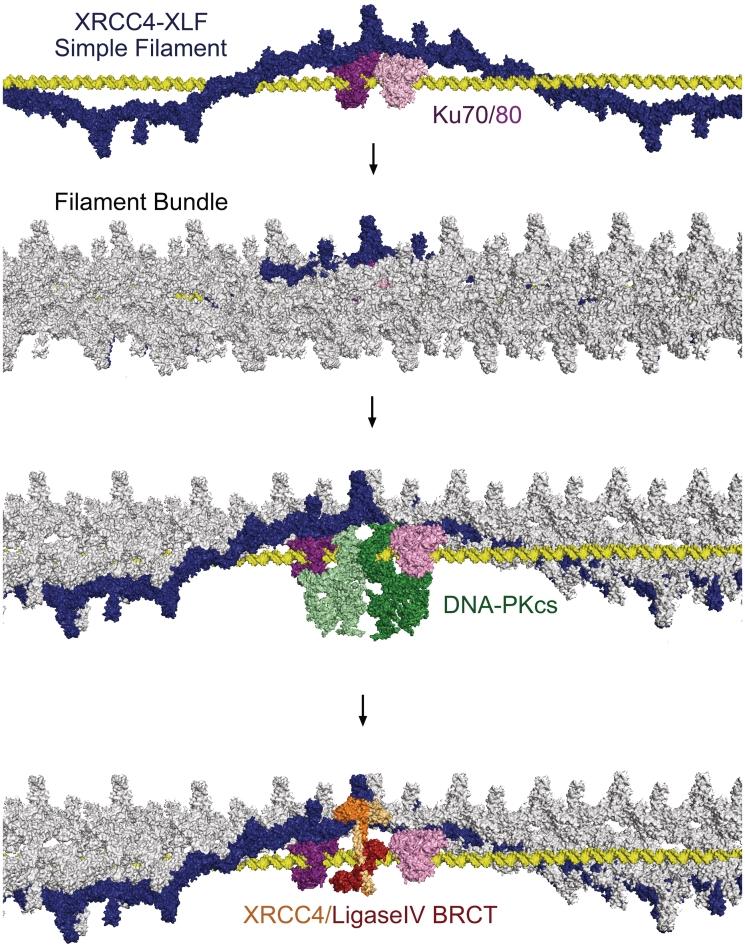
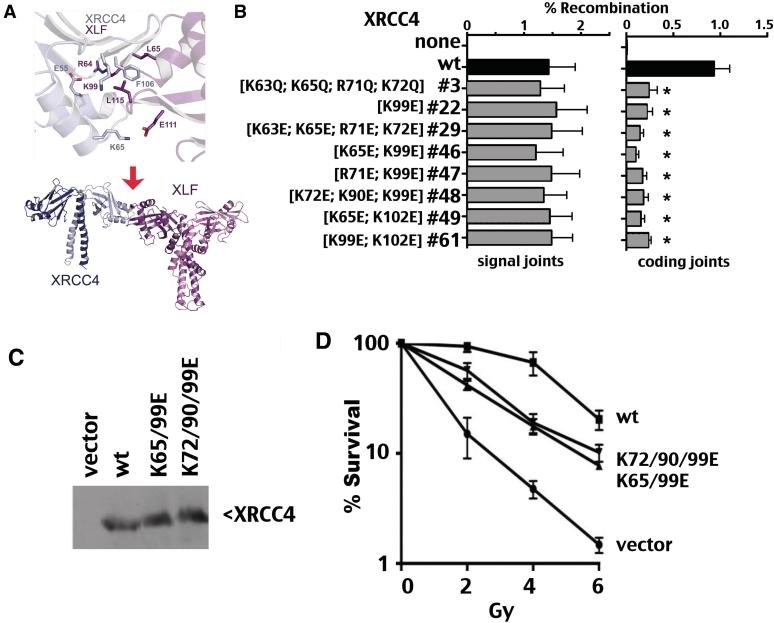
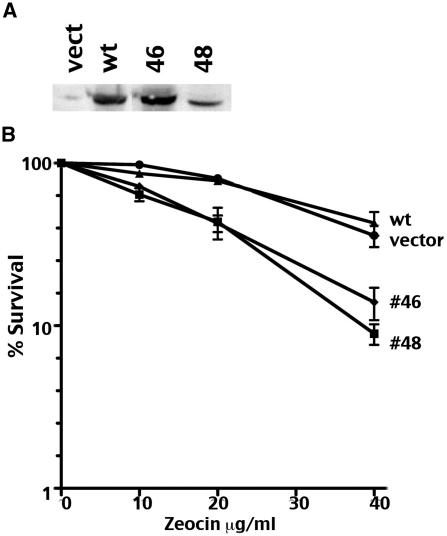
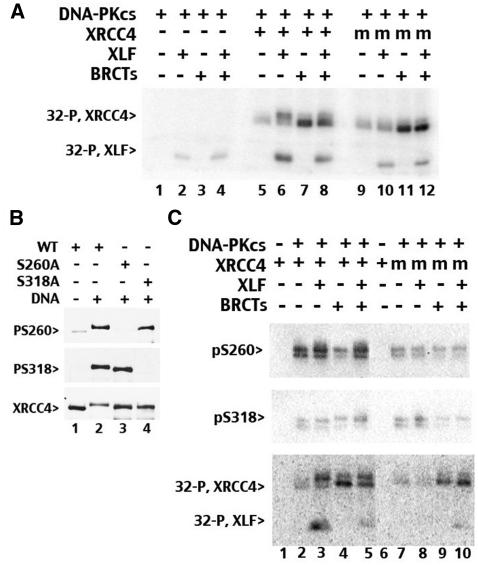
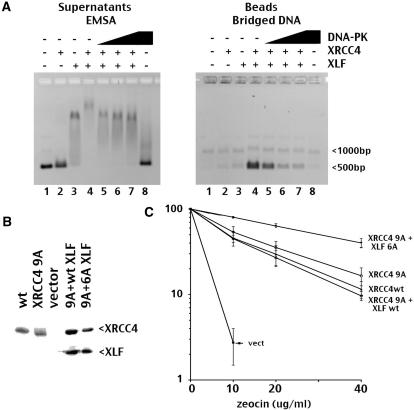
XRCC4 and XLF are structurally related proteins important for DNA Ligase IV function. XRCC4 forms a tight complex with DNA Ligase IV while XLF interacts directly with XRCC4. Both XRCC4 and XLF form homodimers that can polymerize as heterotypic filaments independently of DNA Ligase IV. Emerging structural and in vitro biochemical data suggest that XRCC4 and XLF together generate a filamentous structure that promotes bridging between DNA molecules. Here, we show that ablating XRCC4's affinity for XLF results in DNA repair deficits including a surprising deficit in VDJ coding, but not signal end joining. These data are consistent with a model whereby XRCC4/XLF complexes hold DNA ends together--stringently required for coding end joining, but dispensable for signal end joining. Finally, DNA-PK phosphorylation of XRCC4/XLF complexes disrupt DNA bridging in vitro, suggesting a regulatory role for DNA-PK's phosphorylation of XRCC4/XLF complexes.
XRC4 和 XLF 是对 DNA 连接酶 IV 功能至关重要的结构相关蛋白。XRC4 与 DNA 连接酶 IV 形成紧密复合物,而 XLF 则直接与 XRC4 相互作用。XRC4 和 XLF 都形成同源二聚体,可独立于 DNA 连接酶 IV 聚合为异源纤维。新兴的结构和体外生化数据表明,XRC4 和 XLF 共同形成一种纤维状结构,促进 DNA 分子之间的桥接。在这里,我们表明,消除 XRC4 与 XLF 的亲和力会导致 DNA 修复缺陷,包括 VDJ 编码的惊人缺陷,但信号末端连接不受影响。这些数据与以下模型一致,即 XRC4/XLF 复合物将 DNA 末端保持在一起——这对于编码末端连接是严格必需的,但对于信号末端连接是可有可无的。最后,DNA-PK 对 XRC4/XLF 复合物的磷酸化在体外破坏 DNA 桥接,这表明 DNA-PK 对 XRC4/XLF 复合物的磷酸化具有调节作用。
 Zotero 插件