
蛋白质-DNA 丝的协同组装用于非同源末端连接。
Cooperative assembly of a protein-DNA filament for nonhomologous end joining.
机构信息
Department of Medicine, Stanford University School of Medicine, Stanford, California 94305, USA.
出版信息
J Biol Chem. 2013 Jun 21;288(25):18110-20. doi: 10.1074/jbc.M113.464115. Epub 2013 Apr 25.
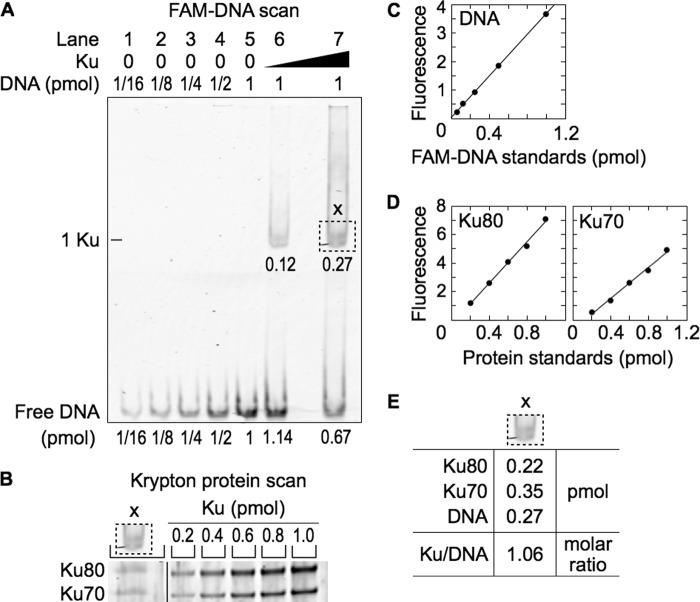
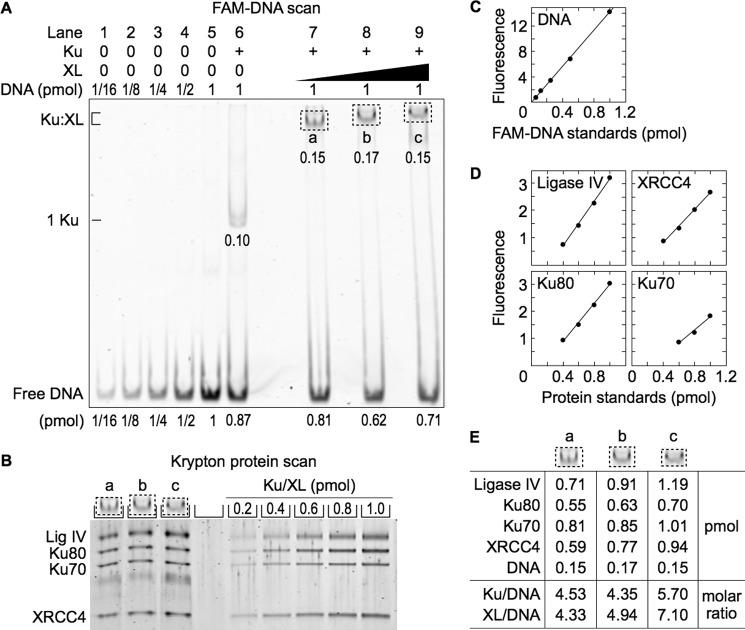
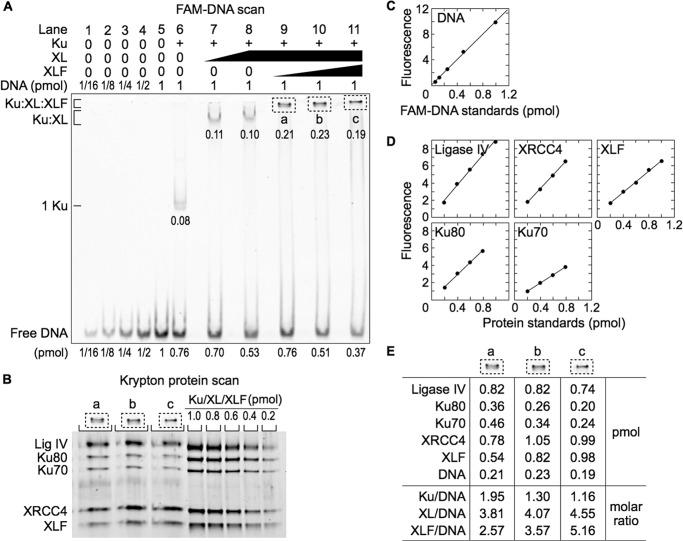
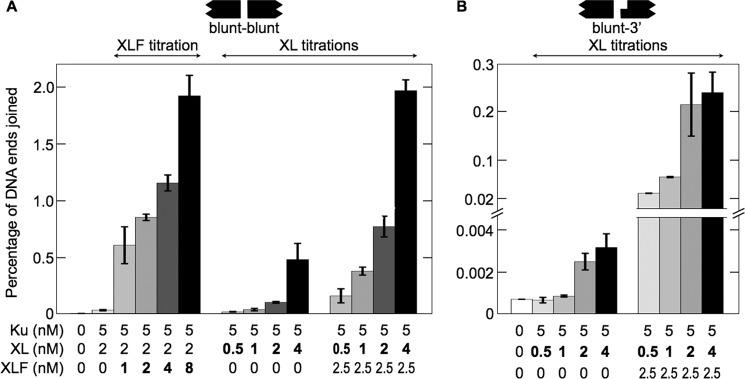
Nonhomologous end joining repairs DNA double-strand breaks created by ionizing radiation and V(D)J recombination. Ku, XRCC4/Ligase IV (XL), and XLF have a remarkable mismatched end (MEnd) ligase activity, particularly for ends with mismatched 3' overhangs, but the mechanism has remained obscure. Here, we showed XL required Ku to bind DNA, whereas XLF required both Ku and XL to bind DNA. We detected cooperative assembly of one or two Ku molecules and up to five molecules each of XL and XLF into a Ku-XL-XLF-DNA (MEnd ligase-DNA) complex. XLF mutations that disrupted its interactions with XRCC4 or DNA also disrupted complex assembly and end joining. Together with published co-crystal structures of truncated XRCC4 and XLF proteins, our data with full-length Ku, XL, and XLF bound to DNA indicate assembly of a filament containing Ku plus alternating XL and XLF molecules. By contrast, in the absence of XLF, we detected cooperative assembly of up to six molecules each of Ku and XL into a Ku-XL-DNA complex, consistent with a filament containing alternating Ku and XL molecules. Despite a lower molecular mass, MEnd ligase-DNA had a lower electrophoretic mobility than Ku-XL-DNA. The anomalous difference in mobility and difference in XL to Ku molar ratio suggests that MEnd ligase-DNA has a distinct structure that successfully aligns mismatched DNA ends for ligation.
非同源末端连接修复由电离辐射和 V(D)J 重组产生的 DNA 双链断裂。Ku、XRCC4/Ligase IV(XL)和 XLF 具有显著的错配末端(MEnd)连接酶活性,特别是对于具有错配 3'突出的末端,但机制仍不清楚。在这里,我们表明 XL 需要 Ku 结合 DNA,而 XLF 需要 Ku 和 XL 结合 DNA。我们检测到一个或两个 Ku 分子以及多达五个 XL 和 XLF 分子协同组装成 Ku-XL-XLF-DNA(MEnd 连接酶-DNA)复合物。破坏其与 XRCC4 或 DNA 相互作用的 XLF 突变也破坏了复合物的组装和末端连接。结合已发表的截短 XRCC4 和 XLF 蛋白的共结晶结构,我们的数据表明全长 Ku、XL 和 XLF 与 DNA 结合后组装成一个包含 Ku 加交替 XL 和 XLF 分子的纤维。相比之下,在没有 XLF 的情况下,我们检测到多达六个 Ku 和 XL 分子协同组装成 Ku-XL-DNA 复合物,这与包含交替 Ku 和 XL 分子的纤维一致。尽管分子量较低,但 MEnd 连接酶-DNA 的电泳迁移率低于 Ku-XL-DNA。迁移率的异常差异和 XL 与 Ku 摩尔比的差异表明,MEnd 连接酶-DNA 具有独特的结构,可以成功对齐错配的 DNA 末端进行连接。



 Zotero 插件