
抑制 AKT2 通过调节 PUMA 和 NF-κB 信号通路增强人胰腺导管腺癌对吉西他滨的敏感性。
Inhibition of AKT2 enhances sensitivity to gemcitabine via regulating PUMA and NF-κB signaling pathway in human pancreatic ductal adenocarcinoma.
机构信息
Department of General Surgery, The Affiliated Hospital of Medical College, Qingdao University, Qingdao 266003, China.
Department of Pharmacy, The Affiliated Hospital of Medical College, Qingdao University,Qingdao 266003, China.
出版信息
Int J Mol Sci. 2012;13(1):1186-1208. doi: 10.3390/ijms13011186. Epub 2012 Jan 20.
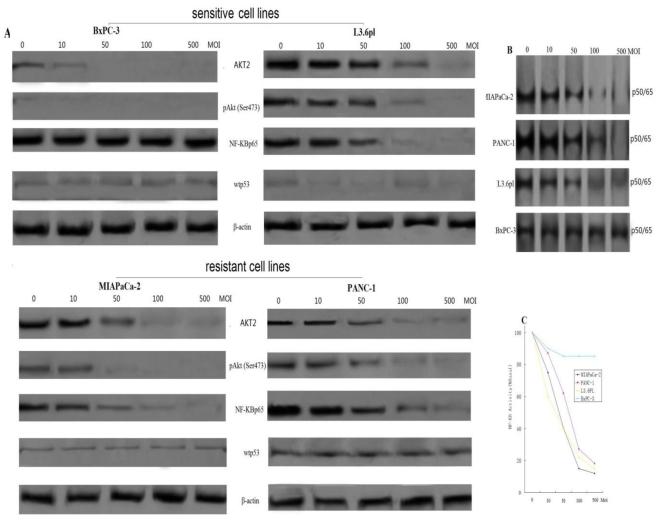
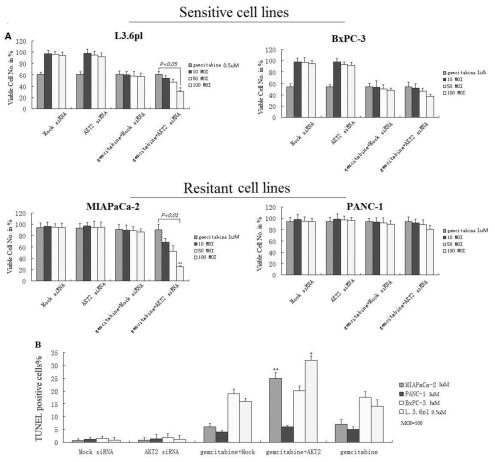
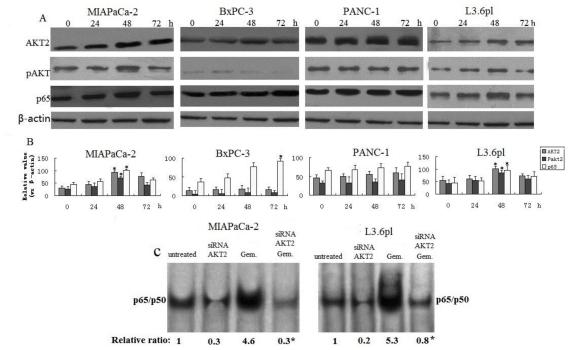
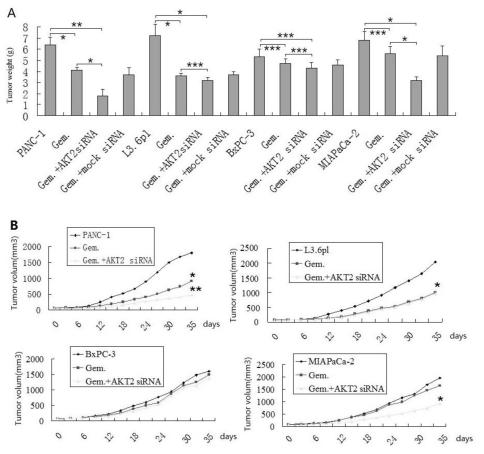
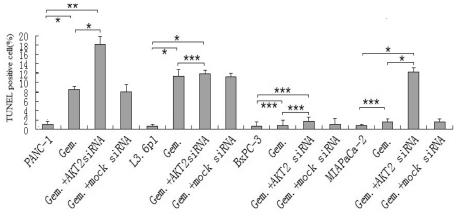
Invasion, metastasis and resistance to conventional chemotherapeutic agents are obstacles to successful treatment of pancreatic cancer, and a better understanding of the molecular basis of this malignancy may lead to improved therapeutics. In the present study, we investigated whether AKT2 silencing sensitized pancreatic cancer L3.6pl, BxPC-3, PANC-1 and MIAPaCa-2 cells to gemcitabine via regulating PUMA (p53-upregulated modulator of apoptosis) and nuclear factor (NF)-κB signaling pathway. MTT, TUNEL, EMSA and NF-κB reporter assays were used to detect tumor cell proliferation, apoptosis and NF-κB activity. Western blotting was used to detect different protein levels. Xenograft of established tumors was used to evaluate primary tumor growth and apoptosis after treatment with gemcitabine alone or in combination with AKT2 siRNA. Gemcitabine activated AKT2 and NF-κB in MIAPaCa-2 and L3.6pl cells in vitro or in vivo, and in PANC-1 cells only in vivo. Gemcitabine only activated NF-κB in BxPC-3 cells in vitro. The presence of PUMA was necessary for gemcitabine-induced apoptosis only in BxPC-3 cells in vitro. AKT2 inhibition sensitized gemcitabine-induced apoptosis via PUMA upregulation in MIAPaCa-2 cells in vitro, and via NF-κB activity inhibition in L3.6pl cells in vitro. In PANC-1 and MIAPaCa-2 cells in vivo, AKT2 inhibition sensitized gemcitabine-induced apoptosis and growth inhibition via both PUMA upregulation and NF-κB inhibition. We suggest that AKT2 inhibition abrogates gemcitabine-induced activation of AKT2 and NF-κB, and promotes gemcitabine-induced PUMA upregulation, resulting in chemosensitization of pancreatic tumors to gemcitabine, which is probably an important strategy for the treatment of pancreatic cancer.
侵袭、转移和对常规化疗药物的耐药性是胰腺癌成功治疗的障碍,更好地了解这种恶性肿瘤的分子基础可能会导致治疗方法的改进。在本研究中,我们研究了 AKT2 沉默是否通过调节 PUMA(p53 上调凋亡调节剂)和核因子(NF)-κB 信号通路使胰腺癌细胞 L3.6pl、BxPC-3、PANC-1 和 MIAPaCa-2 对吉西他滨敏感。MTT、TUNEL、EMSA 和 NF-κB 报告基因分析用于检测肿瘤细胞增殖、凋亡和 NF-κB 活性。Western blot 用于检测不同的蛋白质水平。建立的肿瘤移植用于评估单独使用吉西他滨或与 AKT2 siRNA 联合治疗后原发性肿瘤的生长和凋亡。吉西他滨在体外或体内激活 MIAPaCa-2 和 L3.6pl 细胞中的 AKT2 和 NF-κB,而仅在体内激活 PANC-1 细胞中的 AKT2 和 NF-κB。吉西他滨仅在体外激活 BxPC-3 细胞中的 NF-κB。只有在体外的 BxPC-3 细胞中,PUMA 的存在是吉西他滨诱导凋亡所必需的。在体外,AKT2 抑制通过上调 PUMA 使吉西他滨诱导的 MIAPaCa-2 细胞凋亡敏感,而在体外,通过抑制 NF-κB 活性使 L3.6pl 细胞凋亡敏感。在体内的 PANC-1 和 MIAPaCa-2 细胞中,AKT2 抑制通过上调 PUMA 和抑制 NF-κB 使吉西他滨诱导的凋亡和生长抑制敏感。我们认为 AKT2 抑制消除了吉西他滨诱导的 AKT2 和 NF-κB 的激活,并促进了吉西他滨诱导的 PUMA 上调,从而使胰腺肿瘤对吉西他滨产生化疗敏感性,这可能是治疗胰腺癌的重要策略。



 Zotero 插件