
抗原呈递细胞在丝状病毒出血热中的作用:现有知识的空白。
The role of antigen-presenting cells in filoviral hemorrhagic fever: gaps in current knowledge.
机构信息
Department of Microbiology, Mount Sinai School of Medicine, New York, NY 10029, USA.
出版信息
Antiviral Res. 2012 Mar;93(3):416-28. doi: 10.1016/j.antiviral.2012.01.011. Epub 2012 Feb 8.
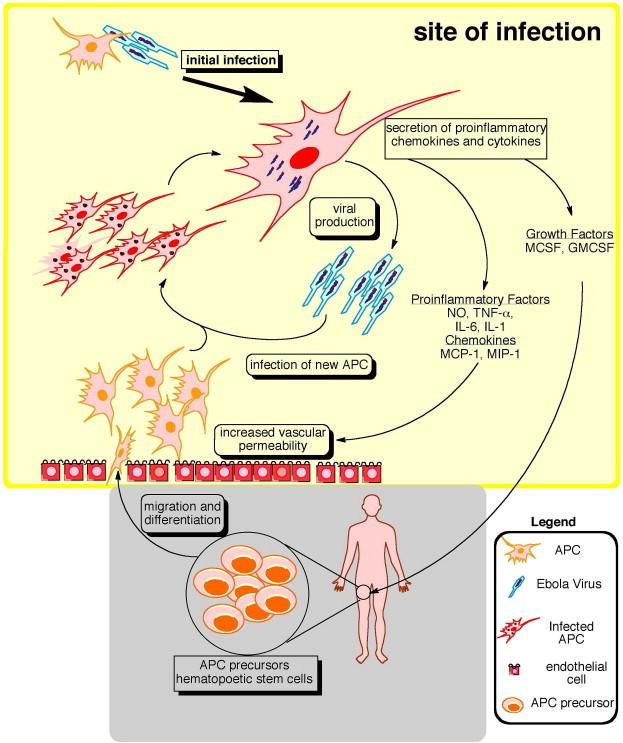
The filoviruses, Ebola virus (EBOV) and Marburg virus (MARV), are highly lethal zoonotic agents of concern as emerging pathogens and potential bioweapons. Antigen-presenting cells (APCs), particularly macrophages and dendritic cells, are targets of filovirus infection in vivo. Infection of these cell types has been proposed to contribute to the inflammation, activation of coagulation cascades and ineffective immune responses characteristic of filovirus hemorrhagic fever. However, many aspects of filovirus-APC interactions remain to be clarified. Among the unanswered questions: What determines the ability of filoviruses to replicate in different APC subsets? What are the cellular signaling pathways that sense infection and lead to production of copious quantities of cytokines, chemokines and tissue factor? What are the mechanisms by which innate antiviral responses are disabled by these viruses, and how may these mechanisms contribute to inadequate adaptive immunity? A better understanding of these issues will clarify the pathogenesis of filoviral hemorrhagic fever and provide new avenues for development of therapeutics.
丝状病毒,埃博拉病毒(EBOV)和马尔堡病毒(MARV),是高致死性的人畜共患病原体,被认为是新兴的病原体和潜在的生物武器。抗原呈递细胞(APCs),特别是巨噬细胞和树突状细胞,是丝状病毒在体内感染的靶标。据推测,这些细胞类型的感染会导致炎症、凝血级联的激活和丝状病毒出血热的无效免疫反应。然而,丝状病毒与 APC 相互作用的许多方面仍有待阐明。在未解答的问题中:是什么决定了丝状病毒在不同 APC 亚群中复制的能力?是什么细胞信号通路感知感染并导致大量细胞因子、趋化因子和组织因子的产生?这些病毒是如何使先天抗病毒反应失活的,这些机制如何导致适应性免疫不足?更好地理解这些问题将阐明丝状病毒出血热的发病机制,并为治疗方法的开发提供新的途径。
 Zotero 插件