
糖化血红蛋白 A1c 和血糖水平在发展中南方中国人群中确定的糖尿病和糖尿病前期。
Diabetes and pre-diabetes as determined by glycated haemoglobin A1c and glucose levels in a developing southern Chinese population.
机构信息
Centre for Disease Control and Prevention of Guangdong Province, Guangzhou, China.
出版信息
PLoS One. 2012;7(5):e37260. doi: 10.1371/journal.pone.0037260. Epub 2012 May 15.
BACKGROUND
The American Diabetes Association and World Health Organization have recently adopted the HbA1c measurement as one method of diagnostic criteria for diabetes. The change in diagnostic criteria has important implications for diabetes treatment and prevention. We therefore investigate diabetes using HbA1c and glucose criteria together, and assess the prevalent trend in a developing southern Chinese population with 85 million residents.
METHODS
A stratified multistage random sampling method was applied and a representative sample of 3590 residents 18 years of age or above was obtained in 2010. Each participant received a full medical check-up, including measurement of fasting plasma glucose, 2-hour post-load plasma glucose, and HbA1c. Information on history of diagnosis and treatment of diabetes was collected. The prevalence of diabetes obtained from the present survey was compared with the data from the survey in 2002.
RESULTS
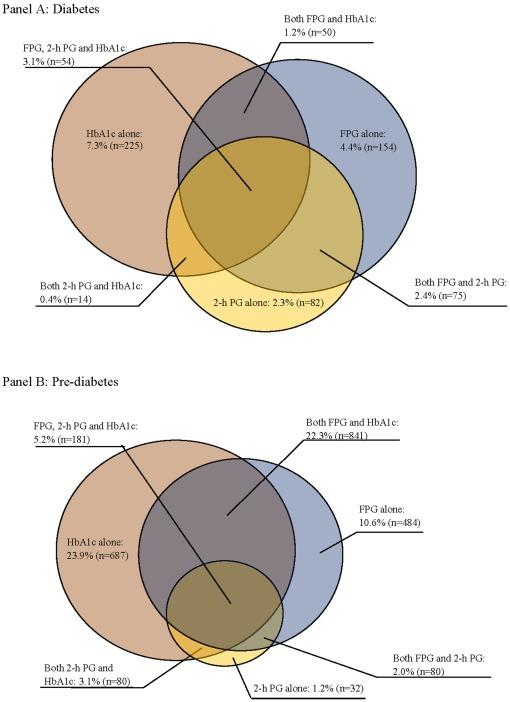
The prevalence of diabetes based on both glucose and HbA1c measurements was 21.7% (95% CI: 17.4%-26.1%) in 2010, which suggests that more than 1 in 5 adult residents were suffering from diabetes in this developing population. Only 12.9% (95% CI: 8.3%-17.6%) of diabetic residents were aware of their condition. The prevalence of pre-diabetes was 66.3% (95% CI: 62.7%-69.8%). The prevalence of diabetes and pre-diabetes which met all the three diagnostic thresholds (fast plasma glucose, 2 hour post-load plasma glucose, and HbA1c) was 3.1% and 5.2%, respectively. Diabetes and pre-diabetes as determined by HbA1c measurement had higher vascular risk than those determined by glucose levels. The prevalence of diabetes increased from 2.9% (95% CI: 2.0%-3.7%) in 2002 to 13.8% (95% CI: 10.2%-17.3%) in 2010 based on the same glucose criteria.
CONCLUSIONS
Our results show that the diabetes epidemic is accelerating in China. The awareness of diabetes is extremely low. The glucose test and HbA1c measurement should be used together to increase detection of diabetes and pre-diabetes.
背景
美国糖尿病协会和世界卫生组织最近将 HbA1c 测量作为诊断糖尿病的标准之一。诊断标准的改变对糖尿病的治疗和预防具有重要意义。因此,我们同时使用 HbA1c 和血糖标准来研究糖尿病,并评估一个拥有 8500 万居民的南方发展中国家的流行趋势。
方法
采用分层多阶段随机抽样方法,于 2010 年抽取了 3590 名年龄在 18 岁及以上的代表性居民。每位参与者都接受了全面的体检,包括空腹血糖、餐后 2 小时血糖和 HbA1c 的测量。收集了有关糖尿病诊断和治疗史的信息。将本次调查获得的糖尿病患病率与 2002 年调查数据进行了比较。
结果
2010 年,根据血糖和 HbA1c 测量结果,糖尿病的患病率为 21.7%(95%CI:17.4%-26.1%),这表明在这个发展中国家,超过五分之一的成年居民患有糖尿病。只有 12.9%(95%CI:8.3%-17.6%)的糖尿病患者知晓自己的病情。糖尿病前期的患病率为 66.3%(95%CI:62.7%-69.8%)。符合所有三个诊断阈值(空腹血糖、餐后 2 小时血糖和 HbA1c)的糖尿病和糖尿病前期的患病率分别为 3.1%和 5.2%。根据 HbA1c 测量结果确定的糖尿病和糖尿病前期的血管风险高于根据血糖水平确定的结果。根据相同的血糖标准,2002 年糖尿病的患病率为 2.9%(95%CI:2.0%-3.7%),2010 年上升至 13.8%(95%CI:10.2%-17.3%)。
结论
我们的结果表明,中国的糖尿病流行正在加速。糖尿病的知晓率极低。应同时使用血糖检测和 HbA1c 测量来提高对糖尿病和糖尿病前期的检出率。
 Zotero 插件