
与空腹血糖受损、葡萄糖耐量受损和糖化血红蛋白升高的糖尿病前期进行目标性预防相关的因素:一项基于人群的纵向研究。
Factors correlated with targeted prevention for prediabetes classified by impaired fasting glucose, impaired glucose tolerance, and elevated HbA1c: A population-based longitudinal study.
机构信息
Key Laboratory of Environment Medicine and Engineering of Ministry of Education, Department of Epidemiology and Health Statistics, School of Public Health, Southeast University, Nanjing, China.
School of Software, Fudan University, Shanghai, China.
出版信息
Front Endocrinol (Lausanne). 2022 Aug 22;13:965890. doi: 10.3389/fendo.2022.965890. eCollection 2022.
BACKGROUND
There is still controversy surrounding the precise characterization of prediabetic population. We aim to identify and examine factors of demographic, behavioral, clinical, and biochemical characteristics, and obesity indicators (anthropometric characteristics and anthropometric prediction equation) for prediabetes according to different definition criteria of the American Diabetes Association (ADA) in the Chinese population.
METHODS
A longitudinal study consisted of baseline survey and two follow-ups was conducted, and a pooled data were analyzed. Prediabetes was defined as either impaired fasting glucose (IFG), impaired glucose tolerance (IGT), or elevated glycosylated hemoglobin (HbA1c) according to the ADA criteria. Robust generalized estimating equation models were used.
RESULTS
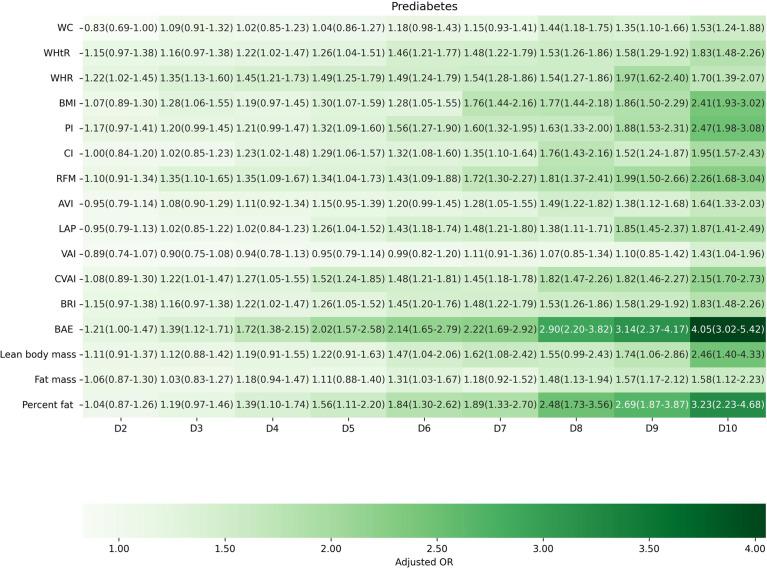
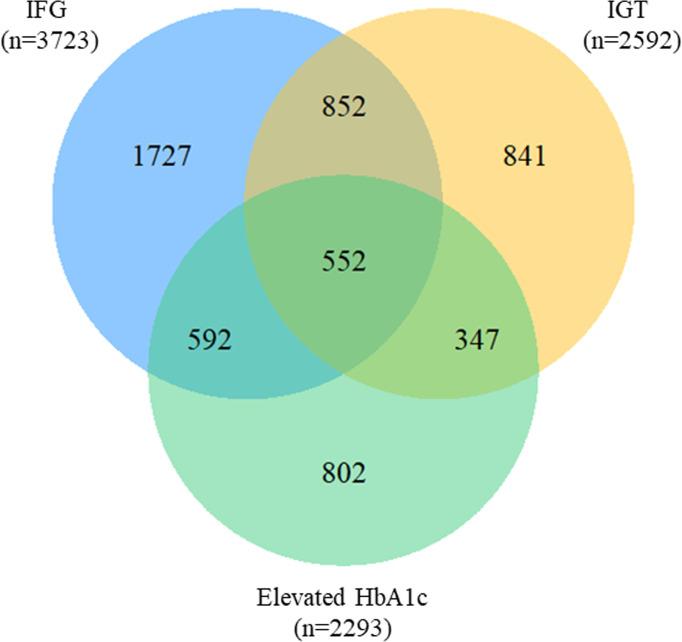
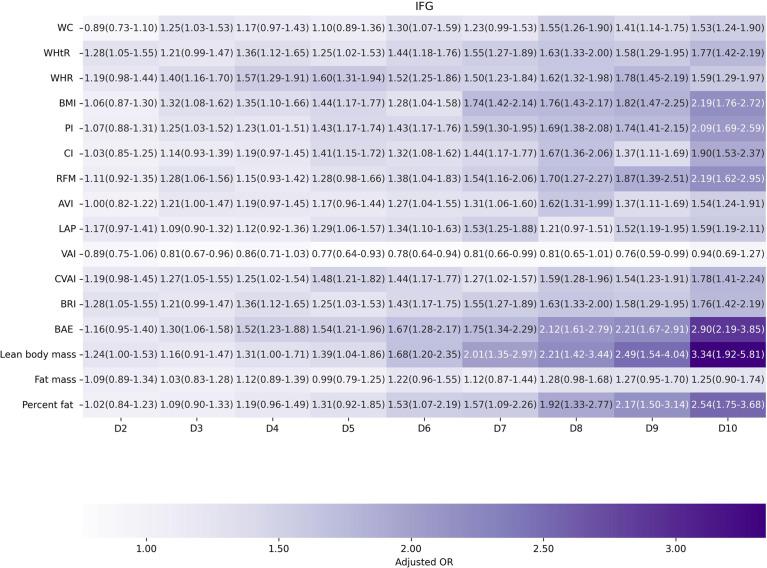
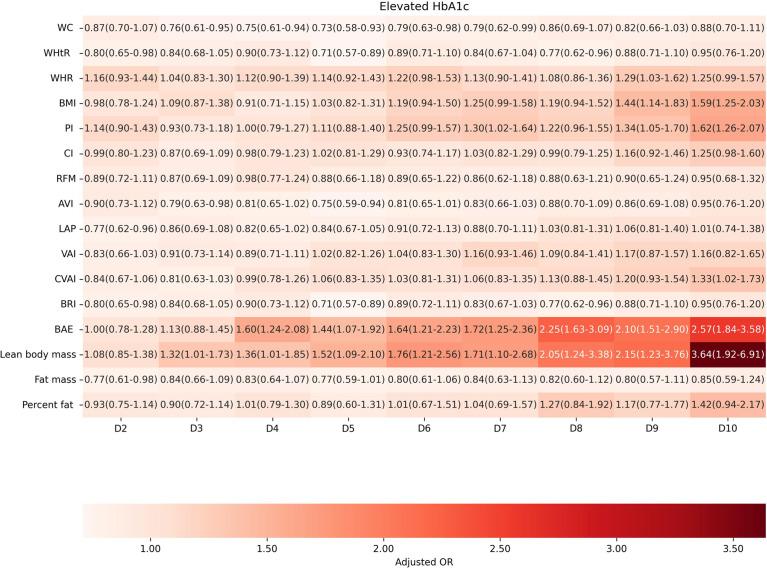
A total of 5,713 (58.42%) observations were prediabetes (IGT, 38.07%; IGT, 26.51%; elevated HbA1c, 23.45%); 9.66% prediabetes fulfilled all the three ADA criteria. Among demographic characteristics, higher age was more evident in elevated HbA1c [adjusted OR (aOR)=2.85]. Female individuals were less likely to have IFG (aOR=0.70) and more likely to suffer from IGT than male individuals (aOR=1.41). Several inconsistency correlations of biochemical characteristics and obesity indicators were detected by prediabetes criteria. Body adiposity estimator exhibited strong association with prediabetes (D10: aOR=4.05). For IFG and elevated HbA1c, the odds of predicted lean body mass exceed other indicators (D10: aOR=3.34; aOR=3.64). For IGT, predicted percent fat presented the highest odds (D10: aOR=6.58).
CONCLUSION
Some correlated factors of prediabetes under different criteria differed, and obesity indicators were easily measured for target identification. Our findings could be used for targeted intervention to optimize preventions to mitigate the obviously increased prevalence of diabetes.
背景
对于糖尿病前期人群的准确特征仍存在争议。我们旨在根据美国糖尿病协会(ADA)不同的定义标准,确定并检查中国人群中与糖尿病前期相关的人口统计学、行为、临床和生化特征以及肥胖指标(人体测量特征和人体测量预测方程)的相关因素。
方法
进行了一项包括基线调查和两次随访的纵向研究,并对汇总数据进行了分析。根据 ADA 标准,糖尿病前期被定义为空腹血糖受损(IFG)、葡萄糖耐量受损(IGT)或糖化血红蛋白升高(HbA1c)。采用稳健广义估计方程模型进行分析。
结果
共有 5713 例(58.42%)观察结果为糖尿病前期(IGT 占 38.07%,IGT 占 26.51%,HbA1c 升高占 23.45%);9.66%的糖尿病前期符合 ADA 的所有三项标准。在人口统计学特征方面,HbA1c 升高者的年龄较大(调整后的比值比[aOR]=2.85)。女性发生 IFG 的可能性较小(aOR=0.70),而发生 IGT 的可能性高于男性(aOR=1.41)。通过糖尿病前期标准检测到生化特征和肥胖指标之间存在一些不一致的相关性。体脂估算值与糖尿病前期具有很强的相关性(D10:aOR=4.05)。对于 IFG 和 HbA1c 升高,预测瘦体重的几率超过其他指标(D10:aOR=3.34;aOR=3.64)。对于 IGT,预测的体脂百分比呈现出最高的几率(D10:aOR=6.58)。
结论
不同标准下糖尿病前期的一些相关因素存在差异,肥胖指标易于测量,可用于目标识别。我们的研究结果可用于有针对性的干预,以优化预防措施,降低糖尿病明显上升的患病率。


 Zotero 插件