
一种逆代谢工程方法,用于设计改良的大肠杆菌宿主平台,以过表达重组蛋白。
An inverse metabolic engineering approach for the design of an improved host platform for over-expression of recombinant proteins in Escherichia coli.
机构信息
School of Biotechnology, Jawaharlal Nehru University, New Delhi, India.
出版信息
Microb Cell Fact. 2012 Jul 3;11:93. doi: 10.1186/1475-2859-11-93.
BACKGROUND
A useful goal for metabolic engineering would be to generate non-growing but metabolically active quiescent cells which would divert the metabolic fluxes towards product formation rather than growth. However, for products like recombinant proteins, which are intricately coupled to the growth process it is difficult to identify the genes that need to be knocked-out/knocked-in to get this desired phenotype. To circumvent this we adopted an inverse metabolic engineering strategy which would screen for the desired phenotype and thus help in the identification of genetic targets which need to be modified to get overproducers of recombinant protein. Such quiescent cells would obviate the need for high cell density cultures and increase the operational life span of bioprocesses.
RESULTS
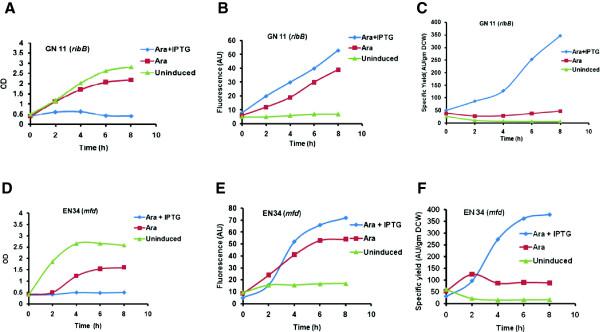
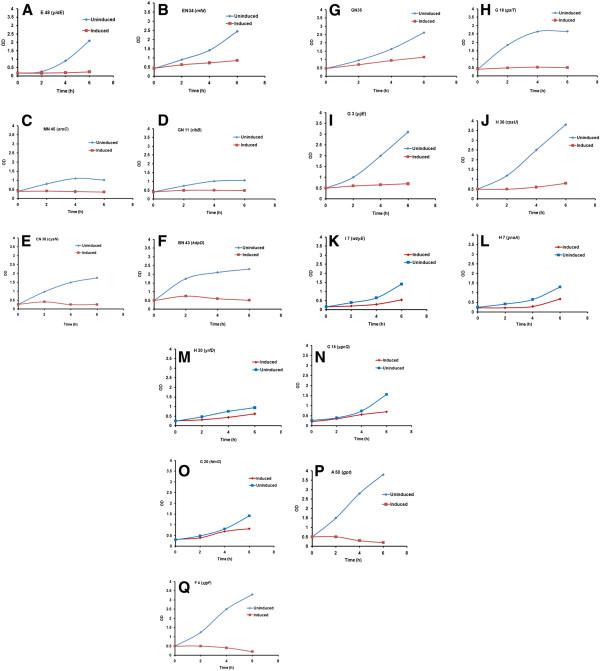
A novel strategy for generating a library, consisting of randomly down regulated metabolic pathways in E. coli was designed by cloning small genomic DNA fragments in expression vectors. Some of these DNA fragments got inserted in the reverse orientation thereby generating anti-sense RNA upon induction. These anti-sense fragments would hybridize to the sense mRNA of specific genes leading to gene 'silencing'. This library was first screened for slow growth phenotype and subsequently for enhanced over-expression ability. Using Green Fluorescent Protein (GFP) as a reporter protein on second plasmid, we were able to identify metabolic blocks which led to significant increase in expression levels. Thus down-regulating the ribB gene (3, 4 dihydroxy-2-butanone-4-phosphate synthase) led to a 7 fold increase in specific product yields while down regulating the gene kdpD (histidine kinase) led to 3.2 fold increase in specific yields.
CONCLUSION
We have designed a high throughput screening approach which is a useful tool in the repertoire of reverse metabolic engineering strategies for the generation of improved hosts for recombinant protein expression.
背景
代谢工程的一个有用目标是生成非生长但代谢活跃的静止细胞,使代谢通量转向产物形成而不是生长。然而,对于像重组蛋白这样与生长过程紧密偶联的产物,很难确定需要敲除/敲入哪些基因才能获得所需的表型。为了克服这一问题,我们采用了反向代谢工程策略,该策略将筛选所需的表型,从而有助于确定需要修饰的遗传靶标,以获得重组蛋白的高产菌。这种静止细胞将避免高密度培养的需要,并增加生物过程的运行寿命。
结果
设计了一种新的策略,通过在表达载体中克隆小基因组 DNA 片段,生成大肠杆菌中随机下调的代谢途径文库。这些 DNA 片段中的一些以反向插入,从而在诱导时产生反义 RNA。这些反义片段将与特定基因的有义 mRNA 杂交,导致基因“沉默”。该文库首先筛选缓慢生长表型,然后筛选增强的过表达能力。使用绿色荧光蛋白(GFP)作为第二个质粒上的报告蛋白,我们能够鉴定导致表达水平显著增加的代谢阻断。因此,下调 ribB 基因(3,4 二羟基-2-丁酮-4-磷酸合酶)可使特定产物产量增加 7 倍,而下调 kdpD 基因(组氨酸激酶)可使特定产物产量增加 3.2 倍。
结论
我们设计了一种高通量筛选方法,这是反向代谢工程策略组合中的一种有用工具,可用于生成用于重组蛋白表达的改良宿主。
 Zotero 插件