
通过对静止期大肠杆菌培养物进行“组学”分析来鉴定蛋白质过表达的基因组靶点。
Identifying genomic targets for protein over-expression by "omics" analysis of Quiescent Escherichia coli cultures.
作者信息
Mahalik Shubhashree, Sharma Ashish Kumar, Jain Priyanka, Mukherjee Krishna Jyoti
机构信息
School of Biotechnology, Jawaharlal Nehru University, New Delhi, 110067, India.
出版信息
Microb Cell Fact. 2017 Jul 28;16(1):133. doi: 10.1186/s12934-017-0744-3.
BACKGROUND
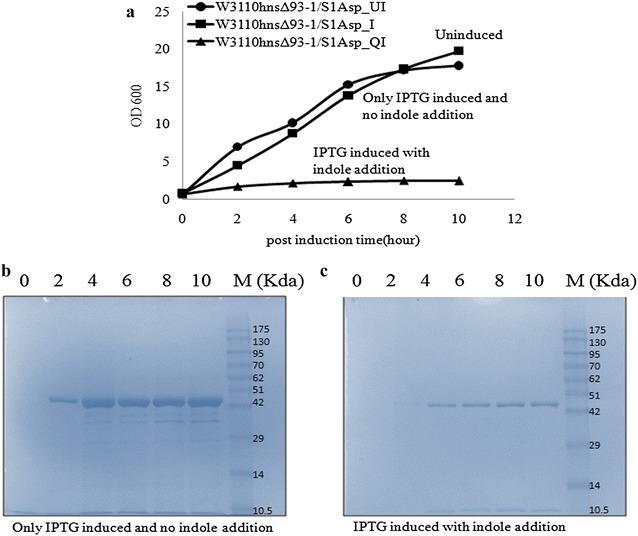
A cellular stress response is triggered upon induction of recombinant protein expression which feedback inhibits both growth as well as protein synthesis. In order to separate these two effects, it was decided to study "quiescent cultures" which continue to be metabolically active and express recombinant proteins even after growth cessation. The idea was to identify and up-regulate genes which are responsible for protein synthesis in the absence of growth. This would ensure that, even if growth were adversely affected post induction, there would be no attendant reduction in the protein expression capability of the cells. This strategy allowed us to design host strains, which did not grow better post induction but had significantly higher levels of protein expression.
RESULTS
A quiescent Escherichia coli culture, which is able to sustain recombinant protein expression in the absence of growth, was analyzed by transcriptomic and proteomic profiling. Many genes involved in carbon utilization, biosynthesis of building blocks and stress protection were found to be up-regulated in the quiescent phase. Analysis of the global regulators showed that fis, which tends to get down-regulated as the cells enter stationary phase, remained up-regulated throughout the non-growing quiescent phase. The downstream genes regulated by fis like carB, fadB, nrfA, narH and queA were also up-regulated in the quiescent phase which could be the reason behind the higher metabolic activity and protein expression ability of these non-growing cells. To test this hypothesis, we co-expressed fis in a control culture expressing recombinant L-asparaginase and observed a significantly higher buildup of L-asparaginase in the culture medium.
CONCLUSIONS
This work represents an important breakthrough in the design of a superior host platform where a gene not directly associated with protein synthesis was used to generate a phenotype having higher protein expression capability. Many alternative gene targets were also identified which may have beneficial effects on expression ability.
背景
重组蛋白表达诱导时会触发细胞应激反应,该反应会反馈抑制生长及蛋白质合成。为了区分这两种效应,决定研究“静止培养物”,即使在生长停止后,它们仍保持代谢活性并表达重组蛋白。目的是鉴定并上调在无生长情况下负责蛋白质合成的基因。这将确保即使诱导后生长受到不利影响,细胞的蛋白质表达能力也不会随之降低。该策略使我们能够设计宿主菌株,这些菌株诱导后生长情况并未改善,但蛋白质表达水平显著提高。
结果
通过转录组学和蛋白质组学分析了一种能够在无生长情况下维持重组蛋白表达的静止大肠杆菌培养物。发现许多参与碳利用、构件生物合成和应激保护的基因在静止期上调。对全局调节因子的分析表明,随着细胞进入稳定期往往会下调的fis,在整个非生长静止期都保持上调。受fis调控的下游基因如carB、fadB、nrfA、narH和queA在静止期也上调,这可能是这些非生长细胞具有较高代谢活性和蛋白质表达能力的原因。为了验证这一假设,我们在表达重组L-天冬酰胺酶的对照培养物中共表达fis,观察到培养基中L-天冬酰胺酶的积累显著增加。
结论
这项工作代表了在设计优质宿主平台方面的一项重要突破,即利用一个与蛋白质合成无直接关联的基因产生具有更高蛋白质表达能力的表型。还鉴定出许多可能对表达能力有有益影响的替代基因靶点。



 Zotero 插件