
戒烟后吸烟者体重增加:荟萃分析。
Weight gain in smokers after quitting cigarettes: meta-analysis.
机构信息
Centre d'Enseignement, de Recherche et de Traitement des Addictions, Hôpital Paul Brousse, AP-HP, Univ Paris-Sud, INSERM U669, 94804 Villejuif, France.
出版信息
BMJ. 2012 Jul 10;345:e4439. doi: 10.1136/bmj.e4439.
OBJECTIVE
To describe weight gain and its variation in smokers who achieve prolonged abstinence for up to 12 months and who quit without treatment or use drugs to assist cessation.
DESIGN
Meta-analysis.
DATA SOURCES
We searched the Central Register of Controlled Trials (CENTRAL) and trials listed in Cochrane reviews of smoking cessation interventions (nicotine replacement therapy, nicotinic partial agonists, antidepressants, and exercise) for randomised trials of first line treatments (nicotine replacement therapy, bupropion, and varenicline) and exercise that reported weight change. We also searched CENTRAL for trials of interventions for weight gain after cessation.
REVIEW METHODS
Trials were included if they recorded weight change from baseline to follow-up in abstinent smokers. We used a random effects inverse variance model to calculate the mean and 95% confidence intervals and the mean of the standard deviation for weight change from baseline to one, two, three, six, and 12 months after quitting. We explored subgroup differences using random effects meta-regression.
RESULTS
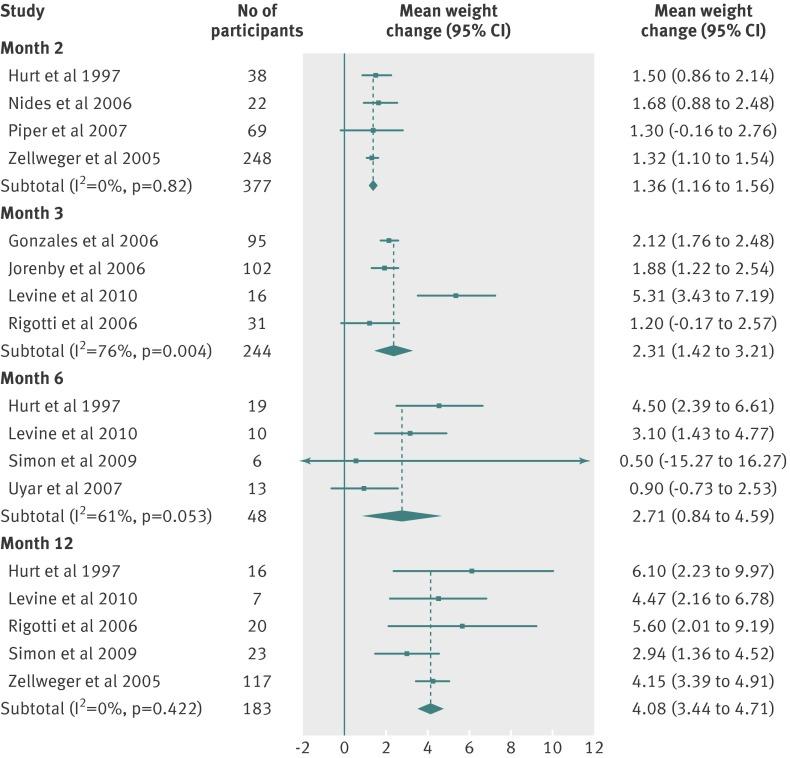
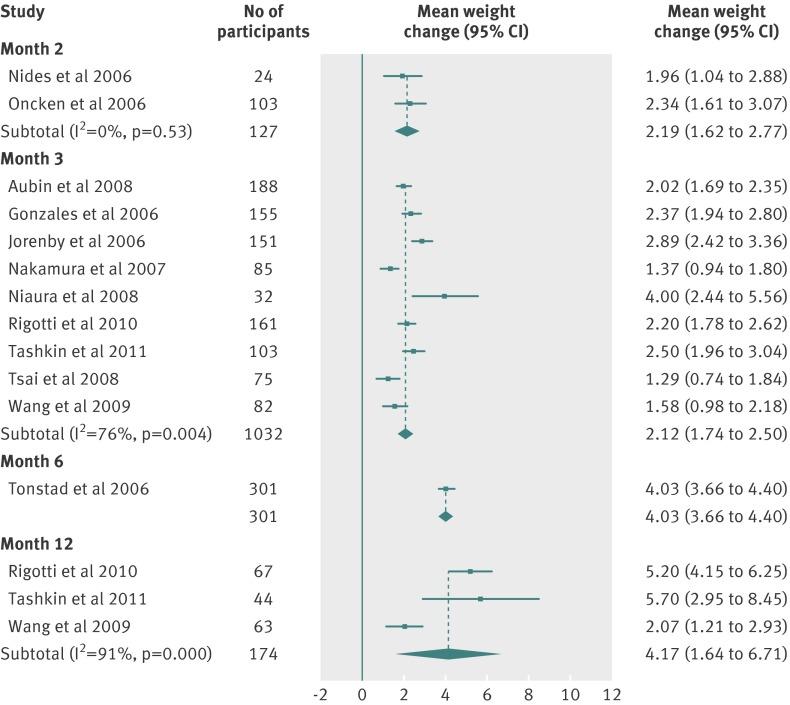
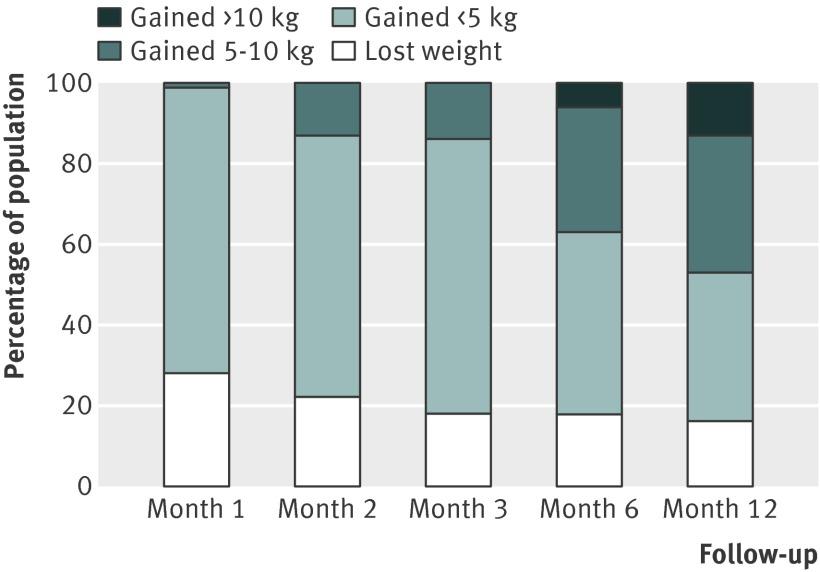
62 studies were included. In untreated quitters, mean weight gain was 1.12 kg (95% confidence interval 0.76 to 1.47), 2.26 kg (1.98 to 2.54), 2.85 kg (2.42 to 3.28), 4.23 kg (3.69 to 4.77), and 4.67 kg (3.96 to 5.38) at one, two, three, six, and 12 months after quitting, respectively. Using the means and weighted standard deviations, we calculated that at 12 months after cessation, 16%, 37%, 34%, and 13% of untreated quitters lost weight, and gained less than 5 kg, gained 5-10 kg, and gained more than 10 kg, respectively. Estimates of weight gain were similar for people using different pharmacotherapies to support cessation. Estimates were also similar between people especially concerned about weight gain and those not concerned.
CONCLUSION
Smoking cessation is associated with a mean increase of 4-5 kg in body weight after 12 months of abstinence, and most weight gain occurs within three months of quitting. Variation in weight change is large, with about 16% of quitters losing weight and 13% gaining more than 10 kg.
目的
描述在长达 12 个月的时间内实现长期戒烟且未接受治疗或使用药物来辅助戒烟的吸烟者的体重增加及其变化情况。
设计
荟萃分析。
资料来源
我们在中央对照试验注册库(CENTRAL)和 Cochrane 戒烟干预措施(尼古丁替代疗法、尼古丁部分激动剂、抗抑郁药和运动)的综述中检索了一线治疗(尼古丁替代疗法、安非他酮和伐尼克兰)和运动的随机试验,这些试验报告了体重变化情况。我们还在 CENTRAL 中检索了与戒烟后体重增加相关的干预措施的试验。
方法
如果试验记录了从基线到戒烟后随访期间的体重变化情况,则纳入该试验。我们使用随机效应逆方差模型计算体重从基线到戒烟后 1、2、3、6 和 12 个月的均值和 95%置信区间以及体重标准差的均值。我们使用随机效应荟萃回归来探索亚组差异。
结果
共纳入 62 项研究。在未接受治疗的戒烟者中,体重平均增加 1.12kg(95%置信区间 0.76-1.47)、2.26kg(1.98-2.54)、2.85kg(2.42-3.28)、4.23kg(3.69-4.77)和 4.67kg(3.96-5.38),分别在戒烟后 1、2、3、6 和 12 个月。根据均值和加权标准差,我们计算得出,在戒烟后 12 个月时,16%、37%、34%和 13%的未接受治疗的戒烟者体重减轻,体重减轻不足 5kg、减轻 5-10kg、减轻超过 10kg。支持戒烟的不同药物疗法的体重增加估计值相似。对于特别关注体重增加和不关注体重增加的人来说,估计值也相似。
结论
戒烟后 12 个月,体重平均增加 4-5kg,大多数体重增加发生在戒烟后 3 个月内。体重变化的差异很大,约 16%的戒烟者体重减轻,13%的戒烟者体重增加超过 10kg。




 Zotero 插件