
靶向与运输:微管如何控制焦点黏附动力学。
Targeting and transport: how microtubules control focal adhesion dynamics.
机构信息
Department of Cell and Tissue Biology, University of California, San Francisco, San Francisco, CA 94143, USA.
出版信息
J Cell Biol. 2012 Aug 20;198(4):481-9. doi: 10.1083/jcb.201206050.
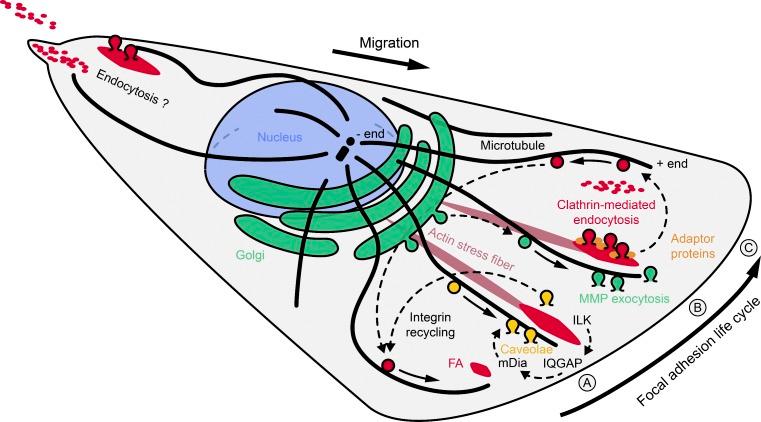
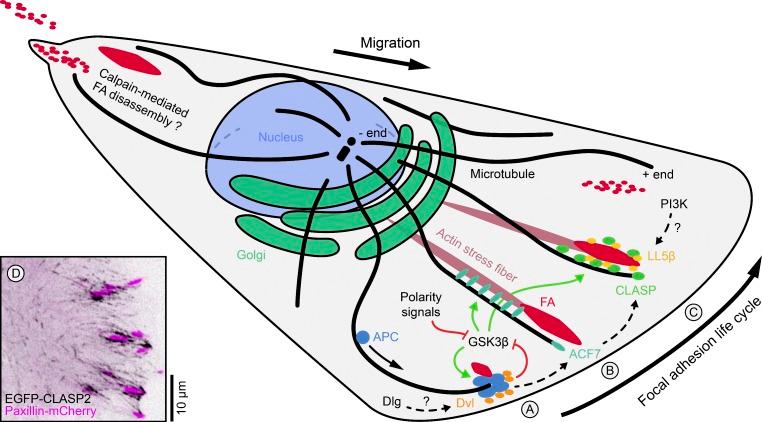
Directional cell migration requires force generation that relies on the coordinated remodeling of interactions with the extracellular matrix (ECM), which is mediated by integrin-based focal adhesions (FAs). Normal FA turnover requires dynamic microtubules, and three members of the diverse group of microtubule plus-end-tracking proteins are principally involved in mediating microtubule interactions with FAs. Microtubules also alter the assembly state of FAs by modulating Rho GTPase signaling, and recent evidence suggests that microtubule-mediated clathrin-dependent and -independent endocytosis regulates FA dynamics. In addition, FA-associated microtubules may provide a polarized microtubule track for localized secretion of matrix metalloproteases (MMPs). Thus, different aspects of the molecular mechanisms by which microtubules control FA turnover in migrating cells are beginning to emerge.
定向细胞迁移需要产生力,这依赖于与细胞外基质(ECM)相互作用的协调重塑,而这是由整合素基焦点黏附(FA)介导的。正常的 FA 周转率需要动态微管,并且微管末端追踪蛋白的三个不同的成员主要参与介导微管与 FA 的相互作用。微管还通过调节 Rho GTPase 信号来改变 FA 的组装状态,最近的证据表明,微管介导的网格蛋白依赖性和非依赖性内吞作用调节 FA 的动态。此外,FA 相关的微管可能为基质金属蛋白酶(MMPs)的局部分泌提供极化的微管轨道。因此,微管控制迁移细胞中 FA 周转率的分子机制的不同方面开始显现出来。
 Zotero 插件