
虚弱的老年患者对药物信息的体验。一项定性研究。
Frail elderly patients' experiences of information on medication. A qualitative study.
机构信息
Department of Clinical Sciences in Malmö, Family Medicine, Skåne University Hospital, Lund University, SE 20502 Malmö, Sweden.
出版信息
BMC Geriatr. 2012 Aug 22;12:46. doi: 10.1186/1471-2318-12-46.
BACKGROUND
Older patients generally have only poor knowledge about their medicines. Knowledge is important for good adherence and for participating in decisions about treatment. Patients are entitled to be informed on an individual and adequate level. The aim of the study was to explore frail elderly patients' experiences of receiving information about their medications and their views on how the information should best be given.
METHODS
The study was qualitative in design and was carried out in 2011. Twelve frail elderly (aged 68-88) participants taking cardiovascular medications participated in semi-structured interviews covering issues related to receiving information about prescribed medicines. The interviews were recorded, transcribed and subjected to content analysis, in which the text was analysed in five steps, inspired by Graneheim and Lundman.
RESULTS
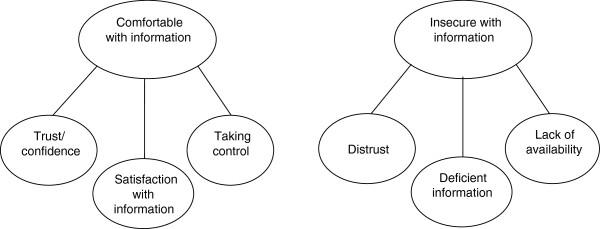
The results revealed that the experiences which the elderly participants had regarding the receiving of medical information fell into two main categories: "Comfortable with information" or "Insecure with information". The elderly felt comfortable when they trusted their physician or their medication, when they received enough information from the prescriber or when they knew how to find out sufficient information by themselves. They felt insecure if they were anxious, if the availability of medical care was poor or if they did not receive enough information.
CONCLUSIONS
Factors that frequently caused insecurity about information and anxiety were too short consultations, lack of availability of someone to answer questions or of the opportunity to contact the physician if adverse effects are suspected. These factors could easily be dealt with and there must be improvements in the clinics if the patients' feelings of security are to be increased.
背景
老年患者通常对自己的药物知之甚少。知识对于良好的依从性和参与治疗决策至关重要。患者有权获得个性化和充分的信息。本研究旨在探讨体弱老年患者接受药物信息的体验,以及他们对最佳信息提供方式的看法。
方法
本研究为定性研究,于 2011 年进行。12 名服用心血管药物的体弱老年(68-88 岁)患者参与了涵盖与接受处方药物信息相关问题的半结构化访谈。访谈进行了录音、转录和内容分析,受 Graneheim 和 Lundman 的启发,对文本进行了五个步骤的分析。
结果
研究结果显示,老年参与者在接受医疗信息方面的体验分为两个主要类别:“信息舒适”或“信息不安”。当他们信任医生或药物、从处方医生那里获得足够的信息或知道如何自行找到足够的信息时,他们会感到舒适。当他们感到焦虑、医疗保健资源不足或没有获得足够的信息时,他们会感到不安。
结论
导致信息不安全感和焦虑的因素通常是咨询时间过短、缺乏可回答问题的人,或者怀疑出现不良反应时无法联系医生。这些因素很容易解决,如果要提高患者的安全感,诊所必须进行改进。
 Zotero 插件