
太平洋真涡虫生殖系信号基因对寿命和先天免疫的全基因组分析。
Genome-wide analysis of germline signaling genes regulating longevity and innate immunity in the nematode Pristionchus pacificus.
机构信息
Department of Evolutionary Biology, Max Planck Institute for Developmental Biology, Tübingen, Germany.
出版信息
PLoS Pathog. 2012;8(8):e1002864. doi: 10.1371/journal.ppat.1002864. Epub 2012 Aug 9.
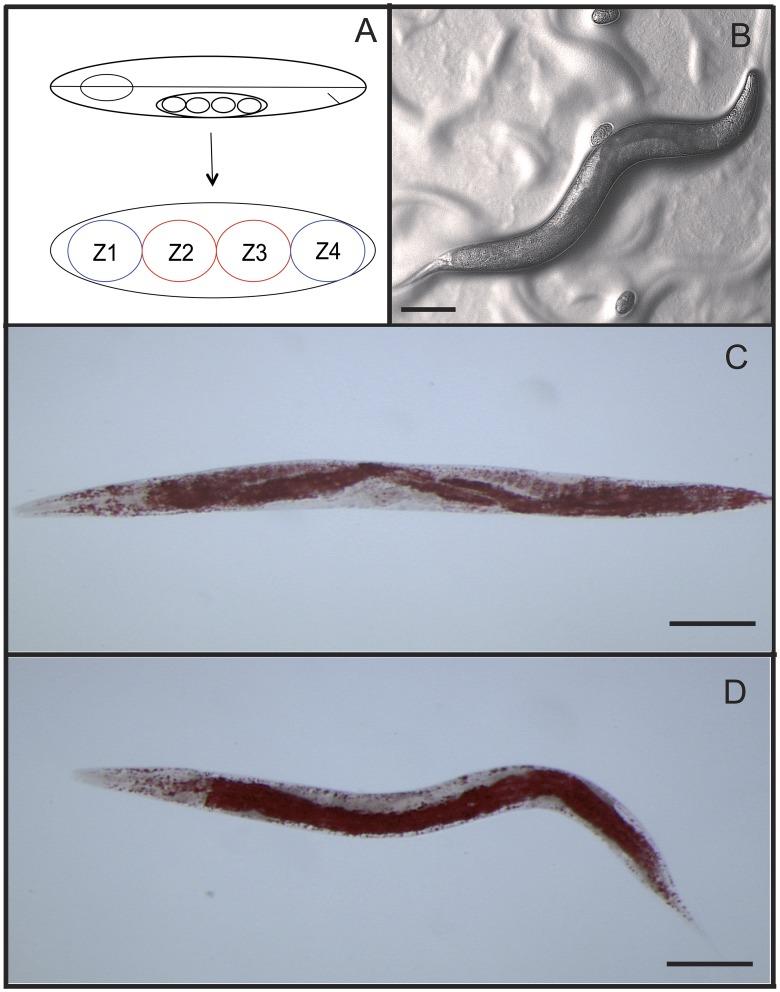
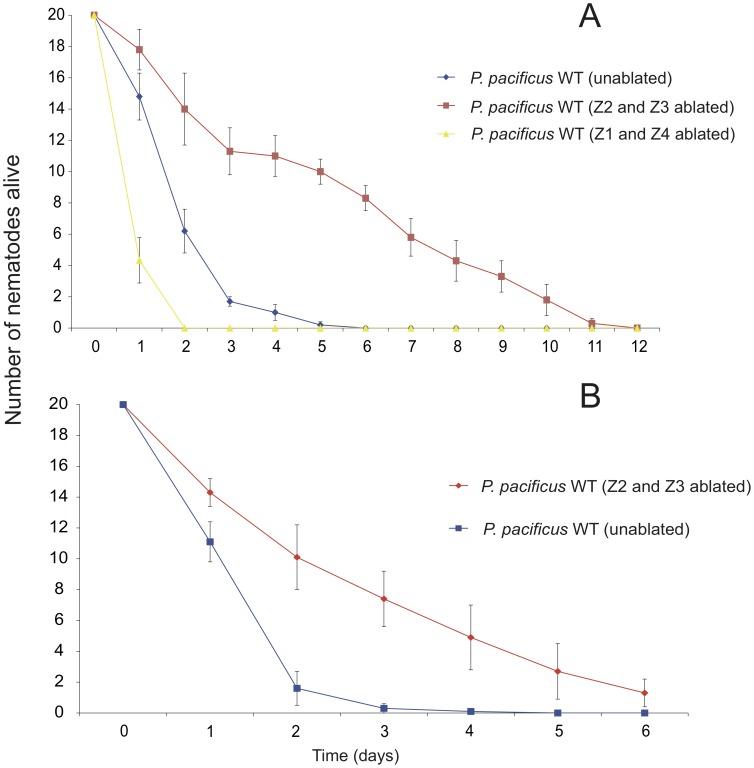
Removal of the reproductive system of many animals including fish, flies, nematodes, mice and humans can increase lifespan through mechanisms largely unknown. The abrogation of the germline in Caenorhabditis elegans increases longevity by 60% due to a signal emitted from the somatic gonad. Apart from increased longevity, germline-less C. elegans is also resistant to other environmental stressors such as feeding on bacterial pathogens. However, the evolutionary conservation of this pathogen resistance, its genetic basis and an understanding of genes involved in producing this extraordinary survival phenotype are currently unknown. To study these evolutionary aspects we used the necromenic nematode Pristionchus pacificus, which is a genetic model system used in comparison to C. elegans. By ablation of germline precursor cells and subsequent feeding on the pathogen Serratia marcescens we discovered that P. pacificus shows remarkable resistance to bacterial pathogens and that this response is evolutionarily conserved across the Genus Pristionchus. To gain a mechanistic understanding of the increased resistance to bacterial pathogens and longevity in germline-ablated P. pacificus we used whole genome microarrays to profile the transcriptional response comparing germline ablated versus un-ablated animals when fed S. marcescens. We show that lipid metabolism, maintenance of the proteasome, insulin signaling and nuclear pore complexes are essential for germline deficient phenotypes with more than 3,300 genes being differentially expressed. In contrast, gene expression of germline-less P. pacificus on E. coli (longevity) and S. marcescens (immunity) is very similar with only 244 genes differentially expressed indicating that longevity is due to abundant gene expression also involved in immunity. By testing existing mutants of Ppa-DAF-16/FOXO and the nuclear hormone receptor Ppa-DAF-12 we show a conserved function of both genes in resistance to bacterial pathogens and longevity. This is the first study to show that the influence of the reproductive system on extending lifespan and innate immunity is conserved in evolution.
去除包括鱼类、苍蝇、线虫、老鼠和人类在内的许多动物的生殖系统可以通过大部分未知的机制延长寿命。由于来自体细胞性腺的信号,秀丽隐杆线虫生殖系的缺失导致其寿命延长 60%。除了寿命延长外,无生殖系的秀丽隐杆线虫还能抵抗其他环境胁迫,如细菌病原体的摄食。然而,这种病原体抗性的进化保守性、其遗传基础以及参与产生这种非凡生存表型的基因的理解目前尚不清楚。为了研究这些进化方面,我们使用了 Necromenic 线虫 Pristionchus pacificus,它是一个与秀丽隐杆线虫进行比较的遗传模式系统。通过生殖系前体细胞的消融和随后摄食细菌病原体沙雷氏菌,我们发现 P. pacificus 对细菌病原体表现出显著的抗性,并且这种反应在整个 Pristionchus 属中是进化保守的。为了深入了解生殖系缺失的 P. pacificus 对细菌病原体的抗性和寿命增加的机制,我们使用全基因组微阵列来分析比较生殖系缺失和未缺失动物在摄食沙雷氏菌时的转录反应。我们表明,脂质代谢、蛋白酶体的维持、胰岛素信号和核孔复合物对于生殖系缺失表型是必不可少的,超过 3300 个基因的表达差异。相比之下,无生殖系的 P. pacificus 在大肠杆菌(寿命)和沙雷氏菌(免疫)上的基因表达非常相似,只有 244 个基因的表达差异表明,寿命的延长是由于大量参与免疫的基因也在表达。通过测试 Ppa-DAF-16/FOXO 和核激素受体 Ppa-DAF-12 的现有突变体,我们表明这两个基因在抵抗细菌病原体和延长寿命方面具有保守的功能。这是第一项表明生殖系统对延长寿命和先天免疫的影响在进化中是保守的研究。



 Zotero 插件