
核小体间距和染色质高级折叠。
Nucleosome spacing and chromatin higher-order folding.
机构信息
Department of Biochemistry and Molecular Biology; Pennsylvania State University, College of Medicine, Hershey, PA USA.
出版信息
Nucleus. 2012 Nov-Dec;3(6):493-9. doi: 10.4161/nucl.22168. Epub 2012 Sep 18.
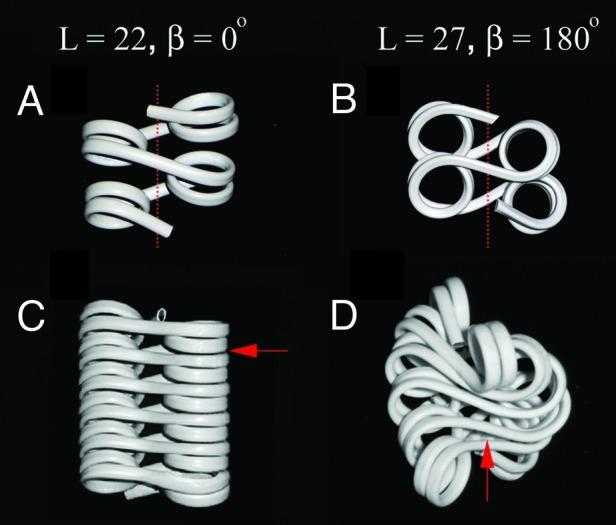
Packing of about two meters of the human genome DNA into chromatin occupying a several micron-sized cell nucleus requires a high degree of compaction in a manner that allows the information encoded on DNA to remain easily accessible. This packing is mediated by repeated coiling of DNA double helix around histones to form nucleosome arrays that are further folded into higher-order structures. Relatively straight DNA linkers separate the nucleosomes and the spacing between consecutive nucleosome varies between different cells and between different chromosomal loci. In a recent work ( 1) our group used a biochemically defined in vitro reconstituted system to explore how do various DNA linkers mediate nucleosome array packing into higher-order chromatin structures. For long nucleosome linkers (about 60 bp) we observed a more open chromatin structure and no effect of small linker length alterations (±2-4 bp) on chromatin folding. In striking contrast, for shorter linkers (20-32 bp) we found more compact packing with strong periodical dependence upon the linker DNA lengths. Our data together with high-resolution nucleosome position mapping provide evidence for the natural nucleosome repeats to support a chromatin architecture that, by default, restricts spontaneous folding of nucleosome arrays into compact chromatin fibers. We suggest that incomplete folding of the nucleosome arrays may promote global inter-array interactions that lead to chromatin condensation in metaphase chromosomes and heterochromatin.
将大约两米长的人类基因组 DNA 包装到占据数微米大小的细胞核内的染色质中,需要以一种使 DNA 上编码的信息易于访问的方式进行高度压缩。这种包装是通过 DNA 双螺旋在组蛋白周围重复缠绕形成核小体阵列来介导的,核小体阵列进一步折叠成更高阶的结构。相对直的 DNA 连接子将核小体分开,并且连续核小体之间的间隔在不同细胞和不同染色体位置之间有所不同。在最近的一项工作中(1),我们小组使用生物化学定义的体外重构系统来探索各种 DNA 连接子如何介导核小体阵列包装成更高阶的染色质结构。对于长核小体连接子(约 60bp),我们观察到更开放的染色质结构,并且小连接子长度变化(±2-4bp)对染色质折叠没有影响。相比之下,对于较短的连接子(20-32bp),我们发现更紧凑的包装,与连接子 DNA 长度具有强烈的周期性依赖性。我们的数据与高分辨率核小体位置图谱一起提供了证据,证明天然核小体重复支持一种染色质结构,默认情况下,这种结构限制了核小体阵列自发折叠成紧凑的染色质纤维。我们认为,核小体阵列的不完全折叠可能会促进全局阵列间相互作用,导致中期染色体和异染色质的染色质浓缩。


 Zotero 插件