
NAD(P)H:醌氧化还原酶1(NQO1)P187S多态性与白种人前列腺癌风险
NAD(P)H:quinone oxidoreductase 1 (NQO1) P187S polymorphism and prostate cancer risk in Caucasians.
作者信息
Stoehr Christine G, Nolte Elke, Wach Sven, Wieland Wolf F, Hofstaedter Ferdinand, Hartmann Arndt, Stoehr Robert
机构信息
Institute of Pathology, University Hospital Erlangen, Erlangen 91054, Germany.
University Clinic of Urology, Friedrich-Alexander University Erlangen-Nürnberg, Erlangen 91054, Germany.
出版信息
Int J Mol Sci. 2012;13(9):10959-10969. doi: 10.3390/ijms130910959. Epub 2012 Jul 26.
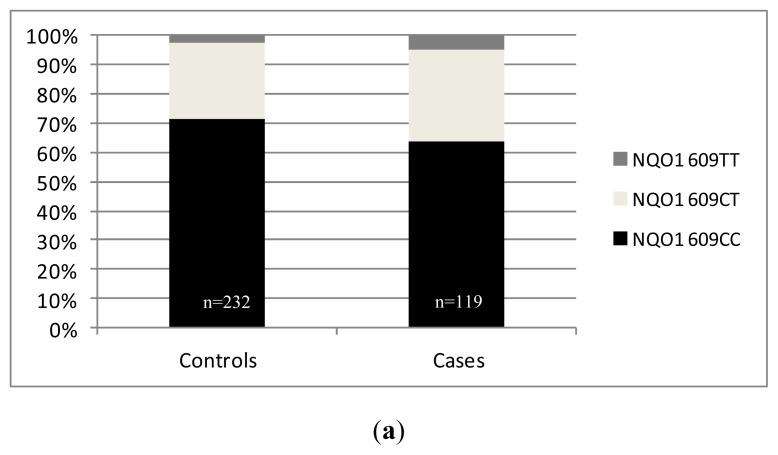
NAD(P)H:quinone oxidoreductase 1 (NQO1) catalyses the reduction of quinoid compounds to hydroquinones, preventing the generation of free radicals and reactive oxygen. A "C" to "T" transversion at position 609 of NQO1, leading to a nonsynonymous amino acid change (Pro187Ser, P187S), results in an altered enzyme activity. No NQO1 protein activity was detected in NQO1(609)TT genotype, and low to intermediate activity was detected in NQO1(609)CT genotype compared with (609)CC genotype. Thus, this polymorphism may result in altered cancer predisposition. For prostate cancer, only sparse data are available. We therefore analyzed the distribution of the NQO1 P187S SNP (single nucleotide polymorphism) in prostate cancer patients and a healthy control group. Allelic variants were determined using RFLP analysis. Overall, 232 patients without any malignancy and 119 consecutive prostate cancer patients were investigated. The genotype distribution in our cohorts followed the Hardy-Weinberg equilibrium in cases and controls. The distribution of the NQO1 codon 187 SNP did not differ significantly between prostate cancer patients and the control group (p = 0.242). There was also no association between the allelic variants and stage or Gleason score of the tumors. The NQO1 P187S SNP was not significantly associated with an increased prostate cancer risk in our cohorts. The SNP has also no influence on histopathological characteristics of the tumors. A combined analysis of all available data from published European studies also showed no significant differences in the genotype distribution between controls and prostate cancer patients. Our data suggest a minor role of the NQO1 nucleotide 609 polymorphism in prostate carcinogenesis.
烟酰胺腺嘌呤二核苷酸磷酸(NAD(P)H):醌氧化还原酶1(NQO1)催化醌类化合物还原为对苯二酚,从而防止自由基和活性氧的产生。NQO1第609位发生C到T的颠换,导致非同义氨基酸改变(脯氨酸187变为丝氨酸,P187S),从而使酶活性发生改变。在NQO1(609)TT基因型中未检测到NQO1蛋白活性,与(609)CC基因型相比,在NQO1(609)CT基因型中检测到低至中等活性。因此,这种多态性可能导致癌症易感性改变。关于前列腺癌,仅有稀少的数据。因此,我们分析了前列腺癌患者和健康对照组中NQO1 P187S单核苷酸多态性(SNP)的分布情况。使用限制性片段长度多态性分析来确定等位基因变体。总体而言,对232名无任何恶性肿瘤的患者和119名连续的前列腺癌患者进行了研究。我们队列中的基因型分布在病例组和对照组中均符合哈迪-温伯格平衡。前列腺癌患者和对照组之间NQO1密码子187 SNP的分布没有显著差异(p = 0.242)。等位基因变体与肿瘤的分期或 Gleason评分之间也没有关联。在我们的队列中,NQO1 P187S SNP与前列腺癌风险增加没有显著关联。该SNP对肿瘤的组织病理学特征也没有影响。对已发表的欧洲研究中所有可用数据的综合分析也显示,对照组和前列腺癌患者之间的基因型分布没有显著差异。我们的数据表明,NQO1第609位核苷酸多态性在前列腺癌发生中起次要作用。


 Zotero 插件