
禽传染性支气管炎与胸肌深层坏死症——病例对照研究。
Avian infectious bronchitis and deep pectoral myopathy - a case control study.
机构信息
Department of Public Health and Veterinary Collective Health, Fluminenese Federal University, Niterói, 24220331, Brazil.
出版信息
Poult Sci. 2012 Dec;91(12):3052-6. doi: 10.3382/ps.2012-02476.
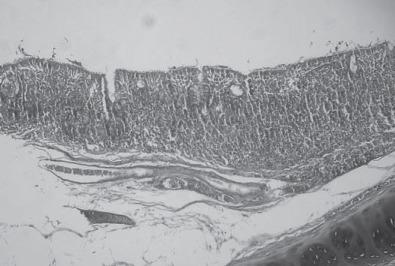
Infectious bronchitis is caused by a coronavirus, infectious bronchitis virus (IBV). Infectious bronchitis is an acute and highly contagious disease of economic importance due to the reduction in weight gain observed with infected broilers and the drop in egg quality and production associated with infected laying hens. The presence of deep pectoral myopathy has been associated with IBV variants. This lesion is detected at slaughterhouses and is characterized by paleness and atrophy of the deep pectoral muscle, including necrosis of the region, leading to condemnations of the breast muscle, a valuable meat cut in the market. This work aimed to study the relationship between deep pectoral myopathy and IBV by describing tracheal and muscle lesions and comparing the frequency of IBV detection via reverse-transcription (RT) PCR in muscle, tracheal, and cecal tonsil samples from broilers with and without myopathy. A case-control study was conducted in 40 broiler flocks vaccinated with the Massachusetts strain. The case group consisted of 23 flocks that presented myopathic lesions under sanitary inspection and a control group of 17 flocks without myopathic lesions. The tracheal, cecal tonsil, and supracoracoid muscle (with and without lesions) samples from the 40 broiler flocks were screened by RT-PCR to detect IBV. Histopathology of muscle and tracheal tissue was carried out. Upon microscopic examination, the muscle samples from the case group presented extensive necrosis, intense mononuclear inflammatory infiltration, muscle fiber fragmentation, and fibrotic tissue, confirming myopathy, whereas muscles from the control group showed no alterations. The tracheal samples presented a large number of infiltrated mononuclear inflammatory cells that in some areas formed submucosal nodules. A total of 25 flocks tested IBV positive by RT-PCR: 14 from the case group and 11 from the control group. The IBV was detected by RT-PCR directly in muscle samples. Despite that, the relationship between deep pectoral myopathy and IBV was not established. The higher positive IBV RT-PCR percentage noted in the cecal tonsil samples demonstrates how important the choice of organs is for diagnostic purposes.
传染性支气管炎由冠状病毒,传染性支气管炎病毒(IBV)引起。传染性支气管炎是一种具有重要经济意义的急性和高度传染性疾病,因为感染肉鸡的体重增加减少,以及感染产蛋鸡的鸡蛋质量和产量下降。深胸肌病的存在与 IBV 变异有关。这种病变在屠宰场被发现,其特征是深胸肌苍白和萎缩,包括该区域的坏死,导致胸肌被谴责,这是市场上有价值的肉类切割。本工作旨在通过描述气管和肌肉病变,并比较肌组织、气管和盲肠扁桃体样本中 IBV 的 RT-PCR 检测频率,研究深胸肌病与 IBV 的关系。在接种马萨诸塞株的 40 个肉鸡群中进行了病例对照研究。病例组由 23 个在卫生检查下出现肌病病变的鸡群组成,对照组由 17 个无肌病病变的鸡群组成。对来自 40 个肉鸡群的气管、盲肠扁桃体和肩带肌(有病变和无病变)样本进行 RT-PCR 检测以检测 IBV。进行了肌肉和气管组织的组织病理学检查。显微镜检查时,病例组的肌肉样本表现出广泛的坏死、强烈的单核炎性浸润、肌纤维碎裂和纤维组织,证实了肌病,而对照组的肌肉则没有改变。气管样本中存在大量浸润的单核炎性细胞,在某些区域形成粘膜下结节。共有 25 个鸡群通过 RT-PCR 检测出 IBV 阳性:14 个来自病例组,11 个来自对照组。IBV 通过 RT-PCR 直接在肌肉样本中检测到。尽管如此,深胸肌病与 IBV 之间的关系尚未确定。在盲肠扁桃体样本中观察到更高的阳性 IBV RT-PCR 百分比表明,选择器官对诊断目的非常重要。


 Zotero 插件