
野生动物宿主物种对微小巴贝斯虫的 reservoir competence。
Reservoir competence of wildlife host species for Babesia microti.
机构信息
Bard College, Annandale-on-Hudson, New York, USA.
出版信息
Emerg Infect Dis. 2012 Dec;18(12):1951-7. doi: 10.3201/eid1812.111392.
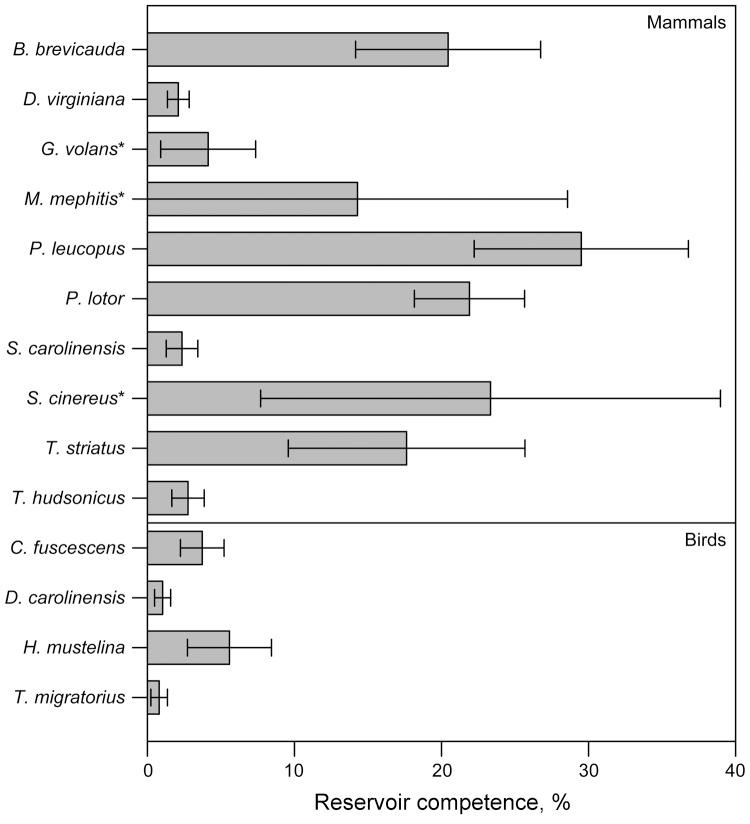
Human babesiosis is an increasing health concern in the northeastern United States, where the causal agent, Babesia microti, is spread through the bite of infected Ixodes scapularis ticks. We sampled 10 mammal and 4 bird species within a vertebrate host community in southeastern New York to quantify reservoir competence (mean percentage of ticks infected by an individual host) using real-time PCR. We found reservoir competence levels >17% in white-footed mice (Peromyscus leucopus), raccoons (Procyon lotor), short-tailed shrews (Blarina brevicauda), and eastern chipmunks (Tamias striatus), and <6% but >0% in all other species, including all 4 bird species. Data on the relative contributions of multiple host species to tick infection with B. microti and level of genetic differentiation between B. microti strains transmitted by different hosts will help advance understanding of the spread of human babesiosis.
人巴贝虫病是美国东北部日益受到关注的健康问题,该病的病原体巴贝虫微小通过受感染的硬蜱Ixodes scapularis 的叮咬传播。我们在纽约东南部的一个脊椎动物宿主群落中采样了 10 种哺乳动物和 4 种鸟类,以实时 PCR 定量测定储主能力(个体宿主感染的蜱百分比平均值)。我们发现,白足鼠(Peromyscus leucopus)、浣熊(Procyon lotor)、短尾鼩鼱(Blarina brevicauda)和东部花栗鼠(Tamias striatus)的储主能力水平>17%,而所有其他物种(包括所有 4 种鸟类)<6%但>0%。关于多种宿主物种对 B. microti 感染蜱的相对贡献以及由不同宿主传播的 B. microti 菌株之间遗传分化水平的数据将有助于增进对人巴贝虫病传播的理解。
 Zotero 插件