
产业员工的高血压控制:SHIMSCO研究结果
Hypertension control in industrial employees: findings from SHIMSCO study.
作者信息
Khosravi Ali Reza, Rowzati Mohsen, Gharipour Mojgan, Fesharaki Mohammad Gholami, Shirani Shahin, Shahrokhi Shahnaz, Jozan Mahnaz, Khosravi Elham, Khosravi Zahra, Sarrafzadegan Nizal
机构信息
Associate Professor, Hypertension Research Center, Isfahan Cardiovascular Research Institute, Isfahan University of Medical Sciences, Isfahan, Iran.
出版信息
ARYA Atheroscler. 2012 Winter;7(4):191-6.
BACKGROUND
Hypertension prevention and control are among the most important public health priorities. We evaluated the impacts of a workplace intervention project "Stop Hypertension in Mobarakeh Steel Company" (SHIMSCO) on controlling hypertension in industrial workers.
METHODS
The study was carried out in Mobarakeh Steel Company in Isfahan among 7286 male workers and employees. All individuals were evaluated for the presence of hypertension (HTN). According to examinations, 500 subjects with systolic blood pressure (SBP) ≥ 140 mmHg, and/or diastolic blood pressure (DBP) ≥ 90 mmHg, and/or those using antihypertensive medications were confirmed to have HTN and thus included in this study. They were questioned for sociodemographic characteristics, past medical history and medication use. They received an educational program including healthy lifestyle and self-care recommendations of HTN management and control as well as training for accurate blood pressure measurement and home monitoring for two years. SBP, DBP, weight, height and routine lab tests were measured for all hypertensive subjects before and after the interventions. Paired t-test, generalized estimation equation (GEE) and ordinary linear regression (OLR) were used for statistical analysis in SPSS.
RESULTS
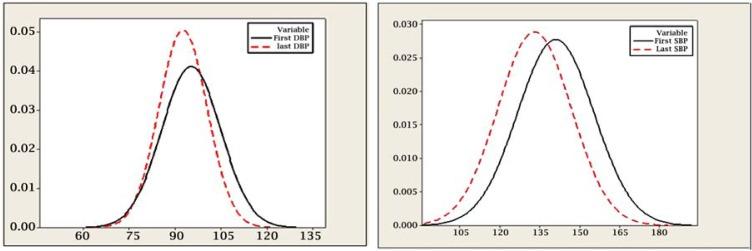
The comparison of SBP and DBP before and after the educational program showed significant reductions in both parameters (-7.97 ± 14.72 and -2.66 ± 9.96 mmHg, respectively). However, a greater decrease was detected in case of DBP. GEE showed SBP and DBP to decrease about -0.115 and -0.054 mmHg/month. OLR also revealed reductions of 4.88 and 2.57 mmHg respectively in SBP and DBP upon adding each antihypertensive drug.
CONCLUSION
SHIMSCO, a 3-year interventional project in workplaces, was effective in reducing SBP and DBP among hypertensive employees and workers. We conclude that implementing simple educational programs in worksites can improve the management and control of hypertension and perhaps other chronic diseases.
背景
高血压的预防与控制是最重要的公共卫生优先事项之一。我们评估了一个名为“莫巴拉克钢铁公司高血压防治项目”(SHIMSCO)的职场干预项目对控制产业工人高血压的影响。
方法
该研究在伊斯法罕的莫巴拉克钢铁公司对7286名男性工人及雇员开展。对所有个体进行高血压(HTN)检查。经检查,收缩压(SBP)≥140 mmHg和/或舒张压(DBP)≥90 mmHg,和/或正在使用抗高血压药物的500名受试者被确诊患有高血压,因此纳入本研究。询问他们的社会人口学特征、既往病史和用药情况。他们接受了为期两年的教育项目,内容包括健康生活方式、高血压管理与控制的自我护理建议,以及准确血压测量和家庭监测培训。对所有高血压受试者在干预前后测量SBP、DBP、体重、身高和常规实验室检查。在SPSS中使用配对t检验、广义估计方程(GEE)和普通线性回归(OLR)进行统计分析。
结果
教育项目前后SBP和DBP的比较显示,这两个参数均显著降低(分别为-7.97±14.72和-2.66±9.96 mmHg)。然而,DBP的下降幅度更大。GEE显示SBP和DBP每月分别下降约-0.115和-0.054 mmHg。OLR还显示,每增加一种抗高血压药物,SBP和DBP分别降低4.88和2.57 mmHg。
结论
SHIMSCO作为一个为期3年的职场干预项目,在降低高血压雇员和工人的SBP和DBP方面是有效的。我们得出结论,在工作场所实施简单的教育项目可以改善高血压以及可能其他慢性病的管理与控制。

 Zotero 插件