
碱基切除修复修复 3-甲基腺嘌呤和无碱基位点介导胶质母细胞瘤对替莫唑胺的耐药性。
Repair of 3-methyladenine and abasic sites by base excision repair mediates glioblastoma resistance to temozolomide.
机构信息
Department of Neurological Surgery, University of Washington Medical Center Seattle, WA, USA.
出版信息
Front Oncol. 2012 Nov 30;2:176. doi: 10.3389/fonc.2012.00176. eCollection 2012.
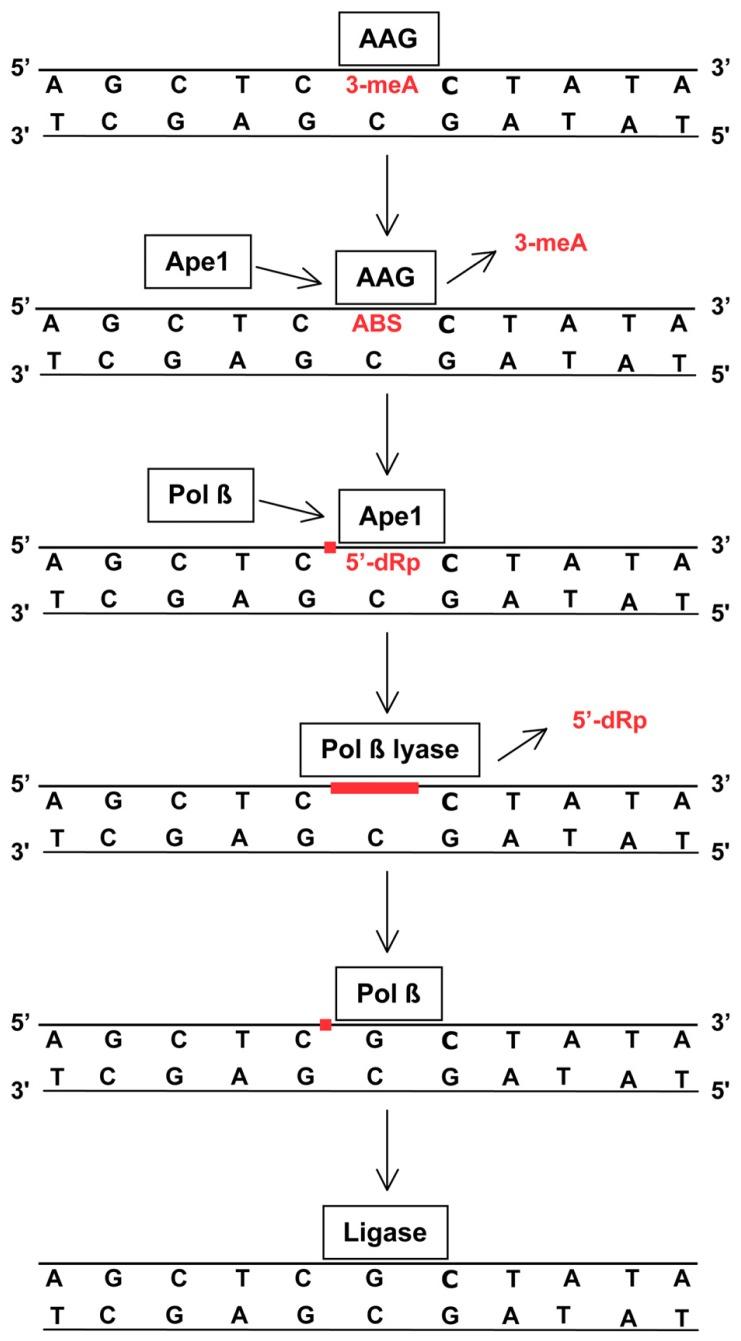
Alkylating agents have long played a central role in the adjuvant therapy of glioblastoma (GBM). More recently, inclusion of temozolomide (TMZ), an orally administered methylating agent with low systemic toxicity, during and after radiotherapy has markedly improved survival. Extensive in vitro and in vivo evidence has shown that TMZ-induced O(6)-methylguanine (O(6)-meG) mediates GBM cell killing. Moreover, low or absent expression of O(6)-methylguanine-DNA methyltransferase (MGMT), the sole human repair protein that removes O(6)-meG from DNA, is frequently associated with longer survival in GBMs treated with TMZ, promoting interest in developing inhibitors of MGMT to counter resistance. However, the clinical efficacy of TMZ is unlikely to be due solely to O(6)-meG, as the agent produces approximately a dozen additional DNA adducts, including cytotoxic N3-methyladenine (3-meA) and abasic sites. Repair of 3-meA and abasic sites, both of which are produced in greater abundance than O(6)-meG, is mediated by the base excision repair (BER) pathway, and occurs independently of removal of O(6)-meG. These observations indicate that BER activities are also potential targets for strategies to potentiate TMZ cytotoxicity. Here we review the evidence that 3-meA and abasic sites mediate killing of GBM cells. We also present in vitro and in vivo evidence that alkyladenine-DNA glycosylase, the sole repair activity that excises 3-meA from DNA, and Ape1, the major human abasic site endonuclease, mediate TMZ resistance in GBMs and represent potential anti-resistance targets.
烷基化剂在胶质母细胞瘤(GBM)的辅助治疗中一直起着核心作用。最近,在放疗期间和之后加入替莫唑胺(TMZ),一种口服给予的低全身毒性甲基化剂,显著提高了生存率。广泛的体外和体内证据表明,TMZ 诱导的 O(6)-甲基鸟嘌呤(O(6)-meG)介导 GBM 细胞杀伤。此外,O(6)-甲基鸟嘌呤-DNA 甲基转移酶(MGMT)的低表达或缺失,MGMT 是唯一能从 DNA 中去除 O(6)-meG 的人类修复蛋白,与接受 TMZ 治疗的 GBM 患者的生存期延长密切相关,这促进了开发 MGMT 抑制剂以对抗耐药性的兴趣。然而,TMZ 的临床疗效不太可能仅仅归因于 O(6)-meG,因为该药物产生了大约十几种其他的 DNA 加合物,包括细胞毒性 N3-甲基腺嘌呤(3-meA)和无碱基位点。3-meA 和无碱基位点的修复,这两者的产生量都多于 O(6)-meG,由碱基切除修复(BER)途径介导,并且独立于 O(6)-meG 的去除而发生。这些观察结果表明,BER 活性也是增强 TMZ 细胞毒性的策略的潜在靶点。本文综述了 3-meA 和无碱基位点介导 GBM 细胞杀伤的证据。我们还提供了体外和体内证据,证明切除 DNA 中 3-meA 的唯一修复活性——烷基腺嘌呤-DNA 糖基化酶和主要的人类无碱基位点内切酶 Ape1,介导 GBM 中的 TMZ 耐药性,并代表潜在的抗耐药性靶点。
 Zotero 插件