
超重和 I 级肥胖与巴西老年人 10 年死亡率降低相关:班布伊老龄化队列研究。
Overweight and class I obesity are associated with lower 10-year risk of mortality in Brazilian older adults: the Bambuí Cohort Study of Ageing.
机构信息
Faculdade de Medicina, Universidade Federal de Minas Gerais, Belo Horizonte, Brazil.
出版信息
PLoS One. 2012;7(12):e52111. doi: 10.1371/journal.pone.0052111. Epub 2012 Dec 14.
BACKGROUND
Prospective studies mostly with European and North-American populations have shown inconsistent results regarding the association of overweight/obesity and mortality in older adults. Our aim was to investigate the relationship between overweight/ obesity and mortality in an elderly Brazilian population.
METHODS AND FINDINGS
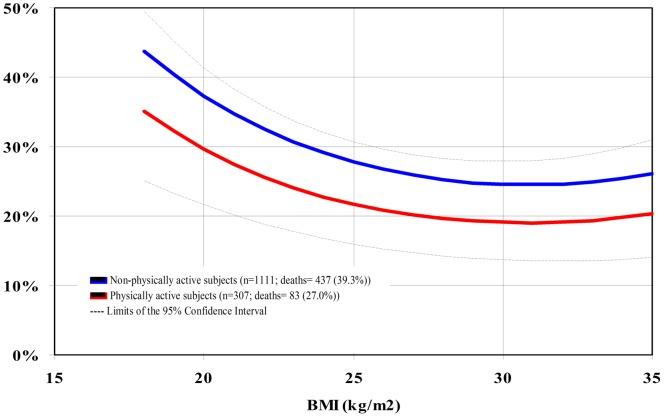
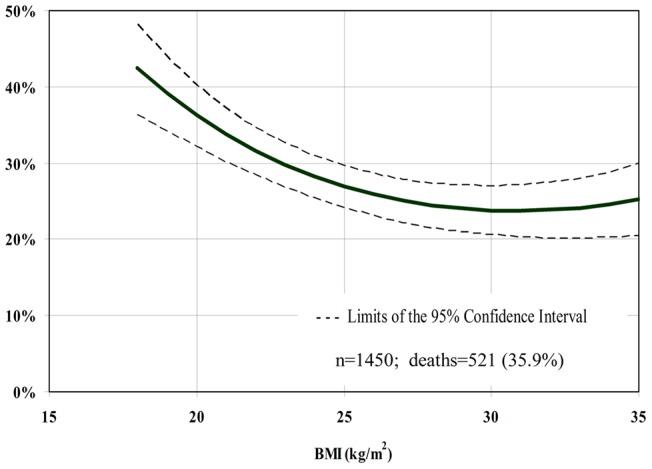
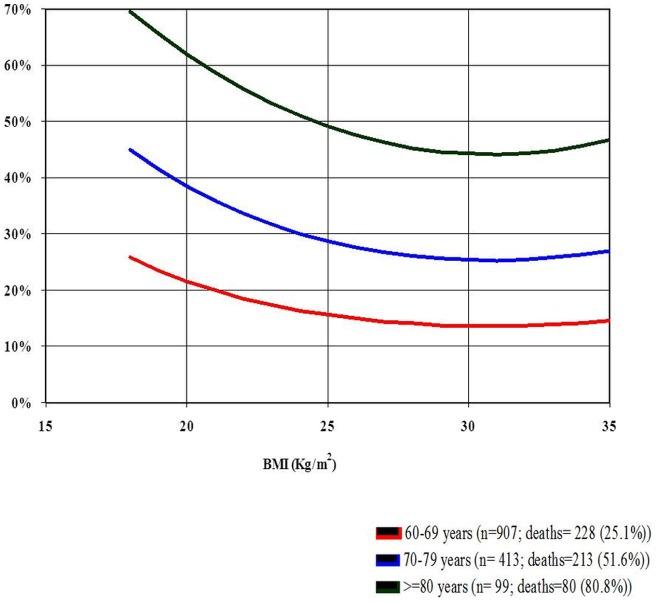
Participants were 1,450 (90.2% from total) individuals aged 60 years and over from the community-based Bambuí (Brazil) Cohort Study of Ageing. From 1997 to 2007, 521 participants died and 89 were lost, leading to 12,905 person-years of observation. Body mass index (BMI) and waist circumference (WC) were assessed at baseline and at the 3rd and 5th years of follow-up. Multiple imputation was performed to deal with missing values. Hazard ratios (HR) of mortality for BMI or WC alone (continuous and categorical), and BMI and WC together (continuous) were estimated by extended Cox regression models, which were fitted for clinical, socioeconomic and behavioral confounders. Adjusted absolute rates of death at 10-year follow-up were estimated for the participants with complete data at baseline. Continuous BMI (HR 0.85; 95% CI 0.80-0.90) was inversely related to mortality, even after exclusion of smokers (HR 0.85; 0.80-0.90), and participants who had weight variation and died within the first 5 years of follow-up (HR 0.83; CI 95% 0.73-0.94). Overweight (BMI 25-30 kg/m(2)) was inversely (HR 0.76; 95%CI 0.61-0.93) and obesity (BMI ≥ 30 kg/m(2); HR 0.85; 95% CI 0.64-1.14) not significantly associated with mortality. Subjects with BMI between 25-35 kg/m(2) (23.8-25.9%) had the lowest absolute rates of death at 10-years follow-up. The association between WC and death was not significant, except after adjusting WC for BMI levels, when the relationship turned into marginally positive (HR 1.01; CI 95% 1.00-1.02).
CONCLUSIONS
The usual BMI and WC cut-off points should not be used to guide public health and clinical weight control interventions in elderly in Brazil.
背景
前瞻性研究主要针对欧洲和北美人群,其关于超重/肥胖与老年人死亡率的相关性结果并不一致。我们的目的是研究超重/肥胖与巴西老年人群死亡率之间的关系。
方法和发现
参与者为来自社区的巴西班比乌(Bambuí)老龄化队列研究的 1450 名(总人数的 90.2%)年龄在 60 岁及以上的个体。1997 年至 2007 年期间,有 521 名参与者死亡,89 名参与者失访,导致 12905 人年的观察。在基线和第 3 年和第 5 年随访时评估了体重指数(BMI)和腰围(WC)。使用多重插补处理缺失值。使用扩展 Cox 回归模型估计 BMI 或 WC 单独(连续和分类)以及 BMI 和 WC 共同(连续)的死亡率风险比(HR),并针对临床、社会经济和行为混杂因素进行了拟合。对于基线时数据完整的参与者,估计了 10 年随访时的死亡绝对率。连续 BMI(HR 0.85;95%CI 0.80-0.90)与死亡率呈负相关,即使在排除吸烟者(HR 0.85;95%CI 0.80-0.90)和在随访的前 5 年内体重变化且死亡的参与者后也是如此(HR 0.83;95%CI 0.73-0.94)。超重(BMI 25-30kg/m²)与死亡率呈负相关(HR 0.76;95%CI 0.61-0.93),肥胖(BMI≥30kg/m²)与死亡率无显著相关性(HR 0.85;95%CI 0.64-1.14)。BMI 在 25-35kg/m²之间(23.8-25.9%)的受试者在 10 年随访时的死亡绝对率最低。WC 与死亡率之间的关联不显著,除非根据 BMI 水平调整 WC 后,这种关系才变成略有正相关(HR 1.01;95%CI 1.00-1.02)。
结论
在巴西,不应该使用通常的 BMI 和 WC 切点来指导公共卫生和临床体重控制干预。

 Zotero 插件