
体重指数与死亡率之间的年龄依赖性关系:新加坡纵向老龄化研究。
Age-dependent relationships between body mass index and mortality: Singapore longitudinal ageing study.
作者信息
Ng Tze Pin, Jin Aizhen, Chow Khuan Yew, Feng Liang, Nyunt Ma Shwe Zin, Yap Keng Bee
机构信息
Gerontology Research Programme, Department of Psychological Medicine, National University of Singapore, Singapore.
National Disease Registry Office, Health Promotion Board, Singapore.
出版信息
PLoS One. 2017 Jul 24;12(7):e0180818. doi: 10.1371/journal.pone.0180818. eCollection 2017.
OBJECTIVES
The relationship between body mass index (BMI) with mortality risk, in particular the BMI category associated with the lowest all-cause and CVD-and-stroke mortality and the BMI threshold for defining overweight or obesity in older persons is controversial. This study investigated the age-dependent associations of BMI categories with all-cause and cardiovascular disease (CVD) and stroke mortality.
METHOD
Prospective cohort study (Singapore Longitudinal Ageing Studies) of older adults aged 55 and above, followed up from 2003 to 2011. Participants were 2605 Chinese with baseline BMI and other variables. Outcome Measurement: Mortality hazard ratios (HR) for all-cause and CVD and stroke mortality.
RESULTS
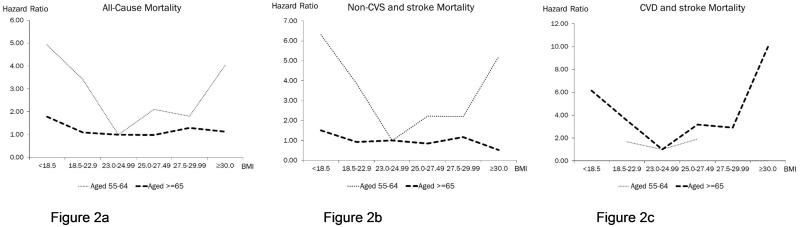
Overall, BMI showed a U-shaped relationship with all-cause and CVD and stroke mortality, being lowest at Normal Weight-II category (BMI 23.0-24.9 kg/m2). Most evidently among the middle-aged (55-64 years), all-cause mortality risks relative to Normal Weight-II were elevated for underweight (<BMI 18.5; HR = 4.92, p<0.0138), Normal Weight-I (BMI 18.5-22.9; HR = 3.41, p = 0.0149), and Overweight-Obese (BMI>30.0; HR = 4.05,p = 0.0423). Among the old (≥65 years), however, Overweight and Obese categories were not significantly associated with increased all-cause mortality (HR from 0.98 to 1.29), but Overweight-Obese was associated with increased CVD and stroke mortality (HR = 10.0, p = 0.0086).
CONCLUSION
BMI showed a U-shaped relationship with mortality. Among older persons aged 65 and above, the overweight-or-obese category of BMI was not associated with excess all-cause mortality.
目的
体重指数(BMI)与死亡风险之间的关系,尤其是与全因死亡率、心血管疾病(CVD)及中风死亡率最低相关的BMI类别,以及老年人超重或肥胖的BMI界定阈值存在争议。本研究调查了BMI类别与全因死亡率、心血管疾病(CVD)及中风死亡率的年龄依赖性关联。
方法
对55岁及以上老年人进行前瞻性队列研究(新加坡纵向老龄化研究),随访时间为2003年至2011年。参与者为2605名有基线BMI及其他变量的中国人。结局测量:全因死亡率、CVD及中风死亡率的死亡风险比(HR)。
结果
总体而言,BMI与全因死亡率、CVD及中风死亡率呈U型关系,在正常体重-II类别(BMI 23.0-24.9 kg/m²)时最低。在中年人(55-64岁)中最为明显,相对于正常体重-II类别,体重过轻(<BMI 18.5;HR = 4.92,p<0.0138)、正常体重-I(BMI 18.5-22.9;HR = 3.41,p = 0.0149)以及超重-肥胖(BMI>30.0;HR = 4.05,p = 0.0423)的全因死亡风险均升高。然而,在老年人(≥65岁)中,超重和肥胖类别与全因死亡率增加无显著关联(HR为0.98至1.29),但超重-肥胖与CVD及中风死亡率增加有关(HR = 10.0,p = 0.0086)。
结论
BMI与死亡率呈U型关系。在65岁及以上的老年人中,BMI的超重或肥胖类别与全因死亡率增加无关。

 Zotero 插件