
人内皮细胞分泌组的糖蛋白质组学分析。
Glycoproteomic analysis of the secretome of human endothelial cells.
机构信息
The King's British Heart Foundation Centre, King's College London, London SE5 9NU, UK.
出版信息
Mol Cell Proteomics. 2013 Apr;12(4):956-78. doi: 10.1074/mcp.M112.024018. Epub 2013 Jan 23.
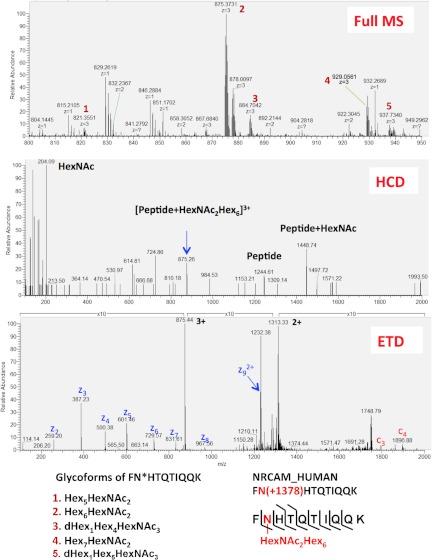
Previous proteomics studies have partially unraveled the complexity of endothelial protein secretion but have not investigated glycosylation, a key modification of secreted and membrane proteins for cell communication. In this study, human umbilical vein endothelial cells were kept in serum-free medium before activation by phorbol-12-myristate-13 acetate, a commonly used secretagogue that induces exocytosis of endothelial vesicles. In addition to 123 secreted proteins, the secretome was particularly rich in membrane proteins. Glycopeptides were enriched by zwitterionic hydrophilic interaction liquid chromatography resins and were either treated with PNGase F and H2(18)O or directly analyzed using a recently developed workflow combining higher-energy C-trap dissociation (HCD) with electron-transfer dissociation (ETD) for a hybrid linear ion trap-orbitrap mass spectrometer. After deglycosylation with PNGase F in the presence of H2(18)O, 123 unique peptides displayed (18)O-deamidation of asparagine, corresponding to 86 proteins with a total of 121 glycosylation sites. Direct glycopeptide analysis via HCD-ETD identified 131 glycopeptides from 59 proteins and 118 glycosylation sites, of which 41 were known, 51 were predicted, and 26 were novel. Two methods were compared: alternating HCD-ETD and HCD-product-dependent ETD. The former detected predominantly high-intensity, multiply charged glycopeptides, whereas the latter preferentially selected precursors with complex/hybrid glycans for fragmentation. Validation was performed by means of glycoprotein enrichment and analysis of the input, the flow-through, and the bound fraction. This study represents the most comprehensive characterization of endothelial protein secretion to date and demonstrates the potential of new HCD-ETD workflows for determining the glycosylation status of complex biological samples.
先前的蛋白质组学研究部分揭示了内皮细胞蛋白分泌的复杂性,但尚未研究糖基化,糖基化是细胞通讯中分泌蛋白和膜蛋白的关键修饰。在这项研究中,人脐静脉内皮细胞在被佛波醇 12-肉豆蔻酸 13-醋酸酯激活之前被置于无血清培养基中,佛波醇 12-肉豆蔻酸 13-醋酸酯是一种常用的分泌剂,可诱导内皮小泡的胞吐作用。除了 123 种分泌蛋白外,分泌组还特别富含膜蛋白。糖肽通过两性离子亲水相互作用色谱树脂进行富集,并分别用 PNGase F 和 H2(18)O 处理,或直接使用最近开发的结合高能量 C 阱解离(HCD)和电子转移解离(ETD)的工作流程进行分析,用于杂交线性离子阱-轨道阱质谱仪。在存在 H2(18)O 的情况下用 PNGase F 进行去糖基化后,123 个独特的肽显示天冬酰胺的(18)O-脱酰胺化,对应于 86 种蛋白质,总共有 121 个糖基化位点。通过 HCD-ETD 直接糖肽分析,从 59 种蛋白质中鉴定出 131 个糖肽和 118 个糖基化位点,其中 41 个是已知的,51 个是预测的,26 个是新的。两种方法进行了比较:交替 HCD-ETD 和 HCD-产物依赖的 ETD。前者主要检测高强度、多电荷糖肽,而后者则优先选择具有复杂/杂交聚糖的前体进行片段化。通过糖蛋白富集和输入、流穿和结合部分的分析进行了验证。本研究代表了迄今为止内皮细胞蛋白分泌的最全面描述,并展示了新型 HCD-ETD 工作流程用于确定复杂生物样品糖基化状态的潜力。




 Zotero 插件