
钙闪光通过 DUOX 激活和过氧化氢释放来协调创伤炎症反应。
Calcium flashes orchestrate the wound inflammatory response through DUOX activation and hydrogen peroxide release.
机构信息
School of Biochemistry, Faculty of Medical and Veterinary Sciences, University of Bristol, University Walk, Bristol BS8 1TD, UK.
出版信息
Curr Biol. 2013 Mar 4;23(5):424-9. doi: 10.1016/j.cub.2013.01.058. Epub 2013 Feb 7.
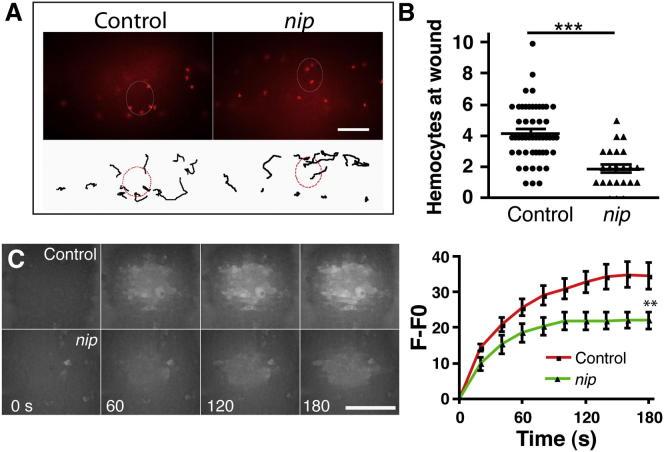
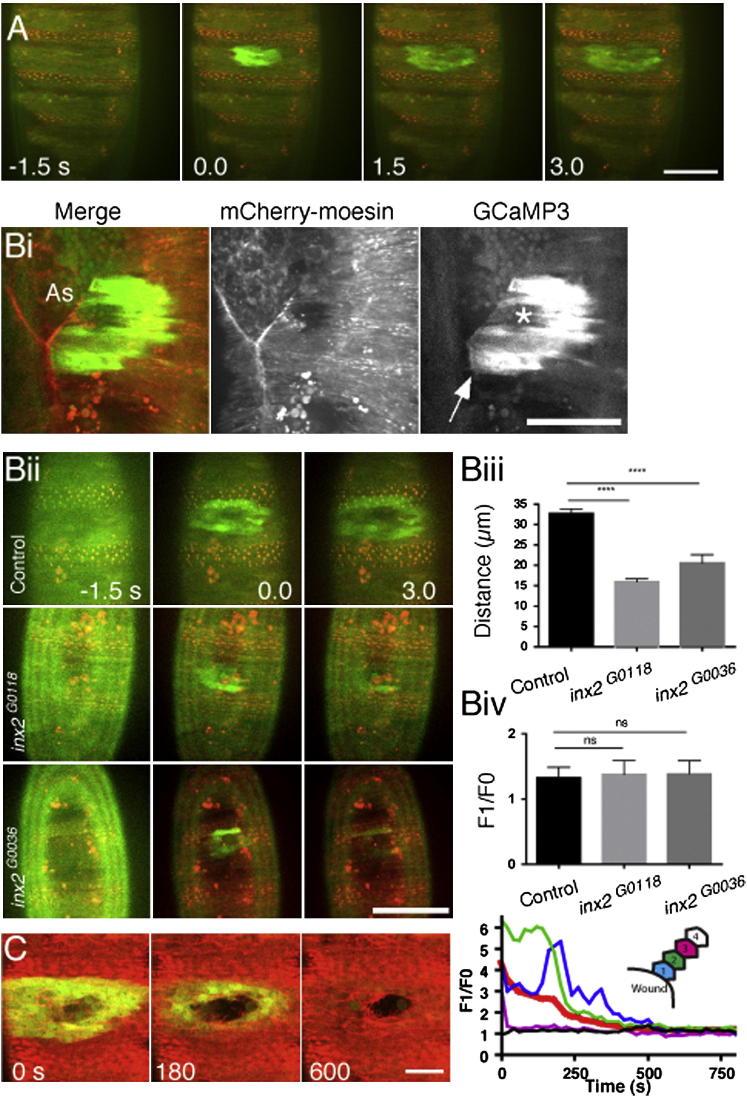
A crucial early wound response is the recruitment of inflammatory cells drawn by danger cues released by the damaged tissue. Hydrogen peroxide (H2O2) has recently been identified as the earliest wound attractant in Drosophila embryos and zebrafish larvae. The H2O2 signal is generated by activation of an NADPH oxidase, DUOX, and as a consequence, the first inflammatory cells are recruited to the wound within minutes. To date, nothing is known about how wounding activates DUOX. Here, we show that laser wounding of the Drosophila embryo epidermis triggers an instantaneous calcium flash, which travels as a wave via gap junctions several cell rows back from the wound edge. Blocking this calcium flash inhibits H2O2 release at the wound site and leads to a reduction in the number of immune cells migrating to the wound. We suggest that the wound-induced calcium flash activates DUOX via an EF hand calcium-binding motif and thus triggers the production of the attractant damage cue H2O2. Therefore, calcium represents the earliest signal in the wound inflammatory response.
一个关键的早期创伤反应是通过损伤组织释放的危险信号招募炎症细胞。最近,过氧化氢 (H2O2) 被确定为果蝇胚胎和斑马鱼幼虫中最早的伤口吸引剂。H2O2 信号是由 NADPH 氧化酶 DUOX 的激活产生的,因此,第一批炎症细胞在几分钟内被招募到伤口处。迄今为止,对于创伤如何激活 DUOX 知之甚少。在这里,我们表明,激光对果蝇胚胎表皮的创伤会引发瞬时钙闪光,该闪光通过缝隙连接以波的形式从前缘向后传播几个细胞行。阻断这种钙闪光会抑制伤口部位的 H2O2 释放,并导致迁移到伤口的免疫细胞数量减少。我们认为,创伤诱导的钙闪光通过 EF 手钙结合基序激活 DUOX,从而触发吸引剂损伤信号 H2O2 的产生。因此,钙是创伤炎症反应中最早的信号。


 Zotero 插件