
从肿瘤学角度对《国际功能、残疾和健康分类》(ICF)框架的批判性探讨:修订建议。
A critical exploration of the International Classification of Functioning, Disability, and Health (ICF) framework from the perspective of oncology: recommendations for revision.
机构信息
Graduate Program in Health and Rehabilitation Sciences, The University of Western Ontario, London, ON, Canada.
出版信息
J Multidiscip Healthc. 2013;6:75-86. doi: 10.2147/JMDH.S40020. Epub 2013 Mar 8.
BACKGROUND
In 2001, the World Health Organization developed the International Classification of Functioning, Disability, and Health (ICF) framework in an effort to attend to the multidimensional health-related concerns of individuals. Historically, although the ICF has frequently been used in a rehabilitation-based context, the World Health Organization has positioned it as a universal framework of health and its related states. Consequently, the ICF has been utilized for a diverse array of purposes in the field of oncology, including: evaluating functioning in individuals with cancer, guiding assessment in oncology rehabilitation, assessing the comprehensiveness of outcome measures utilized in oncology research, assisting in health-related quality of life instrument selection, and comparing the primary concerns of health professionals with those of their patients.
DISCUSSION
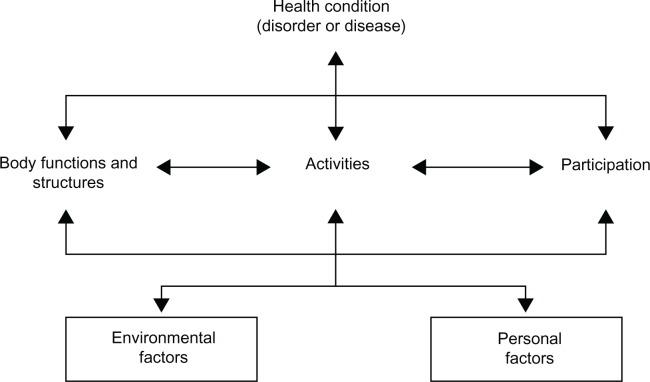
Examination of the ICF through the lens of cancer care highlights the fact that this framework can be a valuable tool to facilitate comprehensive care in oncology, but it currently possesses some areas of limitation that require conceptual revision; to this end, several recommendations have been proposed. Specifically, these proposed recommendations center on the following three areas of the ICF framework: (1) the replacement of the term "health condition" with the more inclusive and dynamic term "health state;" (2) the continuing development and refinement of the personal factors component to ensure issues such as comorbidities can be accounted for appropriately; and (3) the inclusion of a mechanism to account for the subjective dimension of health and functioning (eg, quality of life).
SUMMARY
It is through the expansion of these conceptual parameters that the ICF may become more relevant and applicable to the field of oncology. With these important revisions, the ICF has the potential to provide a broader biopsychosocial perspective of care that captures the diverse range of concerns that arise throughout the continuum of care in oncology.
背景
2001 年,世界卫生组织制定了《国际功能、残疾和健康分类》(ICF)框架,以关注个人多维度的健康相关问题。尽管 ICF 历史上经常在康复背景下使用,但世界卫生组织将其定位为健康及其相关状态的通用框架。因此,ICF 已在肿瘤学领域用于多种目的,包括:评估癌症患者的功能、指导肿瘤康复评估、评估肿瘤学研究中使用的结果测量的全面性、协助选择与健康相关的生活质量工具以及比较卫生专业人员和患者的主要关注点。
讨论
通过癌症护理的视角来审视 ICF,突出了这样一个事实,即该框架可以成为促进肿瘤学综合护理的有价值工具,但它目前存在一些需要概念性修订的局限性;为此,提出了一些建议。具体而言,这些建议集中在 ICF 框架的以下三个方面:(1)用更具包容性和动态性的术语“健康状况”取代“健康状况”一词;(2)继续开发和完善个人因素部分,以确保适当考虑合并症等问题;(3)纳入一种机制,以说明健康和功能的主观维度(例如,生活质量)。
总结
通过扩展这些概念参数,ICF 可能会更相关,并适用于肿瘤学领域。通过这些重要的修订,ICF 有可能提供更广泛的生物心理社会关怀视角,涵盖整个肿瘤学护理连续体中出现的各种关注问题。
 Zotero 插件