
线性生长和生命早期相对体重增加与中低收入国家成人健康和人力资本的关系:五项出生队列研究的结果。
Associations of linear growth and relative weight gain during early life with adult health and human capital in countries of low and middle income: findings from five birth cohort studies.
机构信息
Department of Nutrition, University of North Carolina at Chapel Hill, Chapel Hill, NC 27516-2524, USA.
出版信息
Lancet. 2013 Aug 10;382(9891):525-34. doi: 10.1016/S0140-6736(13)60103-8. Epub 2013 Mar 28.
BACKGROUND
Fast weight gain and linear growth in children in low-income and middle-income countries are associated with enhanced survival and improved cognitive development, but might increase risk of obesity and related adult cardiometabolic diseases. We investigated how linear growth and relative weight gain during infancy and childhood are related to health and human capital outcomes in young adults.
METHODS
We used data from five prospective birth cohort studies from Brazil, Guatemala, India, the Philippines, and South Africa. We investigated body-mass index, systolic and diastolic blood pressure, plasma glucose concentration, height, years of attained schooling, and related categorical indicators of adverse outcomes in young adults. With linear and logistic regression models, we assessed how these outcomes relate to birthweight and to statistically independent measures representing linear growth and weight gain independent of linear growth (relative weight gain) in three age periods: 0-2 years, 2 years to mid-childhood, and mid-childhood to adulthood.
FINDINGS
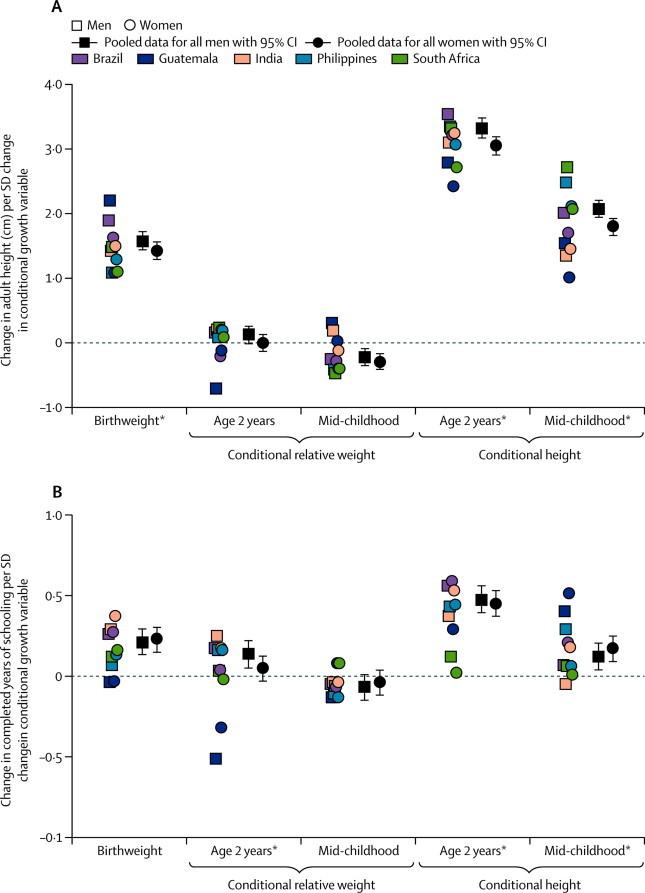
We obtained data for 8362 participants who had at least one adult outcome of interest. A higher birthweight was consistently associated with an adult body-mass index of greater than 25 kg/m(2) (odds ratio 1·28, 95% CI 1·21-1·35) and a reduced likelihood of short adult stature (0·49, 0·44-0·54) and of not completing secondary school (0·82, 0·78-0·87). Faster linear growth was strongly associated with a reduced risk of short adult stature (age 2 years: 0·23, 0·20-0·52; mid-childhood: 0·39, 0·36-0·43) and of not completing secondary school (age 2 years: 0·74, 0·67-0·78; mid-childhood: 0·87, 0·83-0·92), but did raise the likelihood of overweight (age 2 years: 1·24, 1·17-1·31; mid-childhood: 1·12, 1·06-1·18) and elevated blood pressure (age 2 years: 1·12, 1·06-1·19; mid-childhood: 1·07, 1·01-1·13). Faster relative weight gain was associated with an increased risk of adult overweight (age 2 years: 1·51, 1·43-1·60; mid-childhood: 1·76, 1·69-1·91) and elevated blood pressure (age 2 years: 1·07, 1·01-1·13; mid-childhood: 1·22, 1·15-1·30). Linear growth and relative weight gain were not associated with dysglycaemia, but a higher birthweight was associated with decreased risk of the disorder (0·89, 0·81-0·98).
INTERPRETATION
Interventions in countries of low and middle income to increase birthweight and linear growth during the first 2 years of life are likely to result in substantial gains in height and schooling and give some protection from adult chronic disease risk factors, with few adverse trade-offs.
FUNDING
Wellcome Trust and Bill & Melinda Gates Foundation.
背景
在中低收入国家,儿童体重快速增加和线性生长与生存能力提高和认知发育改善有关,但可能会增加肥胖和相关成年心血管代谢疾病的风险。我们研究了婴儿期和儿童期的线性生长和相对体重增加与年轻人的健康和人力资本结果之间的关系。
方法
我们使用了来自巴西、危地马拉、印度、菲律宾和南非的五项前瞻性出生队列研究的数据。我们调查了年轻人的身体质量指数、收缩压和舒张压、血浆葡萄糖浓度、身高、受教育年限,以及相关不良结局的分类指标。我们使用线性和逻辑回归模型,评估了这些结果与出生体重以及三个年龄阶段(0-2 岁、2 岁至儿童中期和儿童中期至成年)中代表独立于线性生长的线性生长和体重增加的统计学独立指标(相对体重增加)与以下成人结果的关系:身体质量指数大于 25kg/m2、成人身高偏矮、未完成中学学业、超重、血压升高、血糖异常。
结果
我们获得了至少有一项感兴趣的成人结果的数据,共 8362 名参与者。较高的出生体重与成人身体质量指数大于 25kg/m2(比值比 1.28,95%置信区间 1.21-1.35)和成人身高偏矮(0.49,0.44-0.54)和未完成中学学业(0.82,0.78-0.87)的风险降低有关。较快的线性生长与成人身高偏矮(2 岁时:0.23,0.20-0.52;儿童中期:0.39,0.36-0.43)和未完成中学学业(2 岁时:0.74,0.67-0.78;儿童中期:0.87,0.83-0.92)的风险降低有关,但增加了超重(2 岁时:1.24,1.17-1.31;儿童中期:1.12,1.06-1.18)和血压升高(2 岁时:1.12,1.06-1.19;儿童中期:1.07,1.01-1.13)的风险。较快的相对体重增加与成人超重(2 岁时:1.51,1.43-1.60;儿童中期:1.76,1.69-1.91)和血压升高(2 岁时:1.07,1.01-1.13;儿童中期:1.22,1.15-1.30)的风险增加有关。线性生长和相对体重增加与血糖异常无关,但较高的出生体重与降低该疾病的风险有关(0.89,0.81-0.98)。
解释
在中低收入国家,增加出生体重和生命最初 2 年的线性生长的干预措施可能会使身高和受教育程度显著提高,并为成人慢性病风险因素提供一定的保护,几乎没有不良的权衡取舍。
资金
英国惠康信托基金会和比尔及梅琳达·盖茨基金会。


 Zotero 插件