
尼泊尔平原出生队列中婴儿生长的决定因素
Determinants of Infant Growth in a Birth Cohort in the Nepal Plains.
作者信息
Busert-Sebela Laura, Cortina-Borja Mario, Paudel Vikas, Devakumar Delanjathan, Wells Jonathan C K, Manandhar Dharma S, Saville Naomi M
机构信息
Great Ormond Street Institute of Child Health, University College London, London, UK.
Mother and Infant Research Activities, Kathmandu, Nepal.
出版信息
Matern Child Nutr. 2025 Jul;21(3):e70004. doi: 10.1111/mcn.70004. Epub 2025 Feb 26.
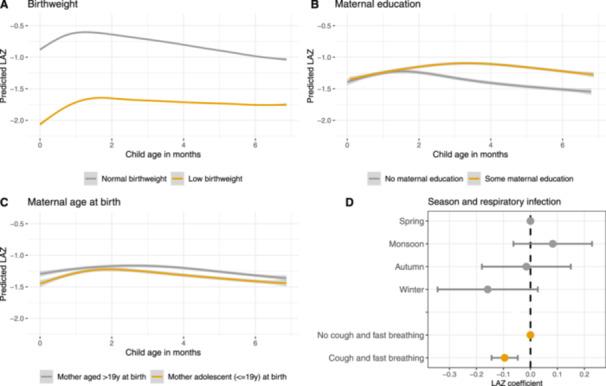
This study aimed to identify the determinants of infant growth in terms of length-for-age z-score (LAZ) in a birth cohort (n = 602) in the plains of Nepal. Children were enrolled within 72 h of birth and followed-up every 28 days until they were 2 years. We fitted mixed-effects linear regression models controlling for multiple measurements within individuals to examine the impact of household and maternal factors, feeding practices and infection on infant LAZ. We conducted separate analyses for the age periods 0-6 months (exclusive breastfeeding period) and 7-24 months (complementary feeding period) to check whether the importance of determinants differed by child age. Maternal factors related to both the environment in-utero and in postnatal life were the most important determinants of infant growth. The overall most important determinant of growth was low birthweight. At birth, babies born with low birthweight had a -1.21 (-1.38, -1.05) lower LAZ compared to normal birthweight babies. The difference in LAZ between low birthweight and normal birthweight babies attenuated with age but low birthweight remained the factor with the largest effect size. The second largest factor was maternal education. Infants of mothers with any level of education had a 0.22 (0.07, 0.38) higher LAZ in the 7-24 months age-period than those whose mothers had never been to school. Other relevant determinants were adolescent pregnancy, minimum dietary diversity, symptoms of respiratory infection, household food insecurity, season and maternal absence. The importance of maternal factors for infant growth calls for public health interventions targeting girls and young women.
本研究旨在确定尼泊尔平原地区一个出生队列(n = 602)中年龄别身长Z评分(LAZ)方面婴儿生长的决定因素。儿童在出生后72小时内入组,并每28天随访一次,直至2岁。我们拟合了混合效应线性回归模型,控制个体内的多次测量,以检验家庭和母亲因素、喂养方式及感染对婴儿LAZ的影响。我们对0至6个月(纯母乳喂养期)和7至24个月(辅食添加期)这两个年龄段分别进行分析,以检查决定因素的重要性是否因儿童年龄而异。与子宫内和产后生活环境相关的母亲因素是婴儿生长的最重要决定因素。生长的总体最重要决定因素是低出生体重。出生时,低出生体重儿的LAZ比正常出生体重儿低1.21(-1.38,-1.05)。低出生体重儿与正常出生体重儿之间的LAZ差异随年龄增长而减小,但低出生体重仍然是效应量最大的因素。第二大因素是母亲的教育程度。在7至24个月龄期间,母亲受过任何教育水平的婴儿的LAZ比母亲从未上学的婴儿高0.22(0.07,0.38)。其他相关决定因素包括青少年怀孕、最低饮食多样性、呼吸道感染症状、家庭粮食不安全、季节和母亲不在家。母亲因素对婴儿生长的重要性要求针对女孩和年轻女性开展公共卫生干预措施。


 Zotero 插件