
美国通过糖化血红蛋白和空腹血糖定义的糖尿病前期患病率的变化趋势:1999-2010 年全国健康和营养调查。
Secular changes in U.S. Prediabetes prevalence defined by hemoglobin A1c and fasting plasma glucose: National Health and Nutrition Examination Surveys, 1999-2010.
机构信息
Division of Diabetes Translation, Centers for Disease Control and Prevention, Atlanta, Georgia, USA.
出版信息
Diabetes Care. 2013 Aug;36(8):2286-93. doi: 10.2337/dc12-2563. Epub 2013 Apr 19.
OBJECTIVE
Using a nationally representative sample of the civilian noninstitutionalized U.S. population, we estimated prediabetes prevalence and its changes during 1999-2010.
RESEARCH DESIGN AND METHODS
Data were from 19,182 nonpregnant individuals aged ≥ 12 years who participated in the 1999-2010 National Health and Nutrition Examination Surveys. We defined prediabetes as hemoglobin A1c (A1C) 5.7 to <6.5% (39 to <48 mmol/mol, A1C5.7) or fasting plasma glucose (FPG) 100 to <126 mg/dL (impaired fasting glucose [IFG]). We estimated the prevalence of prediabetes, A1C5.7, and IFG for 1999-2002, 2003-2006, and 2007-2010. We calculated estimates age-standardized to the 2000 U.S. census population and used logistic regression to compute estimates adjusted for age, sex, race/ethnicity, poverty-to-income ratio, and BMI. Participants with self-reported diabetes, A1C ≥ 6.5% (≥ 48 mmol/mol), or FPG ≥126 mg/dL were included.
RESULTS
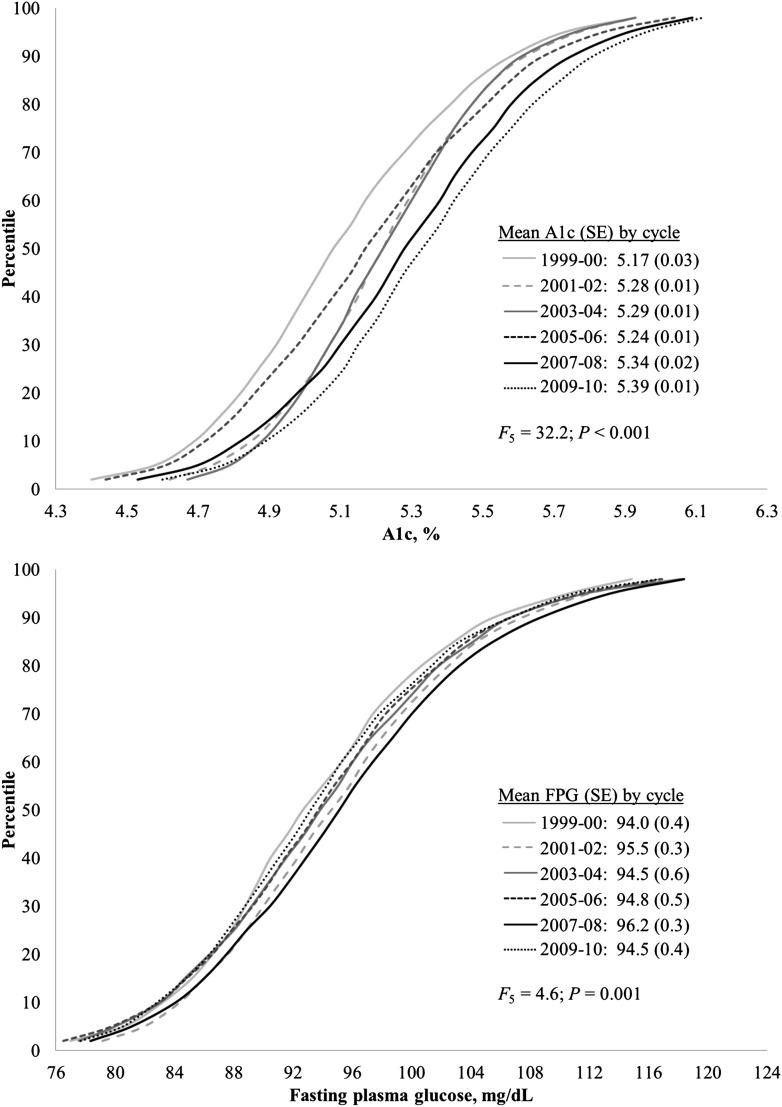
Among those aged ≥ 12 years, age-adjusted prediabetes prevalence increased from 27.4% (95% CI 25.1-29.7) in 1999-2002 to 34.1% (32.5-35.8) in 2007-2010. Among adults aged ≥ 18 years, the prevalence increased from 29.2% (26.8-31.8) to 36.2% (34.5-38.0). As single measures among individuals aged ≥ 12 years, A1C5.7 prevalence increased from 9.5% (8.4-10.8) to 17.8% (16.6-19.0), a relative increase of 87%, whereas IFG remained stable. These prevalence changes were similar among the total population, across subgroups, and after controlling for covariates.
CONCLUSIONS
During 1999-2010, U.S. prediabetes prevalence increased because of increases in A1C5.7. Continuous monitoring of prediabetes is needed to identify, quantify, and characterize the population of high-risk individuals targeted for ongoing diabetes primary prevention efforts.
目的
利用美国非住院的平民总体样本,我们估算了 1999-2010 年期间的糖尿病前期患病率及其变化。
研究设计和方法
数据来自于 19182 名年龄≥12 岁、不包括孕妇的非住院个体,他们参与了 1999-2010 年的国家健康和营养调查。我们将糖尿病前期定义为糖化血红蛋白(HbA1c)5.7 至<6.5%(39 至<48mmol/mol,HbA1c5.7)或空腹血糖(FPG)100 至<126mg/dL(空腹血糖受损[IFG])。我们估算了 1999-2002 年、2003-2006 年和 2007-2010 年的糖尿病前期、HbA1c5.7 和 IFG 的患病率。我们使用标准化到 2000 年美国人口普查的年龄计算了估计值,并使用逻辑回归计算了调整年龄、性别、种族/民族、贫困收入比和 BMI 后的估计值。纳入了自我报告患有糖尿病、HbA1c≥6.5%(≥48mmol/mol)或 FPG≥126mg/dL 的个体。
结果
在≥12 岁的人群中,年龄调整后的糖尿病前期患病率从 1999-2002 年的 27.4%(95%CI 25.1-29.7)增加到 2007-2010 年的 34.1%(32.5-35.8)。在≥18 岁的成年人中,患病率从 29.2%(26.8-31.8)增加到 36.2%(34.5-38.0)。在≥12 岁的个体中,作为单一指标,HbA1c5.7 的患病率从 9.5%(8.4-10.8)增加到 17.8%(16.6-19.0),相对增加了 87%,而 IFG 则保持稳定。这些患病率变化在总人口、亚组之间以及在控制了协变量后都是相似的。
结论
在 1999-2010 年期间,美国的糖尿病前期患病率增加,这是由于 HbA1c5.7 的增加所致。需要持续监测糖尿病前期,以识别、量化和描述高危人群,并针对这些人群开展持续的糖尿病一级预防工作。
 Zotero 插件