
中国结核病发病率的混合季节性预测模型。
A hybrid seasonal prediction model for tuberculosis incidence in China.
机构信息
School of Public Health, Tongji Medical College, Huazhong University of Science and Technology, Wuhan, P.R. China.
出版信息
BMC Med Inform Decis Mak. 2013 May 2;13:56. doi: 10.1186/1472-6947-13-56.
BACKGROUND
Tuberculosis (TB) is a serious public health issue in developing countries. Early prediction of TB epidemic is very important for its control and intervention. We aimed to develop an appropriate model for predicting TB epidemics and analyze its seasonality in China.
METHODS
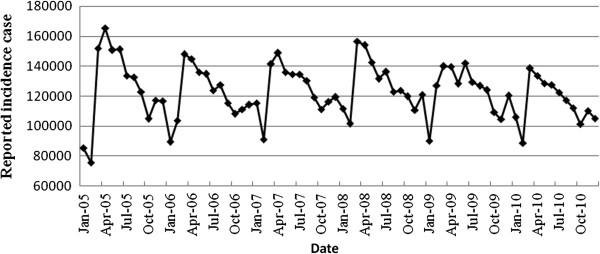
Data of monthly TB incidence cases from January 2005 to December 2011 were obtained from the Ministry of Health, China. A seasonal autoregressive integrated moving average (SARIMA) model and a hybrid model which combined the SARIMA model and a generalized regression neural network model were used to fit the data from 2005 to 2010. Simulation performance parameters of mean square error (MSE), mean absolute error (MAE) and mean absolute percentage error (MAPE) were used to compare the goodness-of-fit between these two models. Data from 2011 TB incidence data was used to validate the chosen model.
RESULTS
Although both two models could reasonably forecast the incidence of TB, the hybrid model demonstrated better goodness-of-fit than the SARIMA model. For the hybrid model, the MSE, MAE and MAPE were 38969150, 3406.593 and 0.030, respectively. For the SARIMA model, the corresponding figures were 161835310, 8781.971 and 0.076, respectively. The seasonal trend of TB incidence is predicted to have lower monthly incidence in January and February and higher incidence from March to June.
CONCLUSIONS
The hybrid model showed better TB incidence forecasting than the SARIMA model. There is an obvious seasonal trend of TB incidence in China that differed from other countries.
背景
结核病(TB)是发展中国家的一个严重的公共卫生问题。对结核病流行的早期预测对其控制和干预非常重要。我们旨在建立一种合适的模型来预测结核病流行,并分析中国结核病的季节性。
方法
从中国卫生部获得 2005 年 1 月至 2011 年 12 月的每月结核病发病率数据。使用季节性自回归综合移动平均(SARIMA)模型和将 SARIMA 模型与广义回归神经网络模型相结合的混合模型来拟合 2005 年至 2010 年的数据。使用均方误差(MSE)、平均绝对误差(MAE)和平均绝对百分比误差(MAPE)的模拟性能参数来比较这两种模型的拟合优度。使用 2011 年结核病发病率数据来验证所选模型。
结果
尽管这两种模型都可以合理地预测结核病的发病率,但混合模型的拟合优度优于 SARIMA 模型。对于混合模型,MSE、MAE 和 MAPE 分别为 38969150、3406.593 和 0.030。对于 SARIMA 模型,相应的数字分别为 161835310、8781.971 和 0.076。预测结核病发病率的季节性趋势表明,1 月和 2 月的月发病率较低,3 月至 6 月的发病率较高。
结论
混合模型在结核病发病率预测方面优于 SARIMA 模型。中国的结核病发病率存在明显的季节性趋势,与其他国家不同。


 Zotero 插件