
利用 SARIMA-NARNNX 混合模型分析 1997 年至 2025 年中国大陆结核病发病率的时间趋势。
Temporal trends analysis of tuberculosis morbidity in mainland China from 1997 to 2025 using a new SARIMA-NARNNX hybrid model.
机构信息
Department of Epidemiology and Health Statistics, School of Public Health, North China University of Science and Technology, Tangshan, China.
Department of Occupational and Environmental Health, School of Public Health, Capital Medical University, Beijing, China.
出版信息
BMJ Open. 2019 Jul 31;9(7):e024409. doi: 10.1136/bmjopen-2018-024409.
OBJECTIVE
Tuberculosis (TB) remains a major deadly threat in mainland China. Early warning and advanced response systems play a central role in addressing such a wide-ranging threat. The purpose of this study is to establish a new hybrid model combining a seasonal autoregressive integrated moving average (SARIMA) model and a non-linear autoregressive neural network with exogenous input (NARNNX) model to understand the future epidemiological patterns of TB morbidity.
METHODS
We develop a SARIMA-NARNNX hybrid model for forecasting future levels of TB incidence based on data containing 255 observations from January 1997 to March 2018 in mainland China, and the ultimate simulating and forecasting performances were compared with the basic SARIMA, non-linear autoregressive neural network (NARNN) and error-trend-seasonal (ETS) approaches, as well as the SARIMA-generalised regression neural network (GRNN) and SARIMA-NARNN hybrid techniques.
RESULTS
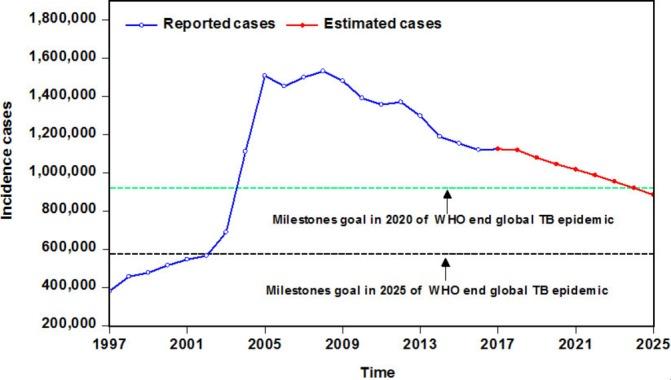
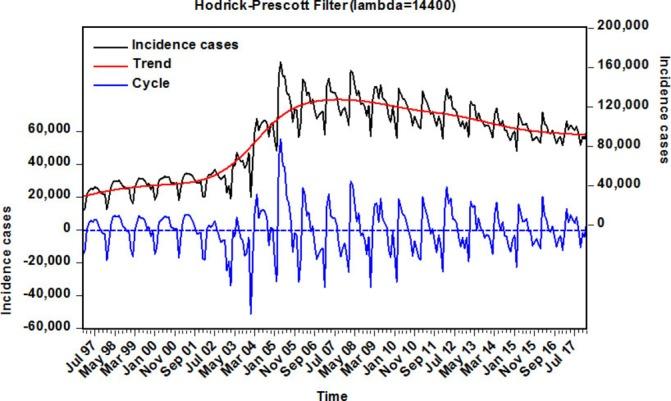
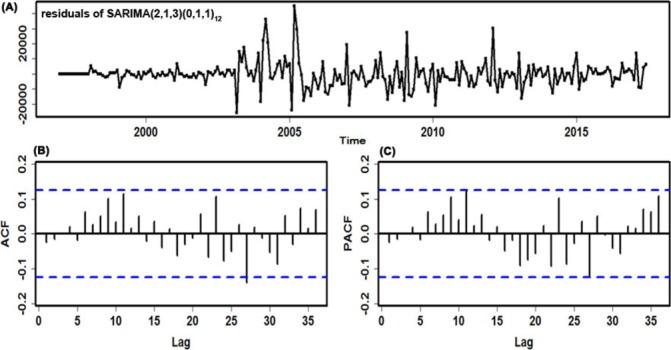
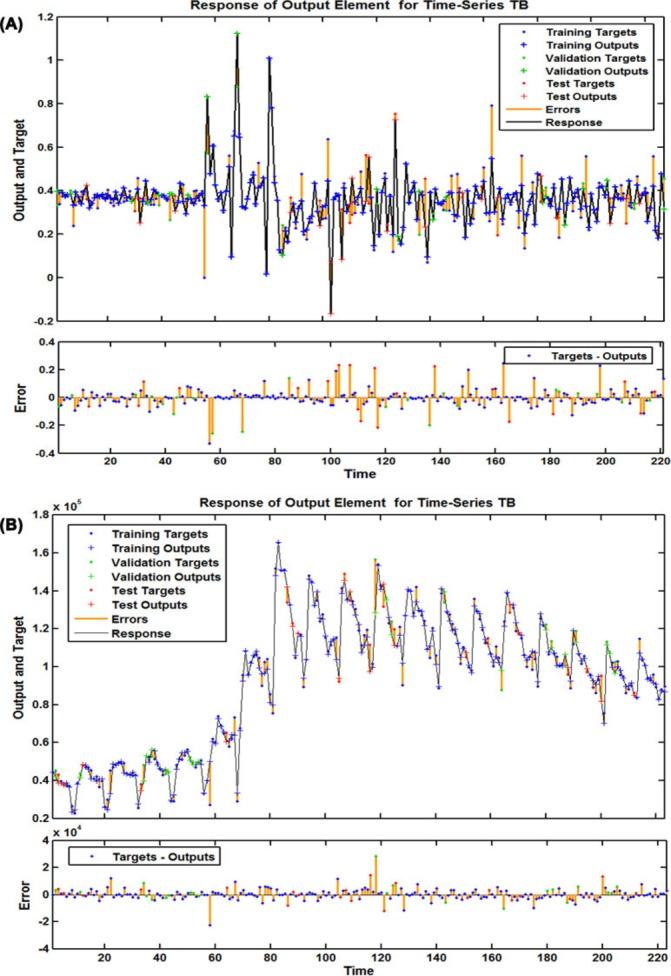
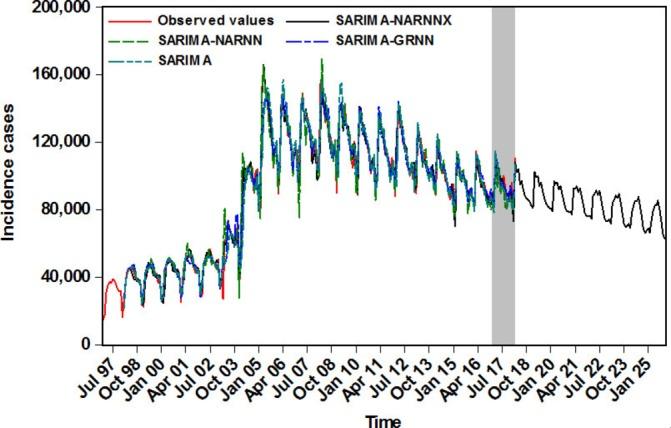
In terms of the root mean square error, mean absolute error, mean error rate and mean absolute percentage error, the identified best-fitting SARIMA-NARNNX combined model with 17 hidden neurons and 4 feedback delays had smaller values in both in-sample simulating scheme and the out-of-sample forecasting scheme than the preferred single SARIMA(2,1,3)(0,1,1) model, a NARNN with 19 hidden neurons and 6 feedback delays and ETS(M,A,A), and the best-performing SARIMA-GRNN and SARIMA-NARNN models with 32 hidden neurons and 6 feedback delays. Every year, there was an obvious high-risk season for the notified TB cases in March and April. Importantly, the epidemic levels of TB from 2006 to 2017 trended slightly downward. According to the projection results from 2018 to 2025, TB incidence will continue to drop by 3.002% annually but will remain high.
CONCLUSIONS
The new SARIMA-NARNNX combined model visibly outperforms the other methods. This hybrid model should be used for forecasting the long-term epidemic patterns of TB, and it may serve as a beneficial and effective tool for controlling this disease.
目的
结核病(TB)仍然是中国大陆地区的主要致命威胁。早期预警和高级响应系统在应对如此广泛的威胁方面发挥着核心作用。本研究的目的是建立一个新的混合模型,结合季节性自回归综合移动平均(SARIMA)模型和具有外部输入的非线性自回归神经网络(NARNNX)模型,以了解结核病发病率的未来流行模式。
方法
我们基于中国大陆 1997 年 1 月至 2018 年 3 月包含 255 个观测值的数据,开发了一种 SARIMA-NARNNX 混合模型来预测未来的结核病发病率水平,并将最终的模拟和预测性能与基本 SARIMA、非线性自回归神经网络(NARNN)和误差趋势季节性(ETS)方法以及 SARIMA-广义回归神经网络(GRNN)和 SARIMA-NARNN 混合技术进行了比较。
结果
就均方根误差、平均绝对误差、平均误差率和平均绝对百分比误差而言,在样本内模拟方案和样本外预测方案中,具有 17 个隐藏神经元和 4 个反馈延迟的最佳拟合 SARIMA-NARNNX 组合模型的数值均小于首选的单个 SARIMA(2,1,3)(0,1,1)模型、具有 19 个隐藏神经元和 6 个反馈延迟的 NARNN 和 ETS(M,A,A),以及具有 32 个隐藏神经元和 6 个反馈延迟的性能最佳的 SARIMA-GRNN 和 SARIMA-NARNN 模型。每年 3 月和 4 月都有一个明显的结核病报告病例高发季节。重要的是,2006 年至 2017 年期间结核病的流行水平呈轻微下降趋势。根据 2018 年至 2025 年的预测结果,结核病发病率将继续以每年 3.002%的速度下降,但仍将居高不下。
结论
新的 SARIMA-NARNNX 组合模型明显优于其他方法。该混合模型可用于预测结核病的长期流行模式,它可能成为控制这种疾病的有益和有效工具。

 Zotero 插件