
基于SARIMA-NNNAR的高级数据驱动混合模型用于中国青海省结核病发病率时间序列预测
An Advanced Data-Driven Hybrid Model of SARIMA-NNNAR for Tuberculosis Incidence Time Series Forecasting in Qinghai Province, China.
作者信息
Wang Yongbin, Xu Chunjie, Li Yuchun, Wu Weidong, Gui Lihui, Ren Jingchao, Yao Sanqiao
机构信息
Department of Epidemiology and Health Statistics, School of Public Health, Xinxiang Medical University, Xinxiang, Henan, People's Republic of China.
Department of Occupational and Environmental Health, School of Public Health, Capital Medical University, Beijing, People's Republic of China.
出版信息
Infect Drug Resist. 2020 Mar 24;13:867-880. doi: 10.2147/IDR.S232854. eCollection 2020.
PURPOSE
Qinghai province has invariably been under an ongoing threat of tuberculosis (TB), which has not only been an obstacle to local development but also hampers the prevention and control process for ending the TB epidemic. Forecasting for future epidemics will serve as the base for early detection and planning resource requirements. Here, we aim to develop an advanced detection technique driven by the recent TB incidence series, by fusing a seasonal autoregressive integrated moving average (SARIMA) with a neural network nonlinear autoregression (NNNAR).
METHODS
We collected the TB incidence data between January 2004 and December 2016. Subsequently, the subsamples from January 2004 to December 2015 were employed to measure the efficiency of the single SARIMA, NNNAR, and hybrid SARIMA-NNNAR approaches, whereas the hold-out subsamples were used to test their predictive performances. We finally selected the best-performing technique by considering minimum metrics including the mean absolute error, root-mean-squared error, mean absolute percentage error and mean error rate .
RESULTS
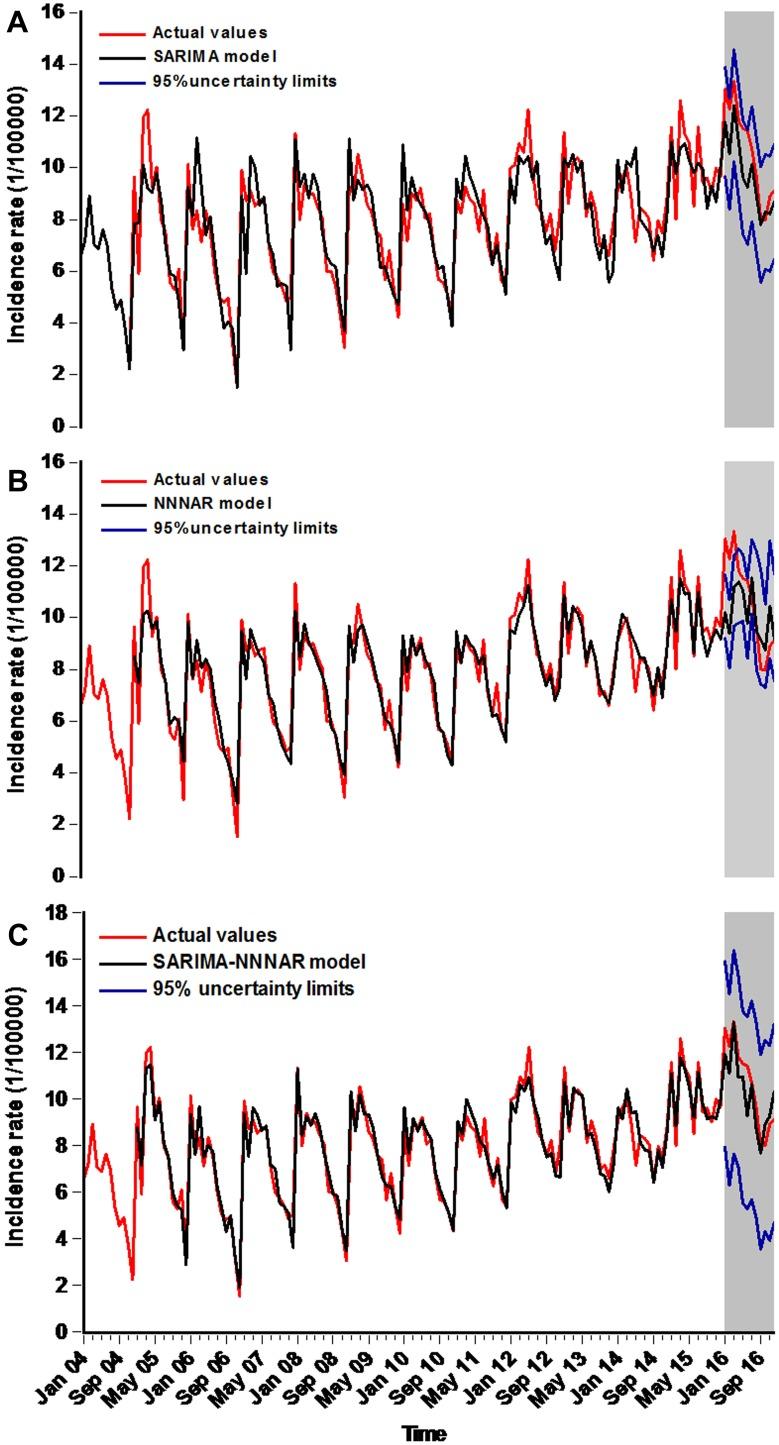
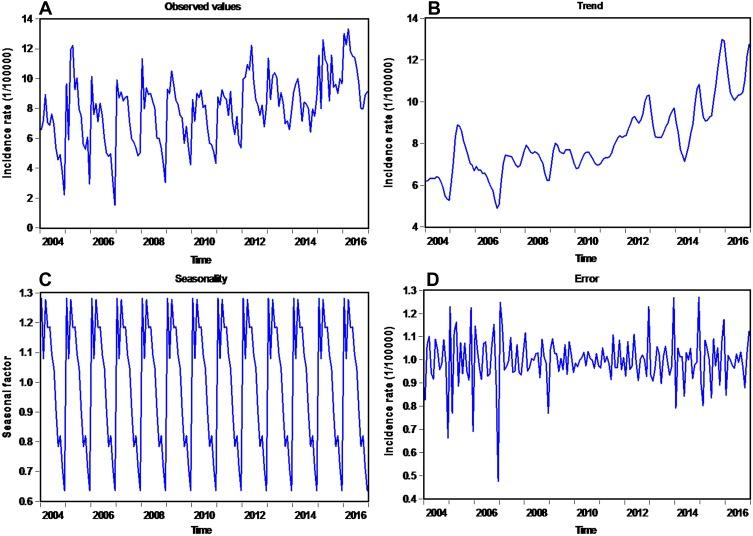
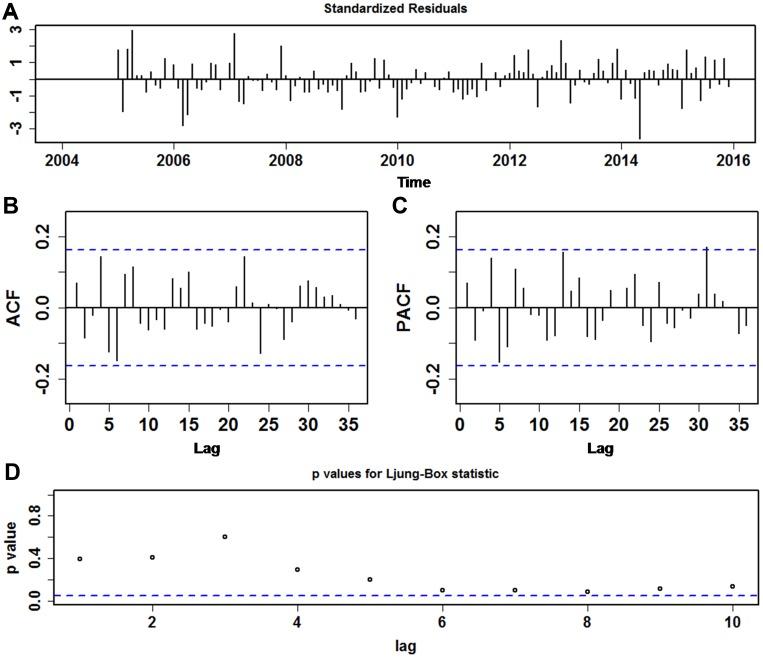
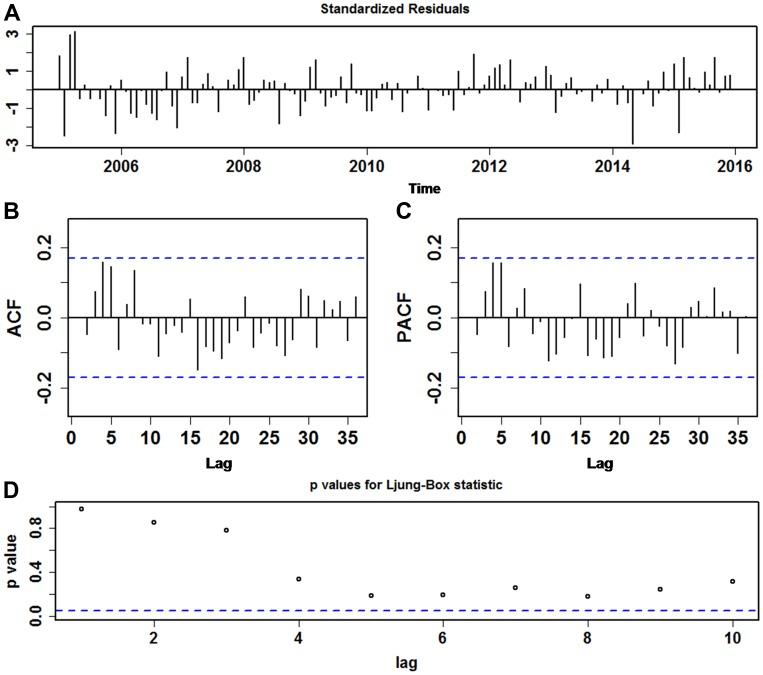
During 2004-2016, the reported TB cases totaled 71,080 resulting in the morbidity of 97.624 per 100,000 persons annually in Qinghai province and showed notable peak activities in late winter and early spring. Moreover, the TB incidence rate was surging by 5% per year. According to the above-mentioned criteria, the best-fitting basic and hybrid techniques consisted of SARIMA(2,0,2)(1,1,0), NNNAR(7,1,4) and SARIMA(2,0,2)(1,1,0)-NNNAR(3,1,7), respectively. Amongst them, the hybrid technique showed superiority in both mimic and predictive parts, with the lowest values of the measured metrics in both the parts. The sensitivity analysis indicated the same results.
CONCLUSION
The best-mimicking SARIMA-NNNAR hybrid model outperforms the best-simulating basic SARIMA and NNNAR models, and has a potential application in forecasting and assessing the TB epidemic trends in Qinghai. Furthermore, faced with the major challenge of the ongoing upsurge in TB incidence in Qinghai, there is an urgent need for formulating specific preventive and control measures.
目的
青海省一直面临结核病(TB)的持续威胁,这不仅阻碍了当地发展,还妨碍了结核病流行的防控进程。对未来疫情进行预测将为早期发现和规划资源需求提供依据。在此,我们旨在通过将季节性自回归积分滑动平均(SARIMA)与神经网络非线性自回归(NNNAR)相结合,开发一种由近期结核病发病率序列驱动的先进检测技术。
方法
我们收集了2004年1月至2016年12月的结核病发病数据。随后,使用2004年1月至2015年12月的子样本测量单一SARIMA、NNNAR和混合SARIMA-NNNAR方法的效率,而留出的子样本用于测试它们的预测性能。我们最终通过考虑包括平均绝对误差、均方根误差、平均绝对百分比误差和平均误差率在内的最小指标来选择性能最佳的技术。
结果
2004 - 2016年期间,青海省报告的结核病病例总数为71,080例,年发病率为每10万人97.624例,在冬末和早春呈现出明显的发病高峰。此外,结核病发病率每年以5%的速度飙升。根据上述标准,最佳拟合的基本技术和混合技术分别为SARIMA(2,0,2)(1,1,0)、NNNAR(7,1,4)和SARIMA(2,0,2)(1,1,0)-NNNAR(3,1,7)。其中,混合技术在模拟和预测部分均表现出优势,两部分的测量指标值均最低。敏感性分析表明结果相同。
结论
最佳模拟的SARIMA-NNNAR混合模型优于最佳模拟的基本SARIMA和NNNAR模型,在预测和评估青海省结核病流行趋势方面具有潜在应用价值。此外,面对青海省结核病发病率持续上升的重大挑战,迫切需要制定具体的防控措施。
 Zotero 插件