
衰老对自然杀伤细胞功能的影响及其对老年人健康的潜在影响。
The impact of ageing on natural killer cell function and potential consequences for health in older adults.
机构信息
MRC-ARUK Centre for Musculoskeletal Ageing Research, School of Immunity and Infection, University of Birmingham, Birmingham B15 2TT, UK.
出版信息
Ageing Res Rev. 2013 Sep;12(4):1069-78. doi: 10.1016/j.arr.2013.04.003. Epub 2013 May 6.
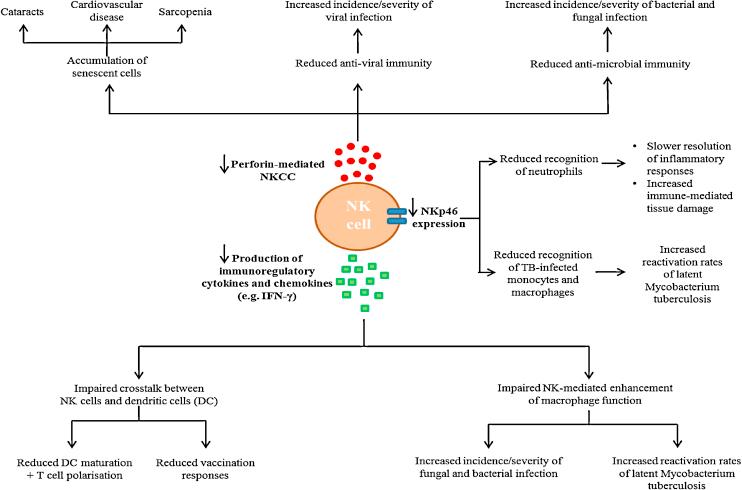
Forming the first line of defence against virally infected and malignant cells, natural killer (NK) cells are critical effector cells of the innate immune system. With age, significant impairments have been reported in the two main mechanisms by which NK cells confer host protection: direct cytotoxicity and the secretion of immunoregulatory cytokines and chemokines. In elderly subjects, decreased NK cell activity has been shown to be associated with an increased incidence and severity of viral infection, highlighting the clinical implications that age-associated changes in NK cell biology have on the health of older adults. However, is an increased susceptibility to viral infection the only consequence of these age-related changes in NK cell function? Recently, evidence has emerged that has shown that in addition to eliminating transformed cells, NK cells are involved in many other biological processes such as immune regulation, anti-microbial immune responses and the recognition and elimination of senescent cells, novel functions that involve NK-mediated cytotoxicity and/or cytokine production. Thus, the decrease in NK cell function that accompanies physiological ageing is likely to have wider implications for the health of older adults than originally thought. Here, we give a detailed description of the changes in NK cell biology that accompany human ageing and propose that certain features of the ageing process such as: (i) the increased reactivation rates of latent Mycobacterium tuberculosis, (ii) the slower resolution of inflammatory responses and (iii) the increased incidence of bacterial and fungal infection are attributable in part to an age-associated decline in NK cell function.
自然杀伤 (NK) 细胞作为抵御病毒感染和恶性细胞的第一道防线,是先天免疫系统的关键效应细胞。随着年龄的增长,NK 细胞发挥宿主保护作用的两种主要机制——直接细胞毒性和分泌免疫调节细胞因子和趋化因子的能力——显著受损。在老年人群中,NK 细胞活性的降低与病毒感染发生率和严重程度的增加有关,这突出表明 NK 细胞生物学的年龄相关性变化对老年人健康的临床意义。然而,易感染病毒是否是 NK 细胞功能这些与年龄相关变化的唯一后果?最近的证据表明,除了消除转化细胞外,NK 细胞还参与许多其他生物学过程,如免疫调节、抗微生物免疫反应以及衰老细胞的识别和消除,这些新功能涉及 NK 介导的细胞毒性和/或细胞因子产生。因此,伴随生理衰老的 NK 细胞功能下降,可能对老年人的健康产生比最初想象的更广泛的影响。在这里,我们详细描述了伴随人类衰老的 NK 细胞生物学变化,并提出衰老过程的某些特征,如:(i)潜伏结核分枝杆菌再激活率增加,(ii)炎症反应的缓解速度较慢,(iii)细菌和真菌感染的发生率增加,部分归因于 NK 细胞功能的年龄相关下降。

 Zotero 插件