
电针对减少小鼠可卡因诱导的癫痫发作和死亡率有效。
Electroacupuncture reduces cocaine-induced seizures and mortality in mice.
机构信息
Graduate Institute of Acupuncture Science, China Medical University, Taichung 40402, Taiwan.
出版信息
Evid Based Complement Alternat Med. 2013;2013:134610. doi: 10.1155/2013/134610. Epub 2013 Apr 17.
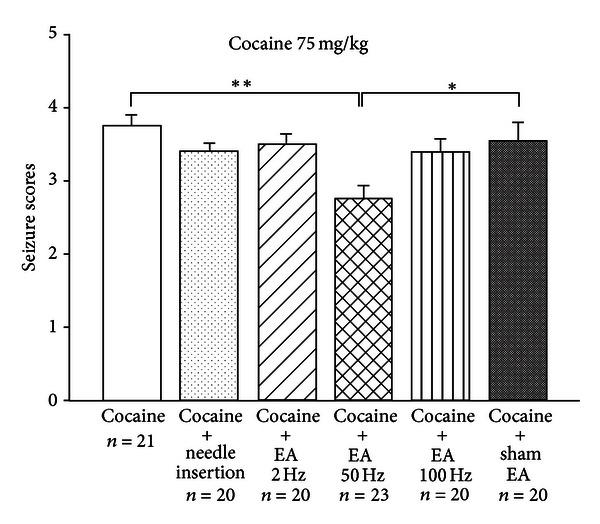
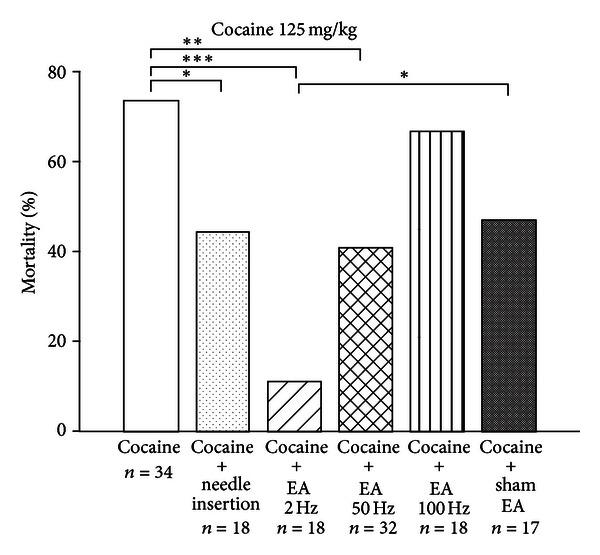
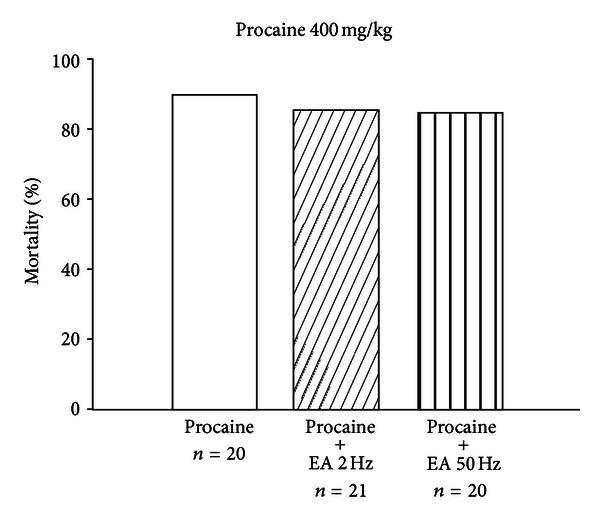
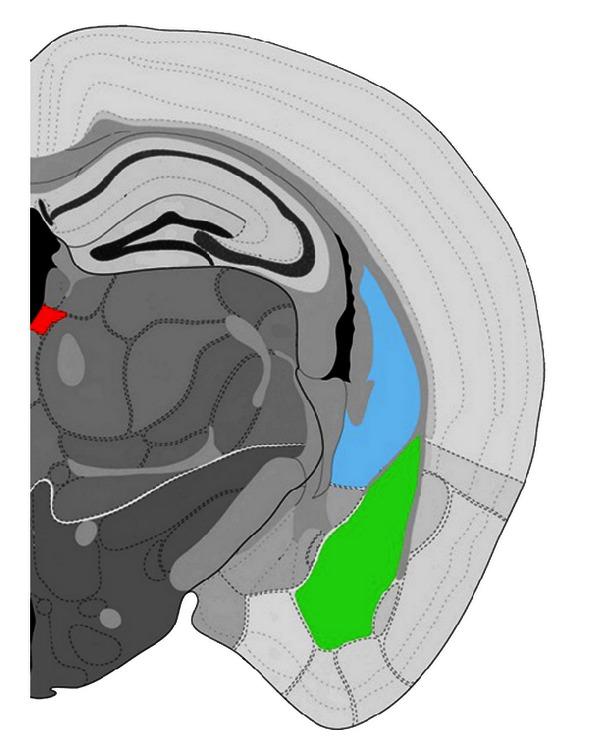
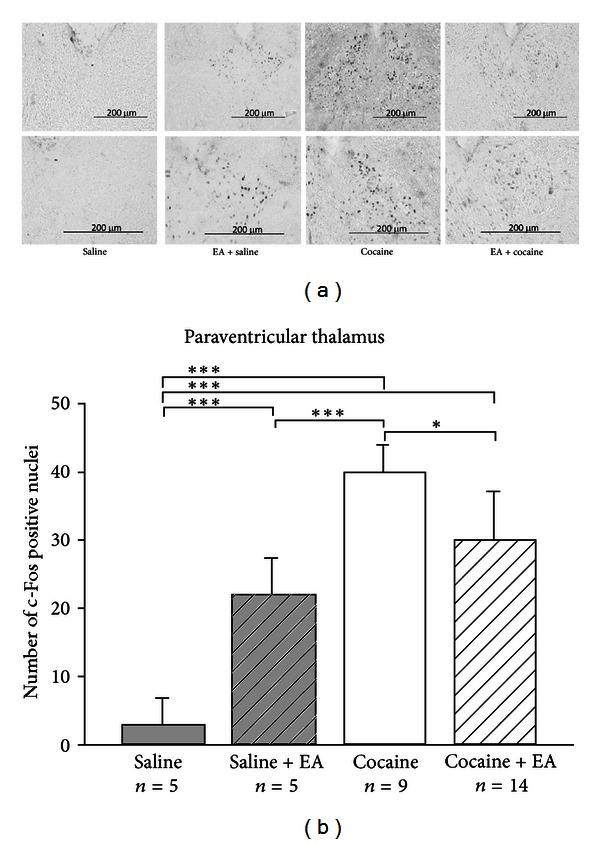
The aims of this study were to characterize the protective profile of electroacupuncture (EA) on cocaine-induced seizures and mortality in mice. Mice were treated with EA (2 Hz, 50 Hz, and 100 Hz), or they underwent needle insertion without anesthesia at the Dazhui (GV14) and Baihui (GV20) acupoints before cocaine administration. EA at 50 Hz applied to GV14 and GV20 significantly reduced the seizure severity induced by a single dose of cocaine (75 mg/kg; i.p.). Furthermore, needle insertion into GV14 and GV20 and EA at 2 Hz and 50 Hz at both acupoints significantly reduced the mortality rate induced by a single lethal dose of cocaine (125 mg/kg; i.p.). In the sham control group, EA at 50 Hz applied to bilateral Tianzong (SI11) acupoints had no protective effects against cocaine. In addition, EA at 50 Hz applied to GV14 and GV20 failed to reduce the incidence of seizures and mortality induced by the local anesthetic procaine. In an immunohistochemistry study, EA (50 Hz) pretreatment at GV14 and GV20 decreased cocaine (75 mg/kg; i.p.)-induced c-Fos expression in the paraventricular thalamus. While the dopamine D3 receptor antagonist, SB-277011-A (30 mg/kg; s.c), did not by itself affect cocaine-induced seizure severity, it prevented the effects of EA on cocaine-induced seizures. These results suggest that EA alleviates cocaine-induced seizures and mortality and that the dopamine D3 receptor is involved, at least in part, in the anticonvulsant effects of EA in mice.
本研究旨在探讨电针对可卡因诱导的小鼠惊厥和死亡率的保护作用。将小鼠分别用 2 Hz、50 Hz 和 100 Hz 的电针(EA)处理,或在给予可卡因前在大椎穴(GV14)和百会穴(GV20)进行针刺但不麻醉,然后观察其对可卡因诱导的惊厥和死亡率的影响。结果发现,电针频率为 50 Hz,应用于 GV14 和 GV20 穴位时,可显著降低单次可卡因(75mg/kg,腹腔注射)诱导的惊厥严重程度。此外,针刺 GV14 和 GV20 穴,或双侧天宗穴(SI11)给予 2 Hz 和 50 Hz 的 EA,均可显著降低单次致死剂量可卡因(125mg/kg,腹腔注射)诱导的死亡率。在假手术对照组中,双侧天宗穴(SI11)给予 50 Hz 的 EA 对可卡因没有保护作用。此外,电针频率为 50 Hz,应用于 GV14 和 GV20 穴时,不能降低可卡因(75mg/kg,腹腔注射)诱导的 c-Fos 表达。而多巴胺 D3 受体拮抗剂 SB-277011-A(30mg/kg,皮下注射)本身并不影响可卡因诱导的惊厥严重程度,但可阻断电针对可卡因诱导的惊厥的作用。这些结果表明,电针可减轻可卡因诱导的惊厥和死亡率,而多巴胺 D3 受体至少部分参与了电针对小鼠的抗惊厥作用。



 Zotero 插件