
丁酰苯类异羟肟酸(SAHA)对卵巢癌细胞侵袭表型的抗肿瘤作用及其分子机制。
The anti-tumor effects and molecular mechanisms of suberoylanilide hydroxamic acid (SAHA) on the aggressive phenotypes of ovarian carcinoma cells.
机构信息
Department of Gynecology, the First Affiliated Hospital of China Medical University, Shenyang, China.
出版信息
PLoS One. 2013 Nov 13;8(11):e79781. doi: 10.1371/journal.pone.0079781. eCollection 2013.
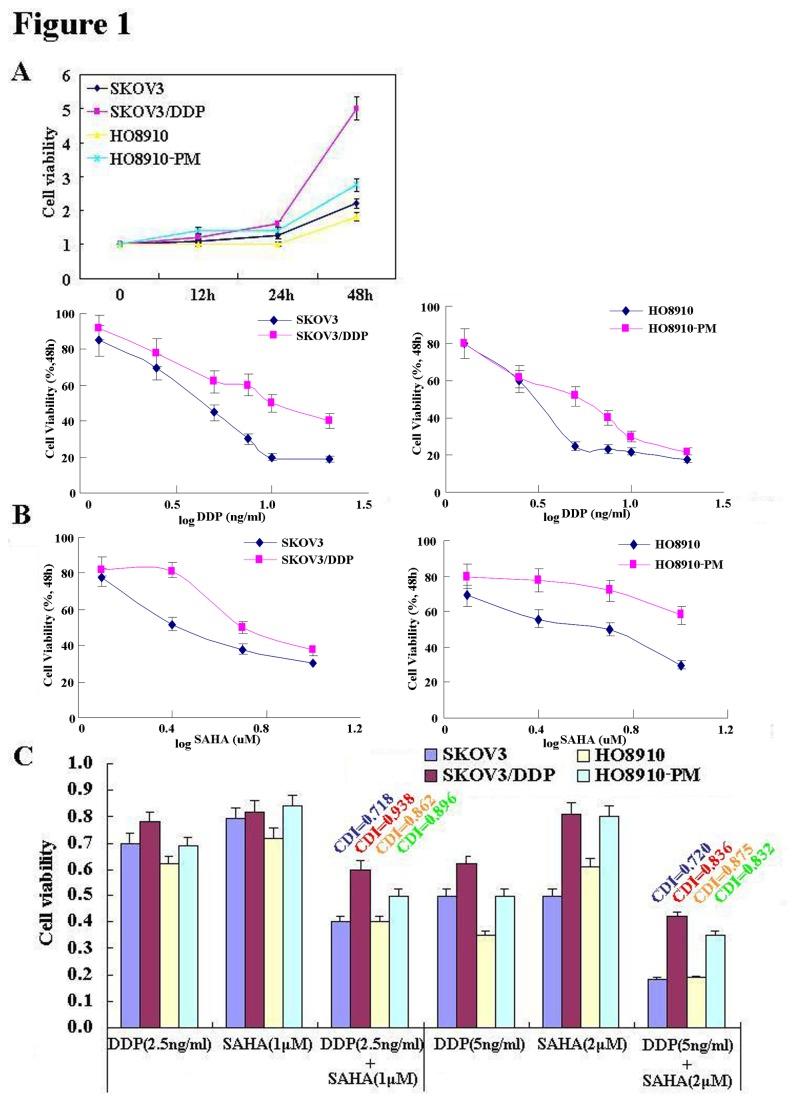
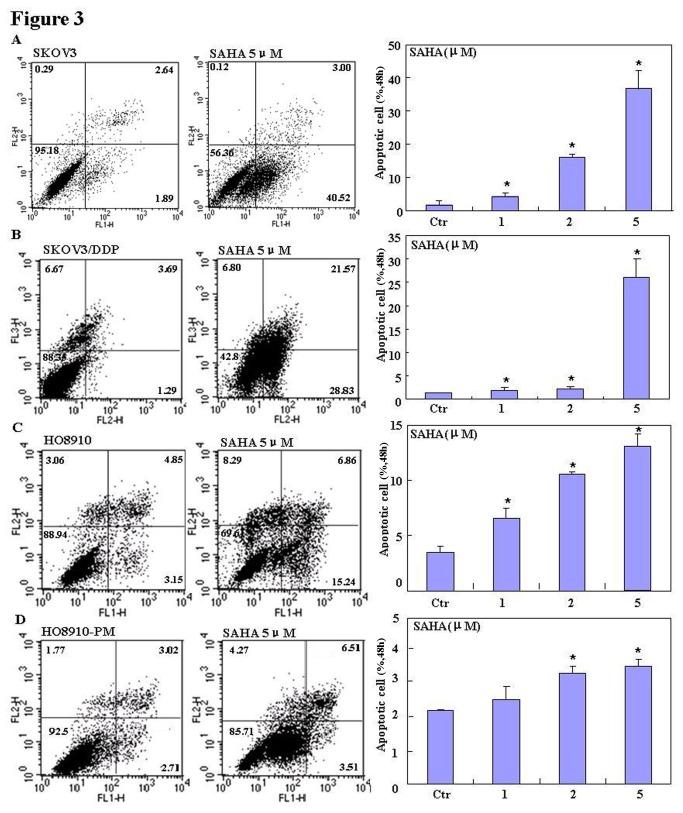
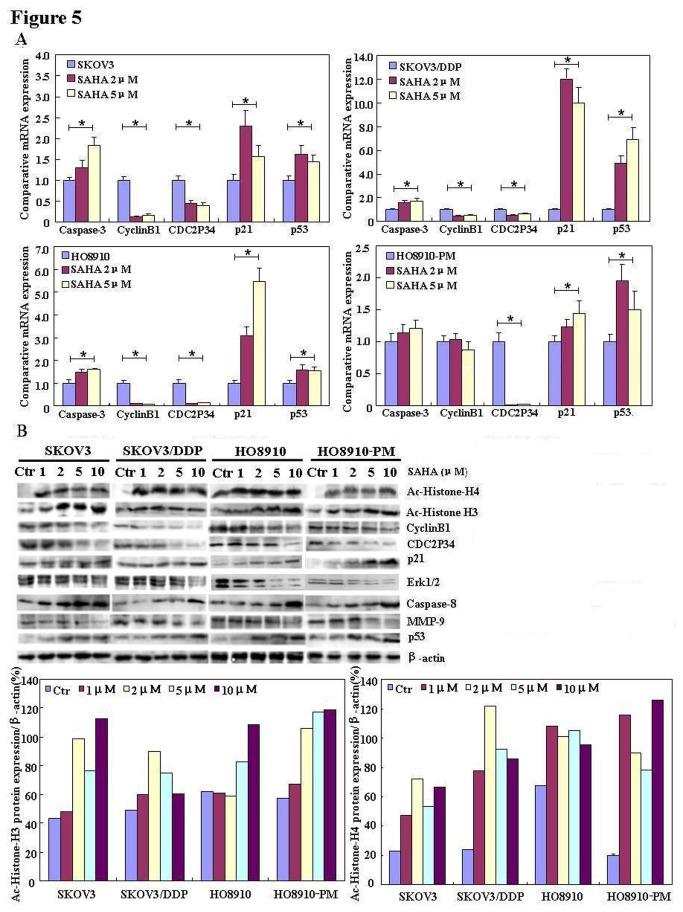
Histone deacetylase inhibitors (HDACi), such as suberoylanilide hydroxamic acid (SAHA), have been shown to act selectively on gene expression, and are potent inducers of growth arrest, differentiation and apoptosis in various types of cancers in vitro and in vivo. This study aimed to elucidate the anti-tumor effects and molecular mechanisms of SAHA on the aggressive phenotypes of ovarian carcinoma. Two pairs of cell lines (SKOV3 and SKOV3/DDP; HO8910 and HO8910-PM) were exposed to SAHA treatment, and the effects on acetyl-Histone H3 and H4 expression levels were analyzed and compared against the aggressive behaviors of ovarian carcinoma. Our results showed that SAHA suppressed proliferation in both a concentration- and time-dependent manner in all four cell lines; induced S/G2 arrest in SKOV3 and SKOV3/DDP cells; and conversely, induced G1 arrest in HO8910 and HO8910-PM cells. SAHA treatment induced apoptosis and reduced migration, invasion and lamellipodia formation in the ovarian carcinoma cells; furthermore, SAHA decreased expression of Cyclin B1 and CDC2P34 mRNA, and downregulated CDC2P34, Erk1/2, CyclinB1 and MMP-9 proteins. In contrast, SAHA increased expression of Caspase-3, p21 and p53 mRNA, and upregulated acetyl-Histones H3 and H4, Caspase-8, and p53 proteins. Basal acetylation of histone H3 and H4 was higher in ovarian carcinoma compared to normal ovarian tissues and benign ovarian tumors, and in borderline tumor than in normal ovarian tissues, and was positively correlated with differentiation and expression of the proliferative marker, Ki-67 (P < 0.05). We suggest that SAHA may suppress growth, migration and invasion in ovarian carcinoma cells, including cisplatin-resistant or highly-invasive ovarian cells, by promoting histone acetylation and modulating their phenotype-related molecules. As such, aberrant acetylation of histone H3 and H4 may play an important role in the carcinogenesis and differentiation of ovarian carcinoma.
组蛋白去乙酰化酶抑制剂(HDACi),如丁酸钠(SAHA),已被证明能选择性地作用于基因表达,并能在体外和体内有效地诱导各种类型癌症的生长停滞、分化和凋亡。本研究旨在阐明 SAHA 对卵巢癌侵袭表型的抗肿瘤作用及其分子机制。两对细胞系(SKOV3 和 SKOV3/DDP;HO8910 和 HO8910-PM)用 SAHA 处理,分析并比较了乙酰化组蛋白 H3 和 H4 表达水平与卵巢癌细胞侵袭行为的关系。结果表明,SAHA 以浓度和时间依赖的方式抑制了所有四种细胞系的增殖;诱导 SKOV3 和 SKOV3/DDP 细胞 S/G2 期阻滞;相反,诱导 HO8910 和 HO8910-PM 细胞 G1 期阻滞。SAHA 处理诱导卵巢癌细胞凋亡,减少迁移、侵袭和片状伪足形成;此外,SAHA 降低了 Cyclin B1 和 CDC2P34 mRNA 的表达,下调了 CDC2P34、Erk1/2、CyclinB1 和 MMP-9 蛋白。相反,SAHA 增加了 Caspase-3、p21 和 p53 mRNA 的表达,上调了乙酰化组蛋白 H3 和 H4、Caspase-8 和 p53 蛋白。与正常卵巢组织和良性卵巢肿瘤相比,卵巢癌中组蛋白 H3 和 H4 的基础乙酰化水平较高,与交界性肿瘤相比,正常卵巢组织中的乙酰化水平较高,且与增殖标志物 Ki-67 的分化和表达呈正相关(P<0.05)。我们认为,SAHA 通过促进组蛋白乙酰化和调节其表型相关分子,可能抑制包括顺铂耐药或高侵袭性卵巢细胞在内的卵巢癌细胞的生长、迁移和侵袭。因此,组蛋白 H3 和 H4 的异常乙酰化可能在卵巢癌的发生和分化中发挥重要作用。




 Zotero 插件