
9-11 岁全身关节过度活动儿童与对照组的步态模式:一项横断面研究。
Gait pattern in 9-11-year-old children with generalized joint hypermobility compared with controls; a cross-sectional study.
机构信息
Department of Rheumatology (COHYPCO), University Hospital of Copenhagen, 2100, Copenhagen Ø, Denmark.
出版信息
BMC Musculoskelet Disord. 2013 Dec 5;14:341. doi: 10.1186/1471-2474-14-341.
BACKGROUND
To study differences in gait patterns in 10-year-old children with Generalized Joint Hypermobility (GJH) and with no GJH (NGJH).
METHODS
A total of 37 children participated (19 GJH, 18 NGJH, mean age 10.2 (SD 0.5) years). Inclusion criteria for GJH were a Beighton score of ≥5, with at least one hypermobile knee joint; for NGJH a Beighton score of ≤4, and no hypermobile knees and for both groups no knee pain during the previous week. All children were recorded by five video cameras, while they walked across three force platforms. Net joint moments were calculated in 3D by inverse dynamics and peak values provided input to statistical analyses.
RESULTS
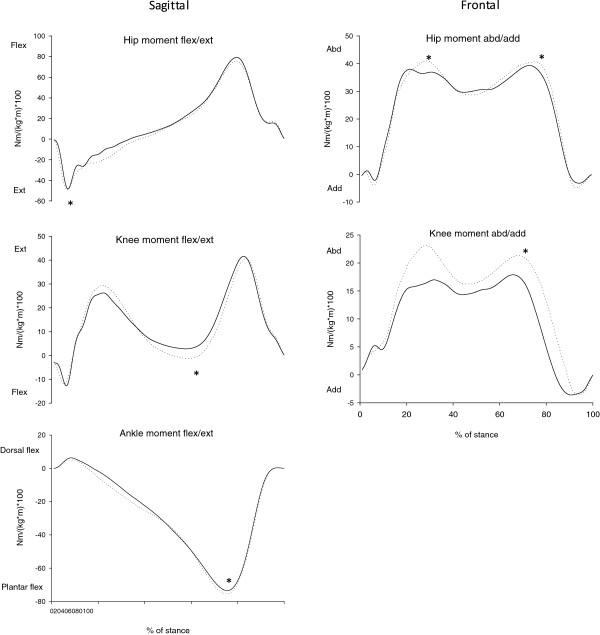
In the frontal plane, children with GJH had a significantly lower peak knee abductor moment and peak hip abductor moment. In the sagittal plane, the peak knee flexor moment and the peak hip extensor moment were significantly lower in the GJH group although the absolute difference was small.
CONCLUSIONS
The walking pattern was the same for children with GJH and for healthy children, as there were no differences in kinematics, but it was, however, performed with different kinetics. Children with GJH walked with lower ankle, knee and hip joint moments compared to children with NGJH. However, the clinical importance of these differences during normal gait is unknown. To obtain this knowledge, children with GJH must be followed longitudinally.
TRIAL REGISTRATION
The study was approved by the Committee on Biomedical Research Ethics for Copenhagen and Frederiksberg, Denmark (jnr. KF01-2006-178).
背景
研究 10 岁具有全身性关节过度活动症(GJH)和无全身性关节过度活动症(NGJH)儿童的步态模式差异。
方法
共有 37 名儿童参与(19 名 GJH,18 名 NGJH,平均年龄 10.2(SD 0.5)岁)。GJH 的纳入标准为 Beighton 评分≥5,至少有一个膝关节过度活动;NGJH 的 Beighton 评分为≤4,且无膝关节过度活动,两组儿童在过去一周内均无膝关节疼痛。所有儿童均由五台摄像机记录,同时在三个力台上行走。通过逆动力学计算 3D 净关节力矩,将峰值提供给统计分析。
结果
在额状面,GJH 儿童的膝关节外展峰值力矩和髋关节外展峰值力矩显著降低。在矢状面,GJH 组的膝关节屈肌峰值力矩和髋关节伸肌峰值力矩显著降低,尽管绝对值较小。
结论
GJH 儿童与健康儿童的行走模式相同,因为在运动学上没有差异,但动力学却不同。与 NGJH 儿童相比,GJH 儿童的踝关节、膝关节和髋关节力矩较低。然而,这些差异在正常步态中对临床的重要性尚不清楚。为了获得这些知识,必须对 GJH 儿童进行纵向随访。
试验注册
该研究得到丹麦哥本哈根和腓特烈斯贝生物医学研究伦理委员会的批准(jnr. KF01-2006-178)。

 Zotero 插件