
外泌体 ITGA3 干扰非癌前列腺细胞功能,并在转移性前列腺癌患者的尿液外泌体中增加。
Exosomal ITGA3 interferes with non-cancerous prostate cell functions and is increased in urine exosomes of metastatic prostate cancer patients.
机构信息
Department of Urology, VU University Medical Center, Amsterdam, The Netherlands.
OncoProteomics Laboratory, Department of Medical Oncology, VU University Medical Center, Amsterdam, The Netherlands.
出版信息
J Extracell Vesicles. 2013 Dec 23;2. doi: 10.3402/jev.v2i0.22097. eCollection 2013.
BACKGROUND
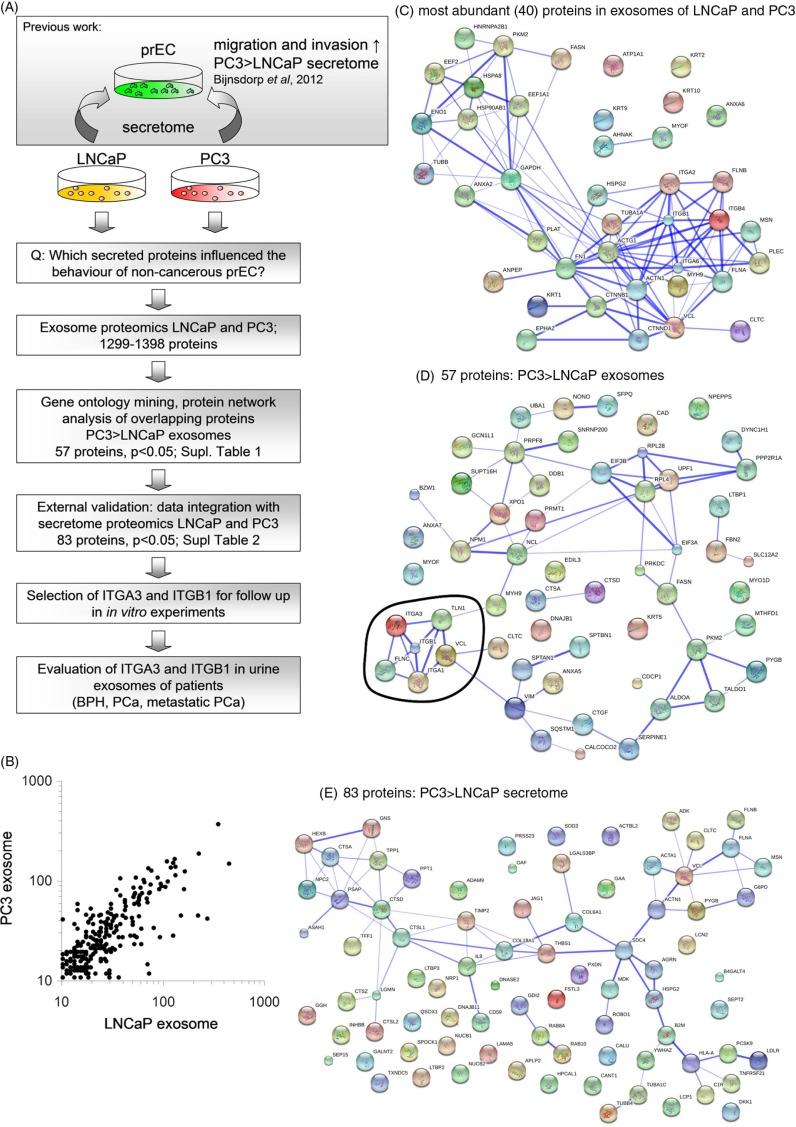
Cancer cells are able to change the protein expression and behavior of non-cancerous surrounding cells. Exosomes, secreted by prostate cancer (PCa) cells, may have a functional role in cancer metastasis and present a promising source for protein biomarkers. The aim of the present study was to identify which proteins in exosomes can influence non-cancerous cells, and to determine whether we can use urine exosomal proteins to identify high-risk PCa patients.
METHOD
Exosomes were isolated by ultracentrifugation. Migration and invasion were studied by the transwell (invasion) assay. Proteomics was performed by LC-MS/MS and identified proteins were validated by Western blotting. Cellular uptake of fluorescent labeled PKH67-exosomes was measured by FACS.
RESULTS
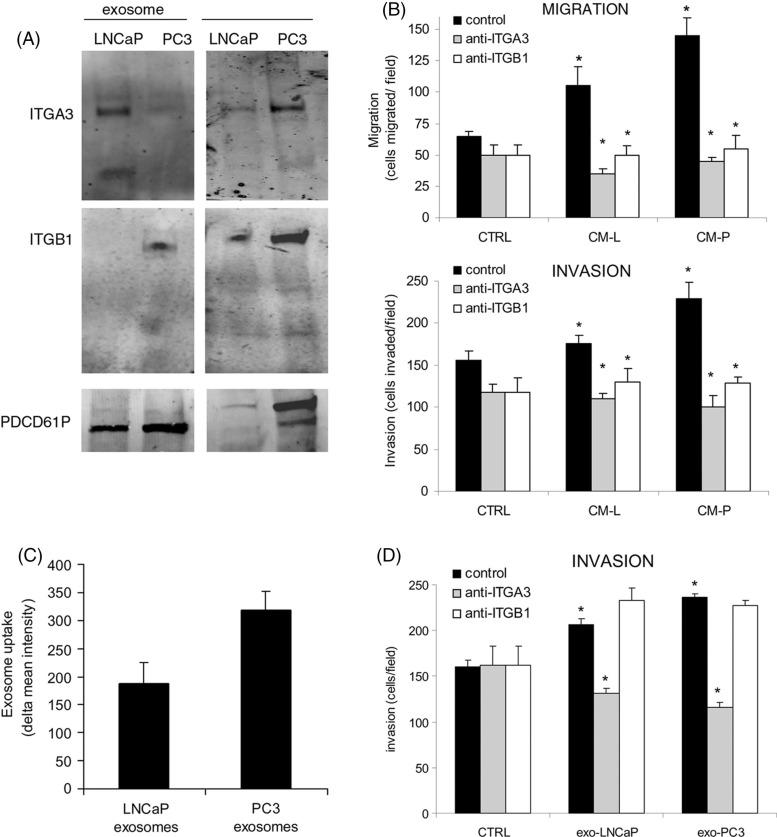
Based on comparative protein profiling by mass spectrometry-based proteomics of LNCaP- and PC3-exosomes, we selected ITGA3 and ITGB1, involved in migration/invasion, for further analyses. Inhibition of exosomal ITGA3 reduced the migration and invasion of non-cancerous prostate epithelial cells (prEC) almost completely. Cellular uptake of exosomes by prEC was higher with PC3-exosomes compared to LNCaP exosomes. Finally, ITGA3 and ITGB1 were more abundant in urine exosomes of metastatic patients (p<0.05), compared to benign prostate hyperplasia or PCa.
CONCLUSION
These data indicate exosomal ITGA3 and ITGB1 may play a role in manipulating non-cancerous surrounding cells and that measurement of ITGA3 and ITGB1 in urine exosomes has the potential to identify patients with metastatic PCa in a non-invasive manner.
背景
癌细胞能够改变周围非癌细胞的蛋白质表达和行为。前列腺癌(PCa)细胞分泌的外泌体可能在癌症转移中具有功能作用,并提供了有前途的蛋白质生物标志物来源。本研究的目的是鉴定外泌体中的哪些蛋白质可以影响非癌细胞,并确定我们是否可以使用尿液外泌体蛋白来识别高危 PCa 患者。
方法
通过超速离心分离外泌体。通过 Transwell(侵袭)测定研究迁移和侵袭。通过 LC-MS/MS 进行蛋白质组学分析,并通过 Western blot 验证鉴定的蛋白质。通过 FACS 测量荧光标记 PKH67-外泌体的细胞摄取。
结果
基于 LNCaP 和 PC3 外泌体的基于质谱的蛋白质组学比较蛋白质谱分析,我们选择了参与迁移/侵袭的 ITGA3 和 ITGB1 进行进一步分析。外泌体 ITGA3 的抑制几乎完全降低了非癌前列腺上皮细胞(prEC)的迁移和侵袭。与 LNCaP 外泌体相比,PC3 外泌体被 prEC 摄取的外泌体更多。最后,与良性前列腺增生或 PCa 相比,转移性患者的尿液外泌体中 ITGA3 和 ITGB1 更为丰富(p<0.05)。
结论
这些数据表明外泌体 ITGA3 和 ITGB1 可能在外泌体在操纵周围非癌细胞方面发挥作用,并且在尿液外泌体中测量 ITGA3 和 ITGB1 具有以非侵入性方式识别转移性 PCa 患者的潜力。

 Zotero 插件